
Si alguna vez te has preguntado how magnetic rod work, you’re not alone. These simple-looking devices pack powerful science behind them—using imanes permanentes to capture and remove metal contaminants in everything from food processing to industrial manufacturing. Understanding the magnetic rod working principle unlocks insight into magnetic fields, materials like Imanes NdFeB, and how these rods help keep products pure and equipment safe. In this guide, you’ll get a clear, no-fluff explanation of magnetic rods’ design, function, and real-world applications—perfect whether you’re a plant manager, engineer, or DIY enthusiast. Let’s dive into the magnetic magic behind these indispensable tools.
Fundamentals of Magnetism in Magnetic Rod
Magnetic rod works on a simple yet powerful principle: permanent magnets generate a static magnetic field. This happens because the electrons inside the magnet are aligned in the same direction, thanks to their spin. When many electrons spin uniformly, they create a magnetic force that extends outside the rod.
Key Physics Concepts
| Concept | Explicación |
|---|---|
| Magnetic Domains | Tiny regions inside the magnet where electron spins are aligned. |
| Bucle de histéresis | Shows how magnetism changes when exposed to external magnetic forces or temperature. Important for understanding magnet retention. |
| Gauss Measurement | The unit (Gauss, Gs) used to measure magnetic field strength on the rod’s surface. Typical magnetic rods range from 8,000 to 14,000 Gauss. |
Permanent Magnetic Rods vs. Electromagnets
| Característica | Permanent Magnetic Rod | Electroimán |
|---|---|---|
| Fuente de Energía | No se necesita energía externa | Requires electricity |
| Campo Magnético | Constant, stable field | Field strength varies with current |
| Portability | Easy to install and maintain | Bulkier due to coils and power requirements |
| Aplicaciones | Ideal for continuous magnetic separation | Used where adjustable magnetic force needed |
By understanding these basics, you can see why permanent magnetic rods are a reliable and low-maintenance choice for industrial magnetic separation and contaminant removal.
Internal Structure and Materials
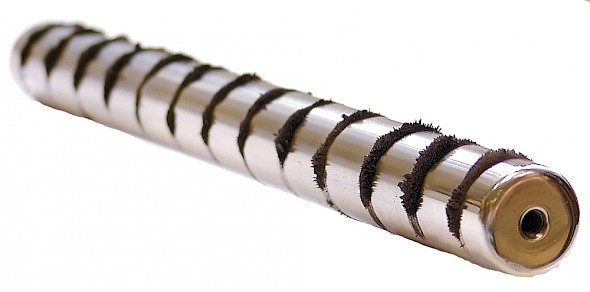
Magnetic rods typically feature a durable stainless steel tube, often made from SUS304 or SUS316L, which houses powerful rare-earth magnets like NdFeB (Neodimio Hierro Boro) or SmCo (Samario Cobalto). These magnets are arranged in specific configurations—axial, radial, or staggered poles—to maximize the magnetic field density on the rod’s surface. This setup ensures strong magnetic attraction where it’s needed most.
The surface magnetic strength, or Gauss rating, usually ranges between 8,000 to 14,000 Gauss, depending on the magnet grade and arrangement. Additionally, these rods are built to withstand varying temperatures, from around 80°C for NdFeB magnets up to 350°C for SmCo types, making them suitable for different industrial environments. For a deeper look into various powerful permanent magnets, you can check out the detailed list of magnets by strength available from experts in the field.
Step-by-Step Working Mechanism of a Magnetic Rod
A magnetic rod works by projecting a strong magnetic field from its surface, creating an invisible zone that attracts ferromagnetic particles like iron dust and metal fragments. This effective radius usually spans between 50 to 100 mm, depending on the rod’s Gauss strength and design.
As materials flow past the rod, these magnetic particles are pulled out of the mix and cling firmly to the rod’s surface. Thanks to the rare-earth magnets inside, such as NdFeB or SmCo types, the magnetic rod maintains strong particle adhesion, even under fast or heavy process flows.
To keep the magnetic rod working efficiently, captured contaminants need to be removed regularly. This can be done through a simple manual cleaning process, or automated via a pneumatic cleaning cycle, which squeezes and shakes the rod to release the trapped metal particles without needing to stop your process flow.
Using these steps ensures consistent contaminant removal and protects your equipment from damage, helping maintain product purity.
Common Industrial Applications of Magnetic Rods
Magnetic rods play a vital role across many industries by efficiently removing ferrous contaminants to ensure product purity and process safety. In the food and beverage sector, magnetic rods help maintain HACCP compliance by extracting iron particles from powders and liquids, protecting both consumers and equipment. In plastics and recycling, these rods safeguard injection molding hoppers from metal debris, preventing costly downtime and damage.
Para pharmaceutical production, magnetic rods are essential for maintaining the purity of active pharmaceutical ingredients (API), ensuring no metallic contamination compromises product quality. Meanwhile, in ceramics and mining, magnetic rods assist in removing iron particles from slurry, helping to improve material quality and avoid equipment wear.
A practical example comes from a cereal processing plant where a 12,000 Gauss NBAEM magnetic rod led to a 40% reduction in downtime by catching metallic contaminants before they caused jams or machine failure. This highlights the rod’s effectiveness in real-world industrial environments.
For more insights on optimizing magnet strength for your application, you can refer to the detailed comparison of magnet grades like N52 and N55, which can influence separation efficiency significantly.
Performance Factors and Optimization
The performance of a magnetic rod depends on several key factors:
- Magnet Grade: Higher grades like N52 offer stronger magnetic fields compared to lower grades such as N35. Choosing the right grade ensures optimal magnetic separation efficiency.
- Pole Spacing: Closer pole spacing can create a denser magnetic field, improving the rod’s ability to attract fine ferromagnetic particles.
- Rod Diameter: Typically ranges from 16 mm to 50 mm. Larger diameters produce stronger fields but may affect flow dynamics.
- Flow Velocity: Faster product flow can reduce the time contaminants spend near the magnetic field, decreasing separation effectiveness.
To verify performance, pull strength tests measure the force needed to detach metal particles, while flux density mapping with a Gaussmeter monitors magnetic field intensity across the rod’s surface. This kind of detailed testing is crucial to maintain field uniformity and efficiency throughout its lifecycle.
Maintenance is equally important. Over time and with exposure to heat or mechanical impact, magnetic rods can experience demagnetization, leading to weaker magnetic fields. Regular inspection and periodic re-gauging help ensure rods meet the required Gauss strength for consistent contaminant removal.
For more detail on measuring and testing magnetic strength, you can explore how to measure magnet strength with specialized devices.
Choosing the Right Magnetic Rod
Picking the right magnetic rod depends on a clear decision matrix: start with your application type, then determine the required Gauss strength, followed by the rod’s diameter and length. The end design also matters—whether you need a threaded, tapered, or easy-clean sleeve version affects installation and maintenance ease. For example, food processing often calls for FDA-approved, food-grade magnetic bars, while industrial settings may need rods certified to ATEX or ISO 9001 standards to meet safety and quality regulations.
If you’re dealing with unusual hopper sizes or high-temperature lines, NBAEM offers custom solutions tailored to fit those specific conditions. Their expertise ensures your magnetic rod performs reliably without compromising safety or efficiency.
FAQs About Magnetic Rods
Can magnetic rods lose strength over time?
Yes, magnetic rods can gradually lose strength, especially if exposed to high temperatures, strong physical shocks, or demagnetizing fields. However, quality rods made from rare earth magnets like NdFeB or SmCo generally maintain their magnetic field for many years under normal conditions. Periodic testing with a Gaussmeter helps ensure they’re still performing optimally.
What is the difference between magnetic bars and grids?
Magnetic bars are solid rods or tubes that attract and hold magnetic contaminants, typically installed inside hoppers or pipelines. Magnetic grids consist of multiple rods arranged in a grid pattern to cover larger cross-sections, offering higher surface area for contaminant removal. Both serve similar functions but differ by application scale and installation style.
Are magnetic rods safe for food contact?
Absolutely. We will use SUS316L Stainless steel magnetic tubes for food industry , which are designed specifically for use in food, pharmaceutical, and beverage industries. They comply with safety standards like FDA and HACCP, ensuring no contamination or corrosion occurs during use.
How far can a magnetic rod reach to attract metal?
The effective magnetic field radius typically ranges from 50 to 100 millimeters, depending on the rod’s Gauss strength and configuration. Higher surface Gauss ratings (8,000–14,000 Gs) mean stronger attraction over a greater distance but note that ferromagnetic particles must be within this range to be captured efficiently.
What maintenance is required for magnetic rods?
Routine maintenance includes:
- Regular cleaning (manual or pneumatic) to remove captured metal particles
- Periodic inspection for surface damage or corrosion
- Re-gauging to check magnetic strength and ensure no significant demagnetization
- Storage in protective covers when not in use to maintain performance
Following these steps extends the life and effectiveness of your magnetic rod.
Contáctanos to know more about magnetic rod!
 Spanish (Mexico)
  English
  German
  Vietnamese
  Russian
  Turkish
  Polish
  Hindi
Hindi  Thai
Thai  Malay
Malay  Korean
  Japanese
  French
  Czech
Czech  Danish
  Dutch
Dutch  Finnish
  Italian
  Portuguese (Brazil)
  Portuguese (Portugal)
  Slovenian
  Ukrainian
  Hebrew
  Scottish Gaelic
  Hungarian
  Tagalog
  Spanish (Spain)
  Serbian
  Indonesian
  Slovak
  Dutch (Belgium)
  Persian
  Arabic
  Romanian
  Estonian
Deja un comentario