
You might already know that corrosion is the silent killer of industrial components…
But how do you prove your magnetic assemblies will actually survive the elements before you deploy them?
Well, you’re in the right place, because I’ve put together the ultimate guide to the Salt Spray Test.
As an industry expert, I know that specifying the right aimants en néodyme can make or break the success of your entire engineering project.
In this post, you’re going to learn exactly how this accelerated corrosion testing works, step by step.
We’ll break down the strict ASTM B117 standard, bust the biggest misconceptions about lab hours versus real-world lifespan, and show you exactly how to guarantee true résistance à la corrosion for your applications.
So if you’re looking to stop component failures before they happen and master your quality control, this guide is for you.
Let’s dive right in.
Will your coating survive in the field, or will it fail the moment it hits a harsh environment? As manufacturers and engineers, we face this question daily. To guarantee reliability before deployment, we rely on the test de brouillard salin.
What is a Salt Spray Test?
A test de brouillard salin is a standardized, accelerated corrosion testing method. We use it to evaluate the protective properties of surface coatings, especially on highly reactive materials like sintered neodymium. By forcing components into a highly corrosive environment, we rapidly validate how well a coating resists oxidation and structural degradation.
Defining the Global Standards
We do not guess when it comes to durability; we test against rigid global baselines. The two most critical standards we use to validate corrosion resistance are ASTM B117 et ISO 9227.
Here is exactly how the standards break down:
- ASTM B117 Standard: The industry benchmark for basic salt fog testing. We expose coated components to a continuous 5% sodium chloride solution, atomized inside a salt fog chamber maintained precisely at 35°C (95°F).
- ISO 9227: A comprehensive international standard covering three primary testing variations based on the required aggression level:
- NSS (Neutral Salt Spray)
- ASS (Acetic Acid Salt Spray)
- CASS (Copper-Accelerated Acetic Acid Salt Spray)
By adhering to these parameters, we establish a consistent, repeatable baseline to measure hours to failure. This strict adherence to global standards forms the backbone of our quality control testing, ensuring every batch meets exact engineering specifications.
How the Salt Spray Test Works: Step-by-Step
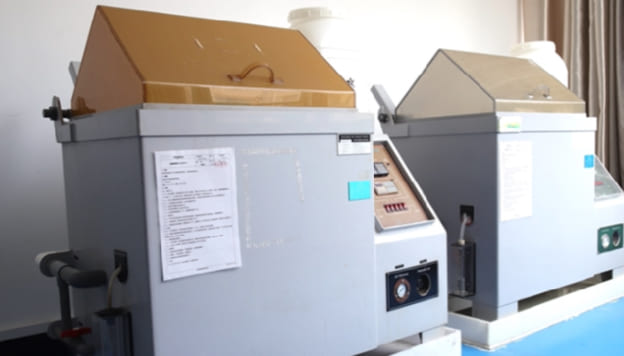
test de brouillard salin
To guarantee our magnetic products hold up in harsh environments, we rely on a strict, standardized process. Here is exactly how we conduct a Salt Spray Test from start to finish.
- Preparation: Before any testing begins, we meticulously clean and prep our coated NdFeB magnet samples. Because we know exactly de quoi sont faits les aimants, we understand how vulnerable the raw material is to oxidation without proper protection. The surfaces must be completely free of dirt, oils, or handling marks so the final results accurately reflect the coating’s true durability.
- Exposure: Next, we secure the components on angled racks and place them inside a specialized salt fog chamber. Inside this sealed environment, the magnets undergo rigorous accelerated corrosion testing. They are continuously exposed to a dense, atomized mist of sodium chloride solution at a steady temperature, simulating severe environmental stress over an extended period.
- Evaluation: Once the required testing hours are complete, we remove the samples and rinse them off for a strict visual and physical inspection. We examine the neodymium magnet coatings for any signs of degradation, specifically looking for:
- White rust: Usually the first sign of surface oxidation on sacrificial layers like zinc.
- Red rust formation: A critical failure showing the protective layer has completely broken down and the internal iron core is corroding.
- Blistering and Creepage: Any bubbling, peeling, or spreading of corrosion under the edges of the coating.
The Great Misconception: Lab Hours vs. Real-World Lifespan
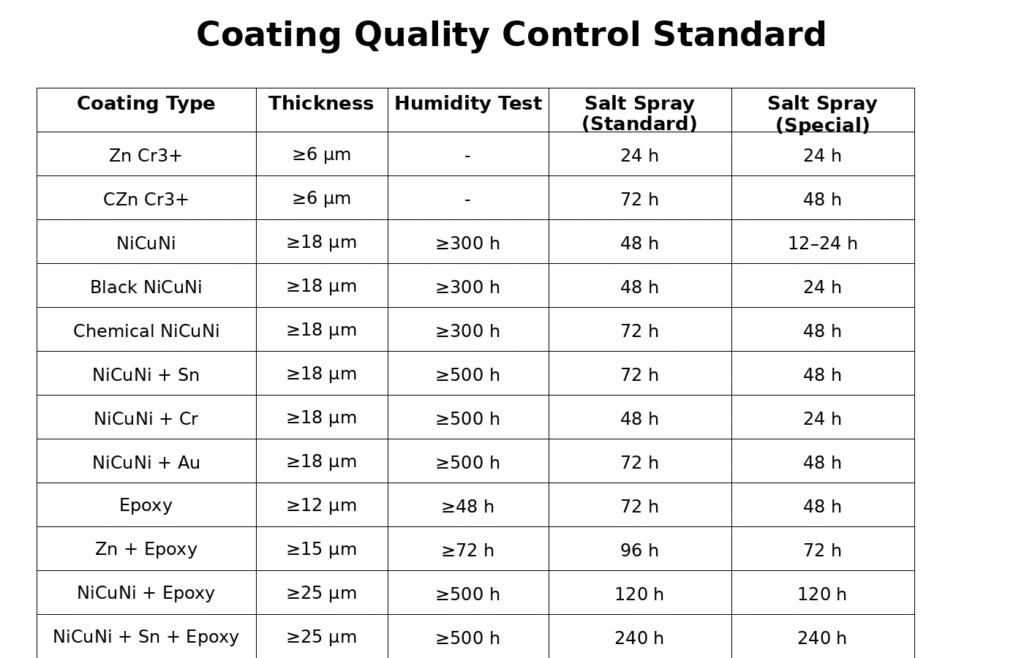
salt spray test time
One of the most common questions we hear is whether a specific number of hours in a salt spray test directly translates to years of outdoor use. The short answer? No.
The Myth: 100 Hours Equals 1 Year
Many assume that surviving 100 hours in a salt fog chamber guarantees a year of flawless performance in the field. This is a widely held myth. While accelerated corrosion testing pushes materials to their absolute limits, a continuous, controlled spray of warm salt water doesn’t perfectly mimic Mother Nature.
The Reality of Outdoor Exposure
A standard salt spray test runs constantly, completely ignoring the dynamic variables found in actual real-world magnet applications. Out in the field, your components face a chaotic mix of elements.
Key variables missing from the lab chamber include:
- UV Exposure: Direct sunlight degrades certain coatings over time.
- Wet/Dry Cycling: Alternating between soaking wet and bone dry causes surface materials to stress, expand, and contract.
- Temperature Fluctuations: Sudden drops or spikes in heat put massive strain on protective layers.
The True Purpose: Quality Control Testing
If we can’t use the chamber to predict the exact hours to failure outdoors, why do we rely on the salt spray test? We use it as a strict, reliable comparative tool.
Instead of guessing lifespan, the test is crucial for:
- Batch-to-Batch Consistency: Ensuring every single production run meets our rigid baseline standards.
- Coating Integrity Validation: Quickly spotting weak points, porosity, or adhesion failures before parts ever leave our facility.
- Baseline Comparisons: Evaluating whether a new coating performs better or worse than an existing one under the exact same harsh conditions.
While a cyclic corrosion test can sometimes offer a closer simulation of outdoor weather, the traditional salt spray test remains our fastest, most effective method for rigorous, everyday quality control.
Why Salt Spray Testing is Critical for Neodymium Magnets
Sintered NdFeB magnets deliver incredible power, but they share a fundamental vulnerability: iron content. Without proper protection, the iron in sintered neodymium readily oxidizes when exposed to moisture, quickly leading to destructive red rust formation. We rely on rigorous accelerated corrosion testing to validate the integrity of our surface protections. For components operating in demanding outdoor environments, such as les aimants utilisés dans l'énergie renouvelable, proving this structural durability is an absolute requirement.
Comparing Neodymium Magnet Coatings
To guarantee performance, we actively monitor how different surface treatments hold up inside the salt fog chamber. Here is how standard options generally perform before reaching their ultimate hours to failure:
- Zinc : Provides basic, cost-effective protection. In the chamber, zinc typically shows signs of white rust relatively early, making it best suited for dry, indoor environments.
- Ni-Cu-Ni Plating: The industry standard. This triple-layer nickel-copper-nickel finish delivers strong, reliable résistance à la corrosion suitable for most commercial and industrial applications.
- Epoxy Coated Magnets: The ultimate performer in salt spray tests. A high-quality epoxy finish creates an impenetrable barrier against moisture and salt, drastically extending the magnet’s lifespan in highly corrosive settings.
NBAEM’s Commitment to Durability
We don’t leave performance to chance. At NBAEM, rigorous quality control testing is the backbone of our manufacturing process. We ensure our neodymium magnets stand up to the harshest conditions so you never have to guess how long your magnets will last out in the real world.
Here is exactly how we guarantee top-tier corrosion resistance:
- Comprehensive Quality Assurance: We conduct continuous salt spray testing across 50+ standard magnet SKUs, as well as complex custom magnetic assemblies.
- Certified Excellence: Our production facilities operate under strict global standards, holding ISO 9001, ISO 14001, and ISO/TS16949 certifications. We also fully support PPAP Niveau 3 documentation for automotive and high-tier industrial applications.
- Custom Engineering: Different environments require different defenses. If your project demands specific hours to failure in the salt fog chamber, reach out to our engineering team to develop custom coatings and alloy compositions built precisely for your exact requirements.
 French
  English
  German
  Vietnamese
  Spanish (Mexico)
  Russian
  Turkish
  Polish
  Hindi
Hindi  Thai
Thai  Malay
Malay  Korean
  Japanese
  Czech
Czech  Danish
  Dutch
Dutch  Finnish
  Italian
  Portuguese (Brazil)
  Portuguese (Portugal)
  Slovenian
  Ukrainian
  Hebrew
  Scottish Gaelic
  Hungarian
  Tagalog
  Spanish (Spain)
  Serbian
  Indonesian
  Slovak
  Dutch (Belgium)
  Persian
  Arabic
  Romanian
  Estonian
  Greek
Greek  Bulgarian
Laissez un commentaire