
Understanding the Power: Why 12,000 Gauss?
When you are fighting to keep your production line pure, standard off-the-shelf magnets often fall short. You need the intense field strength of a Hopper Magnet 12000 Gauss Custom Industrial Grate Separator to capture the finest contaminants. At NBAEM, we leverage over a decade of R&D experience to engineer rare earth neodymium magnetic assemblies that deliver this specific level of high-intensity performance.
Gauss vs. Pull Force: The Technical Difference
It is easy to mix these up, but they serve different roles in flux magnétique density optimization:
- Gauss: This measures the density of the magnetic lines of flux. High Gauss (like 12,000) is critical for trapping small, fine particles and paramagnetic particle capture.
- Pull Force: This is the holding power. While important, high pull force alone won’t catch microscopic metal dust if the Gauss rating is too low.
Our engineering team focuses on balancing these attributes to ensure your separator doesn’t just attract metal, but holds onto it under flow pressure.
Neodymium (NdFeB) Material Science
Reaching 12,000 Gauss requires premium materials. We utilize high-grade Neodymium Iron Boron (NdFeB) for these applications. As specialists in magnetic sourcing and manufacturing, we strictly control the material composition. This ensures that the high-intensity magnetic separation capabilities of our grates remain stable and effective, rather than degrading quickly like cheaper alternatives.
Comparing Ceramic vs. Standard Rare Earth vs. High-Intensity 12,000 Gauss
Not all magnets are created equal. Here is how the materials we handle stack up for industrial separation:
- Ferrite (Céramique): Economical but low energy. Best for catching large bolts or nuts, but useless against fine powders.
- Standard Rare Earth: A step up, usually around 8,000–10,000 Gauss. Good for general use but may miss the smallest contaminants.
- High-Intensity 12,000 Gauss: The peak of fine iron powder separation. This custom configuration provides the deep field penetration required for food safety and high-purity chemical applications.
Customization: Why Standard Grates Fail
Buying a standard size often means compromising on protection. If a grate doesn’t fit your hopper perfectly, you create “dead zones” where material flows past the magnetic field without being filtered. As a manufacturer with a dedicated R&D team, we know that effective injection molding hopper protection requires precision, not a “one size fits all” approach. We focus on custom engineering because standard products simply cannot account for every unique production line variable.
Tailored Hopper Geometry and Shapes
We design custom magnetic grid configurations based strictly on your specific equipment prints and requirements. A round magnet in a square hopper leaves corners exposed, while a square magnet in a round hopper won’t fit at all. To prevent these coverage gaps, we manufacture assemblies in various geometries:
- Round: Ideal for circular feed throats and pipes.
- Square and Rectangular: Designed for standard bins, chutes, and conveyor drop points.
- Kidney and Irregular Designs: Engineered for complex machine openings where standard shapes are impossible to install.
Optimizing Flow and Contact
The physical layout of the tubes is just as critical as the magnet strength. Tighter spacing is necessary to capture fine contaminants, but it can cause bridging or clogging with larger materials. We adjust the tube spacing specifically for your material type—whether it is a free-flowing pellet or a sticky powder.
To further ensure capture, we can engineer baffles and diverters into the assembly. These components force material directly onto the magnetic tubes, ensuring it passes through the strongest part of the magnetic field rather than sliding between them. Understanding the guide des aimants en terres rares is essential for selecting the right material grade to pair with these custom physical configurations for maximum separation efficiency.
Industrial Build Quality and Material Specs
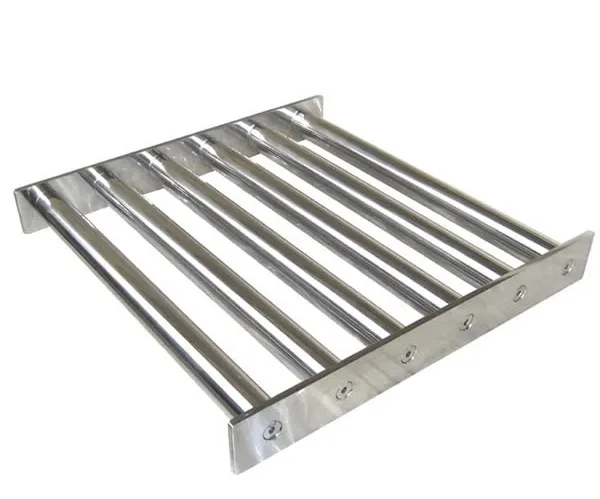
Hopper Magnet
At NBAEM, we understand that a high-performance Hopper Magnet 12000 Gauss Custom Industrial Grate Separator relies on more than just the magnetic core; the external construction must be equally robust. With over 14 years of R&D experience, we engineer our assemblies to withstand harsh environments while maintaining peak magnetic efficiency.
SS304 vs. SS316L Options
We customize the build material to fit your specific industry applications, ensuring the housing matches your regulatory requirements:
- SS304: The standard choice for general industrial plastics, recycling, and heavy-duty processing.
- SS316L: The required specification for SS316L food-grade sanitary housing, providing superior corrosion resistance for food, beverage, and pharmaceutical lines.
Sanitary Construction and Seamless Welding
For clients requiring strict hygiene, we adhere to rigorous sanitary welding standards. Our engineering team ensures that all seams are fully welded and polished to a smooth finish. This seamless construction eliminates cracks and crevices where bacteria or product residue could accumulate, ensuring your facility meets necessary cleanliness protocols.
Balancing Durability with Magnetic Penetration
Achieving a high Gauss rating requires precise engineering. The stainless steel tube wall protects the internal magnets from wear, but a wall that is too thick reduces the magnetic field reaching the product. We optimize this ratio during the design phase, ensuring the tubing is thin enough to allow for magnetic flux density optimization but strong enough to resist abrasion from high-volume material flow.
Advanced Features: Cleaning and Temperature Resistance
When we engineer a Hopper Magnet 12000 Gauss Custom Industrial Grate Separator, raw power isn’t the only factor. Operational efficiency and environmental durability are just as critical. We design our assemblies to match your specific maintenance workflow and heat requirements.
Manual vs. Easy-Clean Systems
Removing fine iron powder from a high-intensity magnetic tube can be difficult. The magnetic field is so strong that contaminants trap firmly against the surface.
- Manual Cleaning: Requires operators to physically wipe the tubes. While simple, this increases downtime and poses safety risks for the operator.
- Easy-Clean Systems: We engineer easy-clean magnetic drawer systems where the magnetic cores are pulled out of stainless steel sleeves. The captured ferrous metal instantly falls away, ensuring fast and safe disposal without direct contact.
Temperature Limitations and Solutions
Standard Neodymium magnets are powerful but sensitive to heat. In processes like plastic injection molding, material temperatures often exceed the limits of standard grades (usually 80°C), leading to irreversible loss of magnetic flux.
To ensure reliable injection molding hopper protection at high temperatures, we utilize specialized temperature-resistant NdFeB magnets. Our engineering team selects the correct material grade based on your operating environment.
Grade Selection for Heat Resistance:
| Grade Series | Température maximale de fonctionnement | Application Context |
|---|---|---|
| N (Standard) | 80°C (176°F) | Cold flow, standard food processing |
| H Series | 120°C (248°F) | Basic drying, lower temp molding |
| SH Series | 150°C (302°F) | Engineering plastics, standard injection |
| UH Series | 180°C (356°F) | High-heat automotive polymers |
For extreme heat applications beyond these limits, we can also source Samarium Cobalt (SmCo) as an alternative. By customizing the neodyme within your grate separator, we guarantee consistent performance regardless of thermal stress.
Key Industries and Applications
We engineer our Hopper Magnet 12000 Gauss Custom Industrial Grate Separator units to serve sectors where product purity and equipment safety are non-negotiable. As a dedicated magnetic assembly manufacturer, we customize these separators to meet the rigorous demands of specific industrial environments, ensuring your production line runs without interruption.
Plastics Injection Molding Protection
In the plastics industry, stray metal is a costly hazard. We design specialized injection molding hopper protection grids that fit directly into the machine throat.
- Equipment Safety: Stops tramp metal before it damages expensive screws, barrels, and nozzles.
- Downtime Reduction: Prevents nozzle blockage and the need for emergency maintenance.
- Material Flow: Optimized tube spacing ensures pellets flow freely while trapping contaminants.
Food and Beverage Compliance
For food processors, maintaining hygiene standards is critical. Our custom magnetic separators are essential tools for facilities aiming for strict quality control.
- HACCP Compliance: We build HACCP compliance magnetic filters using sanitary construction methods to support your hazard analysis protocols.
- Contamination Control: High-intensity fields ensure effective ferrous contamination removal from grains, powders, and liquids.
- Sanitary Design: We utilize high-quality stainless steel casing to meet food-grade requirements.
Chemical and Pharmaceutical Purity
When processing active pharmaceutical ingredients or fine chemicals, even microscopic metal dust is unacceptable. Understanding de quoi sont faits les aimants allows our engineering team to select the exact material composition required to resist corrosion while maintaining peak magnetic performance.
- Ingredient Purity: High-gauss arrays capture fine paramagnetic particles that standard magnets miss.
- Résistance à la corrosion: We source and assemble magnets capable of withstanding harsh chemical exposures.
- Custom Fit: We engineer the assembly to fit seamlessly into your existing gravity-fed chutes or hoppers.
How to Specify Your Custom Grate Magnet
Getting the right Hopper Magnet 12000 Gauss Custom Industrial Grate Separator for your facility requires more than just picking a part number. Since we specialize in bespoke assemblages magnétiques, we approach every project by analyzing your specific production environment. To engineer a solution that fits perfectly and performs reliably, we need to nail down a few critical details from the start.
Defining Dimensions and Flow Requirements
Standard sizes often leave gaps where contamination can slip through. We focus on custom magnetic grid configurations tailored to the exact geometry of your hopper, whether it is round, square, or irregular. Beyond shape, we analyze your material flow rate and particle size. This data helps our engineering team calculate the optimal tube spacing to ensure maximum contact with the product stream without causing bridging or blockages.
Temperature and Performance Specs
Heat is the enemy of standard magnets. If your application involves high heat, such as in plastic injection molding, we need to select temperature-resistant NdFeB magnets or alternative materials like Samarium Cobalt. Understanding your operating environment is crucial because thermal stress significantly impacts how long do magnets last and their ability to maintain peak performance over time.
Checklist for Your Quote:
- Hopper Dimensions: Provide prints or exact measurements of the housing.
- Material Data: Specify the product being processed and the size of the ferrous contaminants.
- Temperature Range: Define the maximum operating temperature to prevent demagnetization.
- Performance Needs: Confirm the requirement for surface gauss rating verification and your preference for cleaning methods.
Frequently Asked Questions About 12,000 Gauss Magnets
How do I verify the 12,000 Gauss rating on my grate?
To confirm the magnetic flux density, you need to perform surface gauss rating verification using a calibrated gauss meter. The probe must be placed directly on the pole of the tube where the magnetic field is strongest. As an ISO 9001 certified manufacturer, we ensure every unit undergoes rigorous testing to match your specified requirements before shipment.
What is the expected lifespan of a high-intensity grate magnet?
Nos rare earth neodymium magnetic assemblies are permanent magnets. Under normal operating conditions, they lose less than 1% of their strength over a decade. Unless the magnets are exposed to temperatures exceeding their specific grade limits or suffer severe physical impact, they will provide reliable high-intensity magnetic separation for the lifetime of your equipment.
Can existing hoppers be retrofitted with custom magnetic assemblies?
Yes, retrofitting is a core part of our service. Because we focus on bespoke engineering, we design custom magnetic assemblies tailored to your specific machinery. We can create custom magnetic grid configurations that slide perfectly into your current setup, eliminating the need for expensive hopper modifications.
What is the difference between food-grade and standard industrial finishes?
The main difference lies in the material and welding standards. For food and pharmaceutical applications, we utilize SS316L food-grade sanitary housing. This involves seamless, polished welding to eliminate crevices where bacteria could hide. Standard industrial models typically use robust stainless steel designed for durability in plastics or heavy industrial environments where sanitary compliance is not the primary concern.
 French
  English
  German
  Vietnamese
  Spanish (Mexico)
  Russian
  Turkish
  Polish
  Hindi
Hindi  Thai
Thai  Malay
Malay  Korean
  Japanese
  Czech
Czech  Danish
  Dutch
Dutch  Finnish
  Italian
  Portuguese (Brazil)
  Portuguese (Portugal)
  Slovenian
  Ukrainian
  Hebrew
  Scottish Gaelic
  Hungarian
  Tagalog
  Spanish (Spain)
  Serbian
  Indonesian
  Slovak
  Dutch (Belgium)
  Persian
  Arabic
  Romanian
  Estonian
Laissez un commentaire