
The Material Science: What Makes a “Rubber Magnet”?
When we talk about a rubber magnet magnetic gasket ring, we aren’t just discussing a simple piece of rubber. We are engineering a composite material that balances flexibility with magnetic flux. At NBAEM, we treat this as a precise science, blending raw physics with polymer engineering to create seals and rings that perform reliably in industrial environments.
Composition Breakdown
The core of any flexible magnet lies in its mixture. We don’t just use standard rubber; we create a composite material.
- Magnetic Powder: We utilize high-grade Strontium or Barium ferrite powder. This provides the permanent magnetic properties.
- Binder Matrix: This powder is mixed with a flexible synthetic rubber or polymer binder. This gives the material its elasticity, allowing it to twist, bend, and compress without cracking—unlike brittle sintered magnets.
Extrusion vs. Calendering
How we shape the material depends entirely on your final application. We employ two primary manufacturing methods:
- Extrusion: This is ideal for creating continuous profiles with complex cross-sections, like the specific shapes needed for a magnetic gasket. The compound is squeezed through a heated die, curing it into the exact shape required for sealing.
- Calendering: If you need flat sheets or wide rolls, we use calendering. The material is passed through heavy rollers to achieve a precise, uniform thickness before being die-cut or punched into rings.
Isotropic vs. Anisotropic
Not all flexible magnets are created equal in strength. Understanding the difference is critical for your project’s success:
- Isotropic: These magnets have no preferred direction of magnetization. They are generally weaker but offer flexibility in how they can be magnetized later. They are cost-effective for standard holding applications.
- Anisotropic: During the molding process, we align the particles in a specific direction. This results in a significantly stronger magnetic field in that direction. If your rubber magnet magnetic gasket ring requires high holding force for a heavy-duty seal, an anisotropic grade is the superior choice.
Application Type A: Magnetic Gasket Rings for Sealing
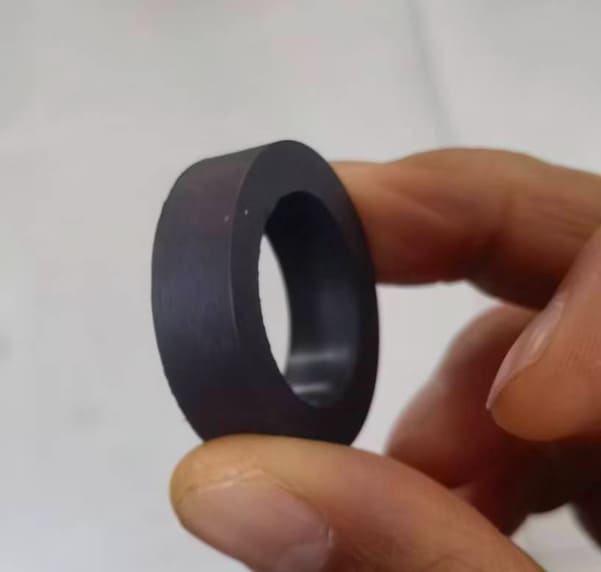
rubber magnet magnetic gasket
When we engineer a rubber magnet magnetic gasket ring, we aren’t just manufacturing a magnet; we are creating a dynamic mechanical seal. The core function here relies on a precise balance between l’attraction magnétique and material compression. The magnet provides the holding force to keep a door or panel closed, while the flexible rubber binder compresses against the mating surface to block airflow, moisture, and dust.
Key Industries Relying on Magnetic Seals
We supply these flexible solutions to sectors where maintaining an internal environment is critical.
- HVAC & Refrigeration: Industrial freezer doors and cooling units require an airtight seal to maintain thermal efficiency.
- Sanitary Systems: In shower enclosures and bathroom fittings, these rings provide a watertight barrier that resists humidity.
- Industrial Enclosures: Protecting sensitive electronics in factory settings often requires a custom magnetic seal to prevent contaminant ingress.
Critical Design Considerations
Creating an effective seal goes beyond just cutting a strip. We focus on specific extruded magnetic profiles—such as T-shapes or Mushroom profiles—that fit into pre-designed channels. For a complete ring assembly, corner welding is essential to ensure a continuous loop without gaps.
To achieve high IP65 sealing solutions or even IP67/IP68 ratings, the magnetic strength matters. Understanding anisotropie magnétique is crucial here; anisotropic rubber magnets provide the superior holding power necessary for heavy industrial doors, whereas isotropic versions are better suited for lighter, non-structural applications. We customize these profiles to ensure the gasket withstands the specific environmental pressures of your application.
Precision Magnetic Rings for Sensing and Encoders
While frequently used for sealing, a rubber magnet magnetic gasket ring plays an equally critical role in motion control systems. We manufacture these rings to serve as the active magnetic target in rotary encoders, providing essential real-time data on motor speed and angular position.
Why Choose Flexible Over Sintered?
In industrial environments, component durability is non-negotiable. Traditional sintered ferrite rings are notoriously brittle; they often crack under vibration or thermal expansion. Our flexible ferrite magnet composite offers distinct engineering advantages:
- Shock Resistance: The synthetic rubber binder absorbs vibration, preventing the catastrophic failure common with brittle ceramics.
- Simplified Assembly: The material’s natural elasticity allows for a secure press-fit onto shafts, often eliminating the need for additional adhesives.
- Polyvalence : We can easily punch or die-cut the material into a différentes formes de magnétisme to fit tight housing constraints that rigid magnets cannot accommodate.
Multipole Magnetization Engineering
The performance of a rotary magnetic encoder ring relies heavily on the magnetic pattern. We don’t just magnetize through the thickness; we engineer specific multipole magnetization patterns around the circumference. By strictly controlling the pole count and pitch (N-S-N-S), we ensure high-resolution feedback for Hall effect sensors, guaranteeing accurate system control.
Critical Technical Specifications (The Buyer’s Checklist)
When sourcing a rubber magnet magnetic gasket ring, understanding the technical specs is the difference between a secure seal and a product failure. We don’t just sell magnets; we engineer solutions based on specific physical and magnetic parameters. Here is the checklist you need to verify before finalizing your order.
Magnetic Properties: Pull Force vs. Gauss
Don’t just look at the Gauss rating. While Gauss measures the magnetic field density, the actual holding power is determined by the force d'attraction (usually measured in $g/cm^2$). For a gasket ring, the pull force must be balanced—strong enough to seal tight against air or moisture, but not so strong that the door or enclosure becomes difficult to open.
- Isotropic Rubber Magnets: Lower magnetic strength, sufficient for standard refrigerator seals and lightweight holding.
- Anisotropic Rubber Magnets: Higher magnetic energy product, used for heavy-duty industrial seals requiring stronger adhesion.
Hardness (Shore A) and Flexibility
The flexibility of the rubber magnet magnetic gasket ring is controlled by the ratio of ferrite powder to the synthetic rubber binder. We measure this using the Shore A hardness scale.
| Hardness Level | Caractéristiques | Typical Application |
|---|---|---|
| Shore A 40-60 | High flexibility, soft touch. | Complex curved surfaces, consumer appliances. |
| Shore A 60-80 | Standard balance of rigid/flex. | Industrial door seals, flat surface mounting. |
| Shore A 80+ | Stiffer, less pliable. | Precision sensor rings, rigid structural components. |
Stabilité à la température
Standard flexible magnets have limits. If your application involves heat—like in automotive engines or industrial ovens—standard binders will fail.
- Standard Grade: Operates effectively up to roughly 80°C – 100°C.
- High-Temp Grade: Our specialized ferrite-based rubber compounds can withstand temperatures up to +250°C.
If you are dealing with extreme cold or heat fluctuations, such as in fridge door seal repair, verifying the temperature coefficient is critical to prevent demagnetization or material cracking.
Surface Treatments and Adhesives
Raw rubber magnets are durable, but specific environments require extra protection.
- UV Coating: Essential for outdoor use to prevent the rubber binder from degrading under sunlight.
- Adhesive Backing: We can laminate the non-magnetic side with industrial-grade adhesives (like 3M or Tesa) for instant peel-and-stick assembly.
- Friction Coatings: Added to increase the coefficient of friction, preventing the gasket ring from sliding under shear loads.
Customization: Why Off-the-Shelf Often Fails
Buying standard rolls off the internet might seem cost-effective initially, but for industrial sealing, “close enough” usually results in failure. We frequently see clients switch to us after struggling with generic stock that simply cannot meet the rigorous demands of a professional rubber magnet magnetic gasket ring.
Common Failures in Standard Rolls
When you rely on generic suppliers, you often encounter two critical issues:
- Weak Magnetism: Standard rolls often use a lower fill rate of ferrite powder to save costs, resulting in insufficient holding force for heavy doors or pressurized enclosures.
- Dimensional Inaccuracies: Generic profiles lack tight tolerances. If the gasket is even a fraction of a millimeter off, it won’t seat correctly in the channel, compromising the IP rating.
The Custom Solution: Precision Extrusion
We don’t just cut strips; we engineer solutions. By working directly from your CAD drawings, we produce a unique extruded magnetic profile that matches your exact cross-section requirements. This ensures the gasket snaps perfectly into place every time, eliminating assembly headaches. You can see how this precision applies across various industries in our magnetic applications overview.
Material Formulation and Chemical Resistance
A rubber magnet magnetic gasket ring is only as good as its binder. Standard flexible magnets may degrade when exposed to industrial oils or harsh cleaning agents. We solve this by adjusting the material formulation at the mixing stage.
Whether you need enhanced UV stability for outdoor use or specific oil resistance (using binders like NBR), we customize the compound before it ever hits the extruder. This level of custom magnetic gasket assembly ensures your product survives the real-world environment it was designed for.
Quality Control Standards
When we manufacture a rubber magnet magnetic gasket ring, consistency is non-negotiable. We don’t just ship products; we validate every batch to ensure it meets strict industrial tolerances. As a direct manufacturer, we operate under rigorous quality management systems that separate professional-grade components from cheap alternatives.
Certifications: ISO 9001 and ISO/TS16949
Our facility operates in full compliance with ISO 9001 et ISO/TS16949 standards. This is critical for our partners in the automotive and industrial sectors who require absolute traceability. These certifications guarantee that our rubber magnet flexible magnet production lines maintain stable processes, ensuring that the gasket you receive today matches the one you order next year.
Essential Testing Methods
To verify performance, we subject our magnetic rings to a battery of tests before they leave the factory:
- Thermal Cycling: We expose materials to temperature extremes (up to +250°C for ferrite-based compounds) to ensure the binder remains flexible and the magnetic field doesn’t degrade.
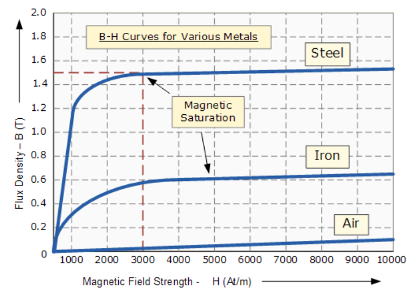
- Demagnetization Curves: We analyze the BH curves to confirm the Remanence (Br) et Coercivity (Hcj) meet the specific grade requirements.
- Tensile Strength & Adhesion: We test the physical durability of the rubber composite to prevent tearing during installation or operation, ensuring long-term reliability in dynamic applications.
FAQ: Common Questions About Rubber Magnetic Rings
What is the maximum temperature resistance for flexible magnetic gaskets?
While standard flexible magnets typically handle temperatures around 80°C to 100°C depending on the binder, our capabilities go much further. Because we utilize high-grade ferrite powders, our specialized high-temperature formulations can remain stable in significantly hotter environments. For demanding industrial applications, some of our ferrite-based solutions are engineered to operate up to +250°C. The limit is usually defined by the synthetic rubber binder rather than the magnetic powder itself, so we select the material compound based on your specific operating environment.
Can rubber magnets be cut to custom lengths without losing magnetism?
Absolutely. One of the primary advantages of a rubber magnet magnetic gasket ring is its exceptional machinability. Unlike brittle sintered magnets that crack easily, these flexible composites can be cut, punched, or die-cut without chipping or degrading their magnetic field. You can slice a roll to any length or punch out complex geometries, and the magnetic properties remain consistent right up to the cut edge.
What is the difference between a magnetic strip and a magnetic gasket ring?
A magnetic strip is typically a linear extrusion—think of a long tape used for simple closures or signage. A magnetic gasket ring, however, is often a custom-engineered profile designed to form a complete, continuous seal. We frequently manufacture these by die-cutting sheets or precision-welding extruded profiles to create a seamless loop. This distinction is critical for applications requiring airtight or watertight sealing (like IP67 enclosures), where a simple strip would invariably leave gaps at the corners.
How do I calculate the necessary pull force for my application?
Calculating pull force requires looking at more than just the magnet’s Gauss rating. You must consider the air gap (the distance between the magnet and the metal surface), the thickness of the steel plate you are attaching to, and the direction of the force (shear vs. direct pull). For complex sealing projects, we recommend reviewing our specifications on les aimants et matériaux or letting our engineering team run a simulation for you. We ensure the magnetic flux density provides the exact compression needed for a reliable seal without over-compressing the rubber.

 French
  English
  German
  Vietnamese
  Spanish (Mexico)
  Russian
  Turkish
  Polish
  Hindi
Hindi  Thai
Thai  Malay
Malay  Korean
  Japanese
  Czech
Czech  Danish
  Dutch
Dutch  Finnish
  Italian
  Portuguese (Brazil)
  Portuguese (Portugal)
  Slovenian
  Ukrainian
  Hebrew
  Scottish Gaelic
  Hungarian
  Tagalog
  Spanish (Spain)
  Serbian
  Indonesian
  Slovak
  Dutch (Belgium)
  Persian
  Arabic
  Romanian
  Estonian

Laissez un commentaire