
Are your motors running hotter than they should? Are you losing power somewhere in your magnetic assemblies? We deal with these challenges from engineers every day. Often, the silent killer of motor efficiency optimization is eddy current loss.
What is Eddy Current Loss?
To understand the root of the problem, we look to Faraday’s law of induction. This fundamental principle states that whenever a conductive material is exposed to a changing magnetic field, a voltage is generated within it.
In electromagnetic devices like transformers or electric motors, alternating magnetic fields constantly sweep through conductive magnetic materials. This continuous magnetic fluctuation induces localized, circular electrical currents right inside the solid metal core. We call these swirling loops “eddy” currents, or sometimes parasitic currents, because they mimic the swirling eddies found in a river.
Here is the physical breakdown of what happens when these currents form and why iron loss reduction is so critical:
- Trapped Energy: The currents swirl uselessly within the core, contributing absolutely nothing to the device’s mechanical or electrical output.
- Unwanted Heat: Because every conductive core material has natural electrical resistance (R), these circulating currents (I) generate significant friction at the atomic level.
- Efficiency Drop: Your useful electrical energy is directly converted into wasted thermal energy. This thermal penalty is governed by the standard power loss equation: P = I^2 R.
If we don’t control these swirling currents, the resulting excessive heat will degrade overall performance, waste expensive energy, and eventually shorten the lifespan of the equipment.
The Eddy Current Loss Formula Explained
When running a core loss calculation, we rely on a specific empirical formula to determine exactly how much electrical energy is wasted as heat inside a magnetic core.
Here is the standard equation we use to calculate this power loss:
P_e = ke B{max}^2 f^2 t^2 V
To break it down, here is what each variable stands for:
- P_e: Eddy current loss (The total wasted power)
- k_e: Eddy current coefficient (A constant that depends on the specific material)
- B_{max}: Maximum שדות השדה המגנטי הגבוהים ביותר (Knowing איך מודדים את עוצמת המגנט is helpful when evaluating peak field limits in your application)
- f: Frequency of the alternating magnetic field
- t: Thickness of the magnetic material
- V: Total volume of the magnetic core
The Critical Takeaway: Look closely at the thickness variable. The formula dictates that power loss increases with the square of the material’s thickness (t^2). Because of this exponential relationship, simply thinning out the conductive material is the single most effective strategy for massive iron loss reduction.
Eddy Current Loss vs. Hysteresis Loss
When tackling core loss calculation, it is important to understand that both Eddy Current Loss ו אובדן היסטרזיס combine to create the total “Core Loss” (often called “Iron Loss”) in your system. While they happen simultaneously inside motors and transformers, their physical mechanics are completely different.
To achieve meaningful iron loss reduction when we engineer our חומרים מגנטיים, we must address both phenomena individually. Hysteresis loss is essentially internal friction—it happens because the magnetic domains resist flipping back and forth as the magnetic field alternates. On the other hand, eddy current loss comes from unwanted parasitic currents actively swirling inside the conductive metal.
Here is a quick comparison to show exactly how they differ and how we mitigate them:
| תכונה | Eddy Current Loss | אובדן היסטרזיס |
|---|---|---|
| סיבה | Induced circular currents flowing within the conductive body. | Magnetic domain friction during magnetization reversals. |
| Formula Dependency | Strongly dependent on material thickness squared and frequency squared. | Dependent on the material’s hysteresis loop area and frequency. |
| Primary Mitigation | Using thin, insulated laminations to block the current path. | Choosing specialized magnetic materials with low coercivity (like silicon steel). |
| תוצאה | Wasteful heat generation and dropped power efficiency. | Wasteful heat generation and dropped power efficiency. |
How to Reduce Eddy Current Loss in Motors and Transformers
To achieve proper motor efficiency optimization and minimize transformer power loss, we must control the path of parasitic currents. Here are the three primary strategies we use for effective iron loss reduction:
1. Thin Laminations
Instead of using a solid block of metal, we construct the core from multiple thin sheets. This physically breaks the conductive path. Since core loss increases with the square of the material’s thickness (t^2), dividing the core drastically reduces this variable. Integrating precision-stamped lamination cores into your design is the most direct way to curb these losses.
2. Reliable Insulation
Simply slicing the metal is not enough; the currents can still bridge the gap between sheets if they touch. We apply specialized insulating varnishes or oxide coatings between every single layer. This strict barrier confines the currents to their individual sheets, stopping them from compounding and neutralizing the heat buildup.
3. High-Resistivity Materials
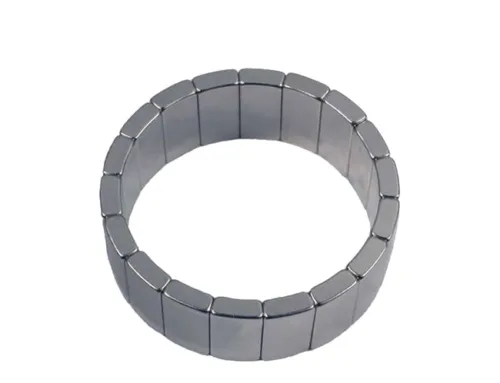
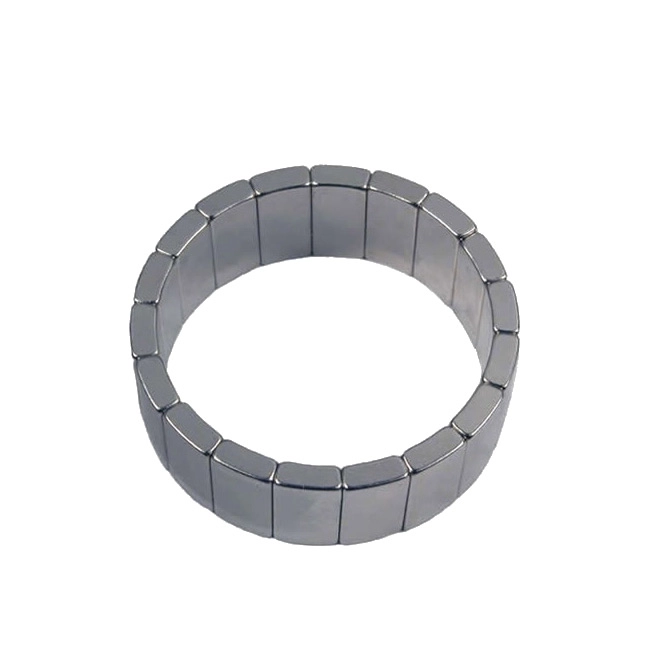
Increasing the electrical resistance of the base material naturally chokes off unwanted currents. We achieve this by utilizing silicon steel laminations, where added silicon boosts resistance without sacrificing magnetic flux density. For high-performance permanent magnet synchronous motors (PMSM), we utilize specialized laminated permanent magnets that deliver maximum magnetic strength while actively suppressing Eddy Current Loss.
Applications Where Eddy Currents Are Useful
While our primary goal in motor efficiency optimization is eliminating eddy current loss, these localized currents are not always a negative force. When controlled properly, the principles of Faraday’s law of induction become incredibly valuable. Rather than fighting parasitic currents, engineers actively harness them for specific, high-performance industrial applications.
Here are the most common ways this phenomenon is put to work:
- Induction Heating: By intentionally inducing massive eddy currents inside a conductive material, we capture the resulting heat to melt, weld, or forge metals rapidly and cleanly without ever making physical contact with a heat source.
- Magnetic Braking Systems: High-speed trains, roller coasters, and industrial machinery use these currents for frictionless deceleration. When a metal disc passes through a strong magnetic field—often powered by high-grade materials detailed in our המדריך של NBAEM על מגנטים נדירים—the induced currents generate an opposing drag force that stops motion smoothly and without mechanical wear.
- Metal Detectors: Security scanners emit a continuous alternating magnetic field. When this field passes over hidden metals, it induces tiny eddy currents within them. These currents generate a secondary, easily detectable magnetic field that triggers the scanner’s alarm.
Understanding how to exploit these magnetic forces is just as critical as knowing how to prevent iron loss in your laminated magnetic cores.
NBAEM: Combating Eddy Current Loss with High-Efficiency Solutions
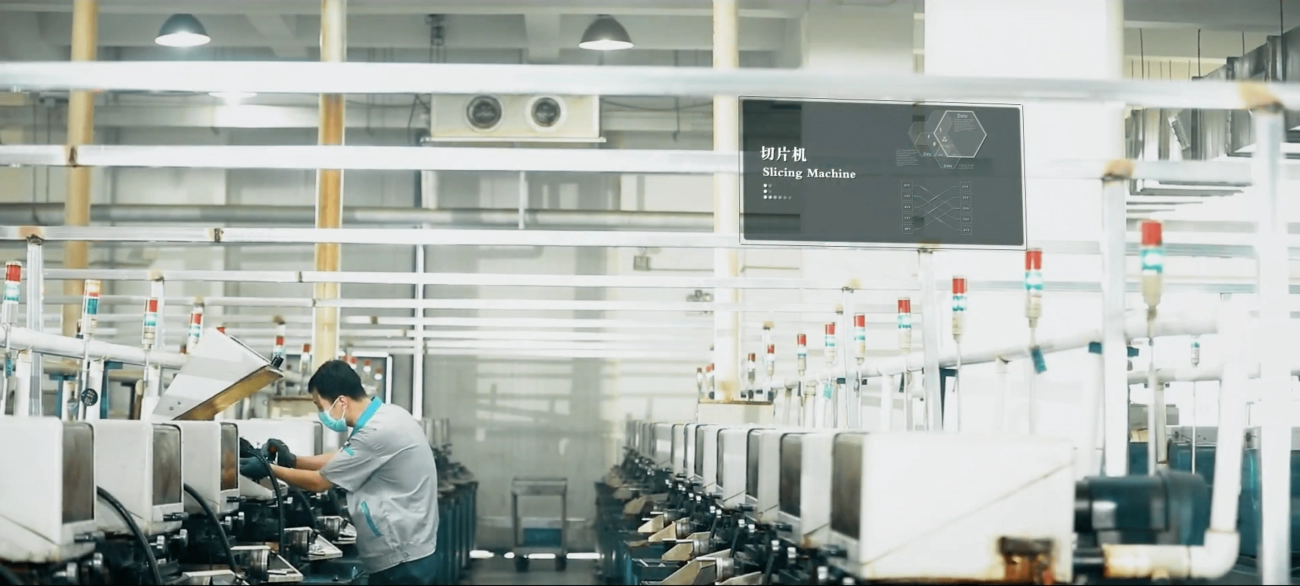
Understanding eddy current loss is only half the battle; applying the right materials is where real motor efficiency optimization happens. At NBAEM, we bring over 14 years of expertise as a premier magnetic material supplier, bridging the gap between theoretical iron loss reduction and high-performance commercial manufacturing.
We engineer components specifically designed to combat severe core losses. Our precision-manufactured lamination cores and laminated magnets are tailored for high-demand applications, including:
- EV motor magnet design
- Permanent magnet synchronous motors (PMSM) for elevators
- High-efficiency wind power generators
Engineering Advantage & Strict Quality Standards
To help you conquer parasitic currents and optimize your stator and rotor laminations, we provide a complete engineering advantage:
- Dedicated R&D: Our 10+ member R&D team excels in custom magnet design and complex magnetic assemblies, driving up overall efficiency while actively reducing your assembly costs.
- Proven Reliability: We manufacture to the highest global standards, maintaining strict compliance with ISO 9001, ISO 14001, ISO/TS16949, and PPAP level 3.
When it comes to minimizing power loss and maximizing output, we deliver the exact precision materials your projects demand.
Contact a Magnetic Specialist Today
Dealing with excessive eddy current loss in your designs? Don’t let parasitic currents ruin your motor efficiency optimization efforts. Whether you are an engineer trying to perfect an EV motor magnet design or a procurement specialist sourcing reliable laminated magnetic cores, we have the expertise you need.
- Get a Free Quote: Fast, competitive pricing on tailored laminations and laminated permanent magnets.
- Expert Consultation: Work directly with our engineering team to solve your specific iron loss reduction challenges.
Reach out today to discuss your custom magnetic assemblies. Discover more about our comprehensive magnetic engineering services and let us help you lock in maximum efficiency and performance for your next project.
 Hebrew
  English
  German
  Vietnamese
  Spanish (Mexico)
  Russian
  Turkish
  Polish
  Hindi
Hindi  Thai
Thai  Malay
Malay  Korean
  Japanese
  French
  Czech
Czech  Danish
  Dutch
Dutch  Finnish
  Italian
  Portuguese (Brazil)
  Portuguese (Portugal)
  Slovenian
  Ukrainian
  Scottish Gaelic
  Hungarian
  Tagalog
  Spanish (Spain)
  Serbian
  Indonesian
  Slovak
  Dutch (Belgium)
  Persian
  Arabic
  Romanian
  Estonian
השאר הערה