
The Core Physics: How Do Superconducting Magnets Work?
Imagine running an electrical current through a wire, turning off the power supply, and watching that current flow forever without losing a single watt of energy. That is the raw power behind a superconducting magnet. By eliminating the friction that plagues normal electricity, we can build some of the most powerful magnetic systems on earth.
The Phenomenon of Superconductivity
In standard electromagnets, copper or aluminum wires fight against electrical resistance, generating massive amounts of waste heat. A superconducting magnet flips the script. When cooled to extreme, cryogenic temperatures, specific materials undergo a phase transition, hitting a state of zero electrical resistance.
Without resistance, currents flow completely unimpeded, allowing the system to achieve an extraordinarily high critical current density and generate an immense magnetic field intensity that standard magnets simply cannot match.
Persistent Mode Operations
Once the electromagnetic coil windings are energized and stabilized, the power supply can actually be bypassed and switched off. This triggers what we call persistent current mode.
- Trapped Energy: The electrical current loops indefinitely through the closed superconducting circuit.
- Perfect Stability: Because there is no resistance to decay the current, the generated magnetic field remains incredibly stable over long periods.
- Efficienza: Power consumption drops to near zero during operation, making it highly efficient for long-term industrial use.
The Physics of Failure: What is a Magnet Quench?
Operating these systems requires maintaining a delicate thermodynamic balance. If any part of the coil leaves its superconducting state, it triggers a failure chain known as magnet quenching safety disruption.
| Fase | What Happens During a Quench |
|---|---|
| 1. Localized Heating | A tiny spot in the coil exceeds its critical temperature, reverting to normal resistance. |
| 2. Rapid Propagation | The sudden resistance generates heat, quickly spreading to adjacent parts of the winding. |
| 3. Energy Dumping | The stored magnetic energy converts rapidly into heat, boiling off the surrounding liquid helium. |
To prevent catastrophic structural damage during a quench, we integrate advanced protection circuits that safely vent the expanding cryogens and redirect the trapped electrical current away from the coil.
Material Selection: LTS vs. HTS Frameworks
When we design a superconducting magnet, the choice of material dictates everything from the cooling budget to the ultimate magnetic field intensity. We generally categorize these materials into two camps: those that need extreme cold and those that offer a bit more flexibility.
Low-Temperature Superconductors (LTS)
LTS materials are the industry workhorses. Most commercial systems, like standard MRI machines, rely on Niobium-Titanium (NbTi) wires or Niobium-Tin (Nb3Sn) tapes. These materials are reliable and cost-effective but have a major catch: they only achieve zero electrical resistance when cooled to near absolute zero using a liquid helium cryostat.
High-Temperature Superconductors (HTS)
HTS materials, such as Rare-earth barium copper oxide (REBCO), are the “game changers.” They can operate at significantly higher temperatures (often above 77 K), allowing for the use of liquid nitrogen instead of expensive helium. This makes the cryogenic cooling system much simpler and more accessible for specialized industrial applications where extreme field strength is required.
A Comparative Material Matrix
To help you decide which framework fits your project, here is a quick breakdown of how these materials stack up:
| Caratteristica | Low-Temperature (LTS) | High-Temperature (HTS) |
|---|---|---|
| Materiali Comuni | NbTi, $Nb_{3}Sn$ | REBCO, BSCCO |
| Typical Coolant | Liquid Helium (4.2 K) | Liquid Nitrogen (77 K) |
| Critical Current Density | High (at low fields) | Exceptional (at high fields) |
| Cost Per Meter | Relatively Low | Alta |
| Ease of Manufacturing | Well-established | Complex / Evolving |
Choosing the right material is a balance of performance and operating costs. While LTS is the go-to for stability, HTS is paving the way for more compact, powerful magnets in next-gen tech.
Anatomy of a Superconducting Magnet System
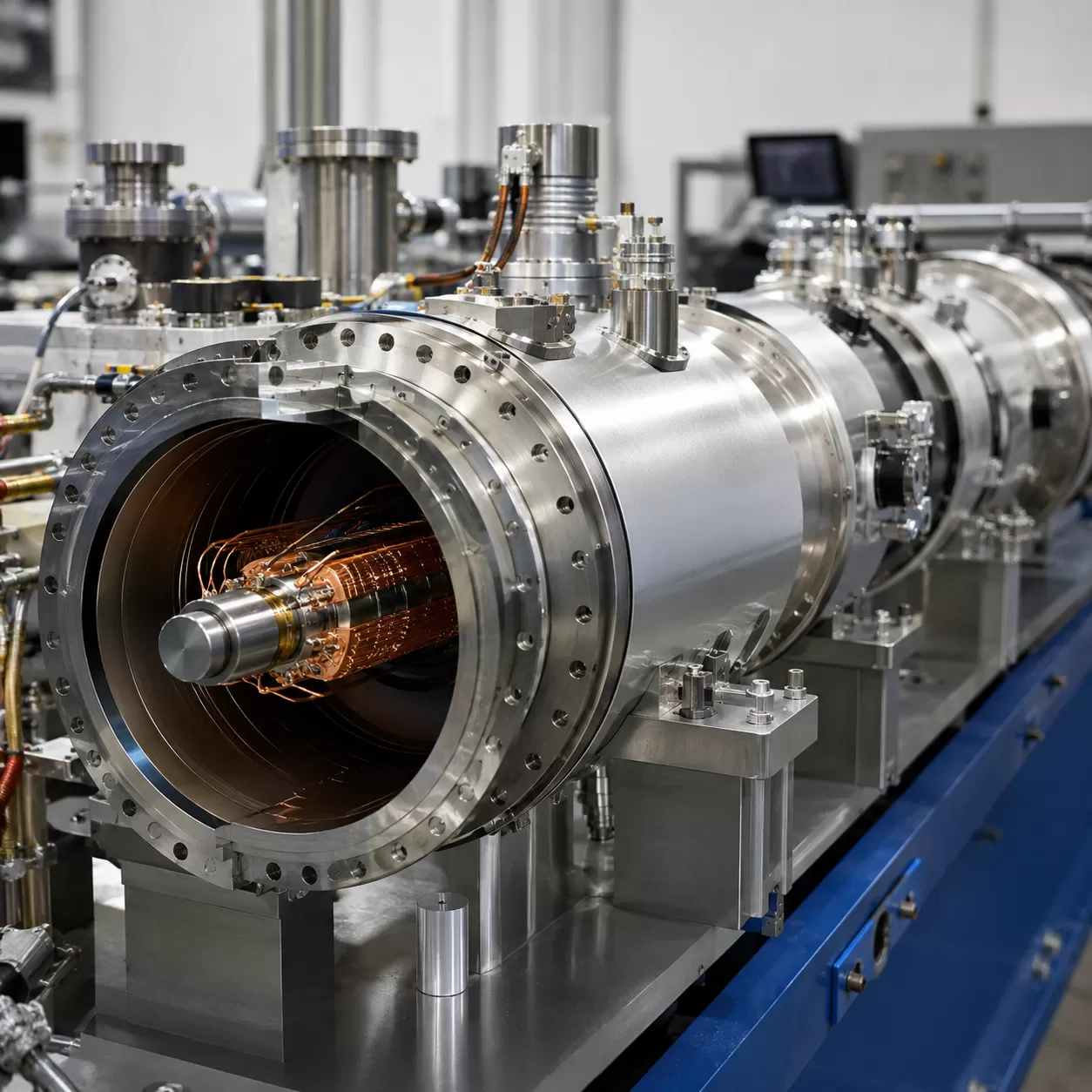
A superconducting magnet is not just a single component; it is a highly engineered system of interacting parts. To maintain zero electrical resistance and generate massive magnetic field intensity, three core pillars must work together flawlessly.
The Coil Windings and Conductor Structures
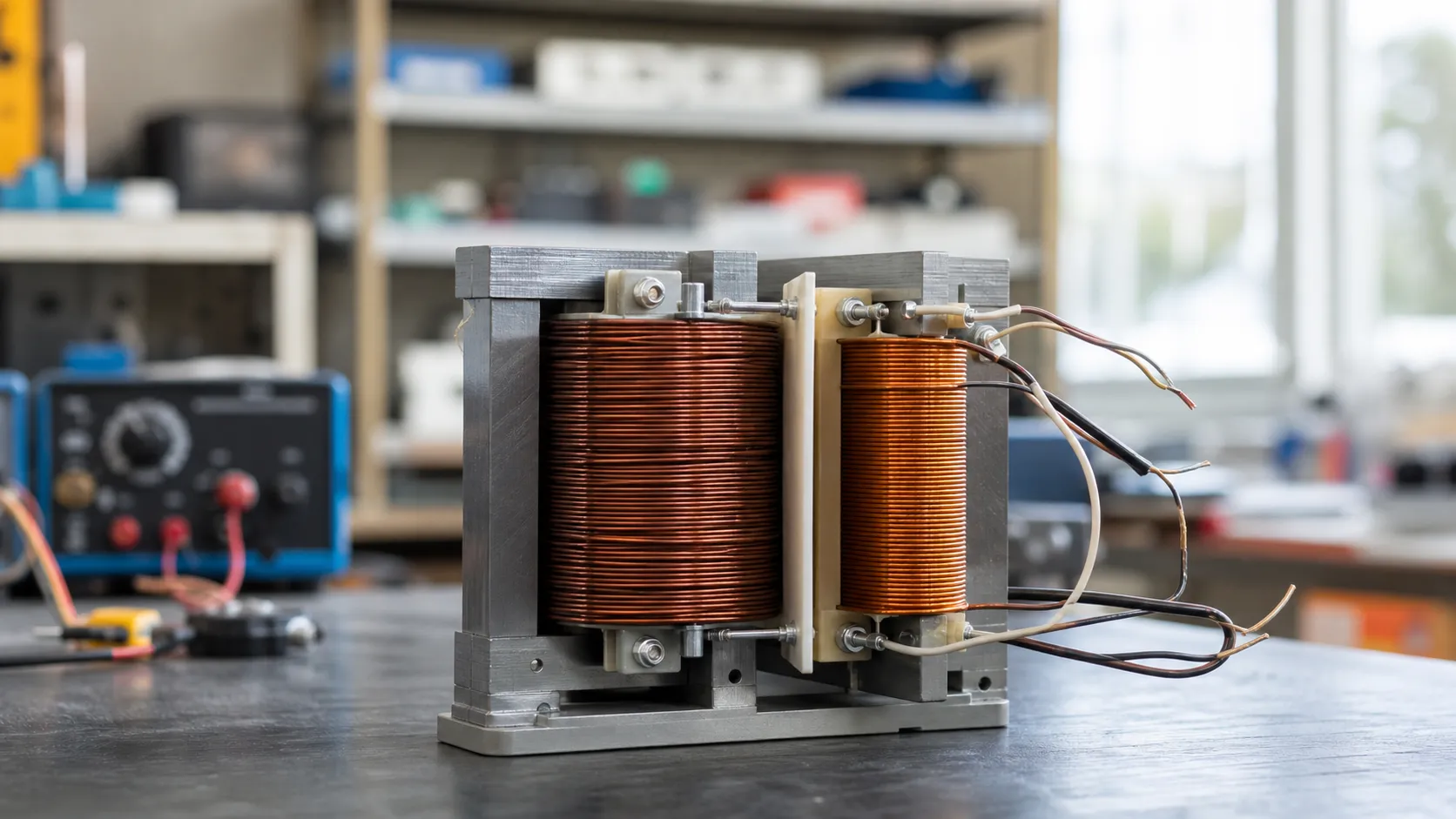
At the heart of the system are the electromagnetic coil windings. We manufacture these using advanced low-temperature superconductors (LTS) like Niobium-Titanium (NbTi) wires or Niobium-Tin ($Nb_3Sn$) tapes, as well as high-temperature superconductors (HTS) like rare-earth barium copper oxide (REBCO).
- Critical Current Density: The windings are tightly packed to maximize the current packed into a small area without degrading the superconducting state.
- Mechanical Reinforcement: Because the strong magnetic fields create massive mechanical forces (Lorentz forces) that want to push the coil apart, the structures are heavily reinforced with structural steel or epoxy composites.
The Cryostat Environment
Superconductivity cannot exist without extreme cold. The entire coil assembly is housed inside a specialized cryogenic cooling system known as a liquid helium cryostat.
- Vacuum Insulation: Prevents convective heat transfer from the outside environment.
- Thermal Radiation Shields: Cool environment layers cooled by liquid nitrogen or mechanical cryocoolers block ambient heat.
- Liquid Helium Bath: Keeps the LTS wires submerged at a stable $4.2\text{ K}$ (around $-269^\circ\text{C}$), ensuring the system never climbs above its critical temperature.
The Power Conditioning System (PCS)
Getting power into and out of a closed, freezing environment requires specialized electronics. The Power Conditioning System manages this delicate balance.
- High-Current Power Supplies: Deliver the initial ramp-up current safely into the system.
- Vapor-Cooled Current Leads: Connect room-temperature external power electronics to the frozen internal coils while minimizing heat leaks.
- Persistent Current Mode Switches: Once the desired magnetic field intensity is reached, a superconducting switch closes the circuit loop. This allows the current to flow indefinitely in a persistent current mode without drawing any further external power.
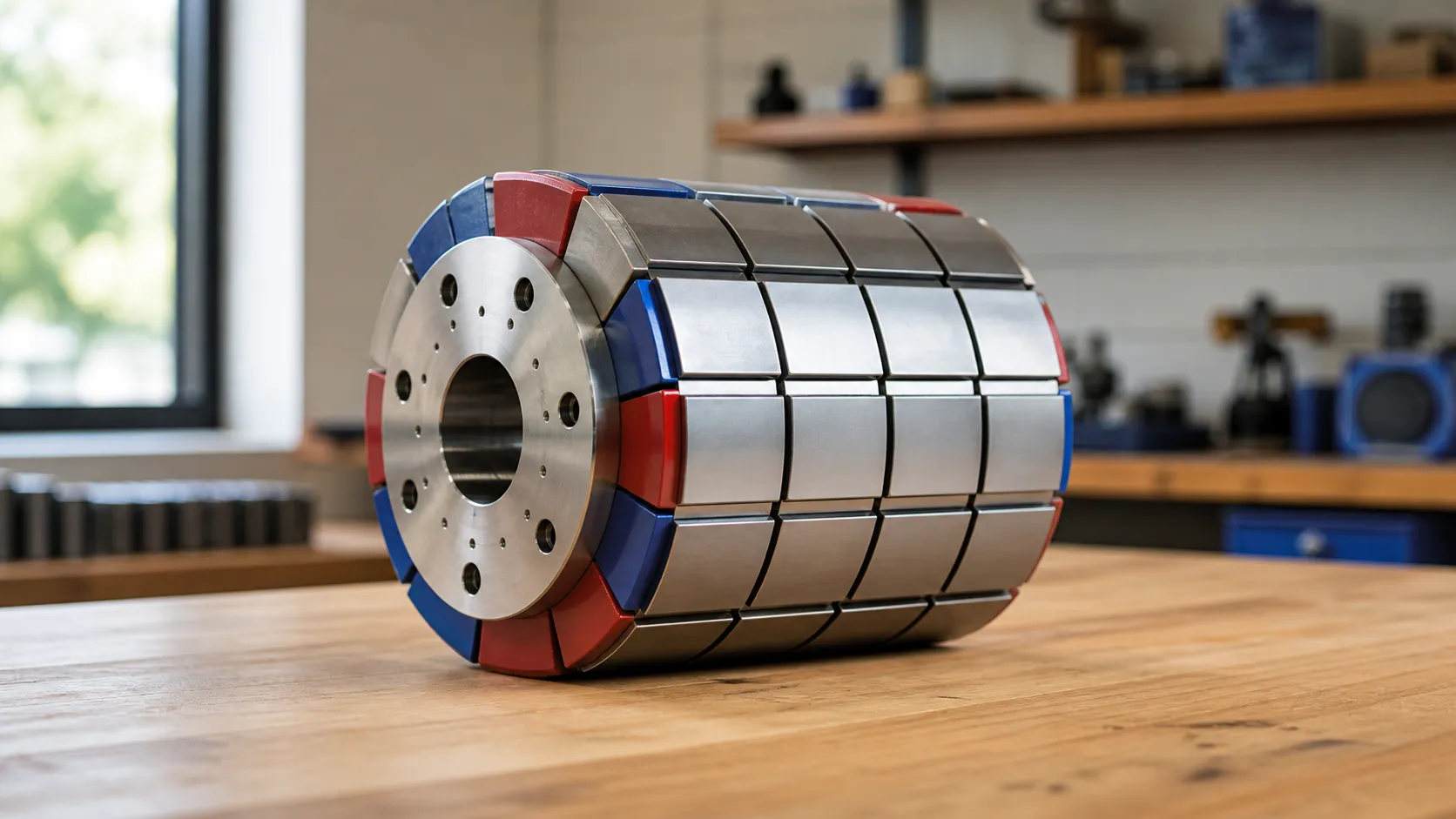
For industrial clients needing precise magnetic integration in related motor applications, our specialized magnetic motor assembly options showcase how we handle high-performance magnetic engineering at scale.
Cutting-Edge Industrial and Scientific Applications of the Superconducting Magnet
Superconducting magnet technology isn’t just a theoretical marvel; it is the driving force behind some of the most advanced industries on the planet. By delivering massive magnetic field intensity with zero electrical resistance, these systems enable breakthroughs that conventional electromagnets simply cannot touch.
Assistenza Sanitaria
In the medical field, the superconducting magnet is the absolute backbone of diagnostic imaging. It provides the intense, ultra-stable magnetic fields required for high-resolution Magnetic Resonance Imaging (MRI) scanners. This high field strength allows doctors to map the human body with incredible clarity, catching diseases early. Because reliability is everything in clinical settings, many healthcare facilities rely on specialized magnets used in medical applications to ensure uninterrupted patient care and precise diagnostic results.
High-Energy Physics
We cannot explore the building blocks of the universe without intense magnetic fields. Massive particle accelerators, like the Large Hadron Collider, use electromagnetic coil windings made from advanced superconductors to steer and focus particle beams moving at nearly the speed of light. Without these high-powered magnets, modern particle physics and quantum research would ground to a halt.
Clean Energy Frontiers
In the push for sustainable power, superconducting magnets are proving to be major game-changers. They are critical components in nuclear fusion reactors (like tokamaks), where they generate the powerful magnetic cages needed to contain scorching-hot plasma. Additionally, integrating high-temperature superconductors into next-generation wind turbines helps drastically reduce weight while boosting power output.
Transportation
The future of high-speed transit relies heavily on superconducting technology. Maglev (magnetic levitation) trains utilize these powerful magnets to lift and propel trains above the tracks, completely eliminating mechanical friction. This allows for smooth, quiet travel at speeds exceeding 300 mph, redefining regional transportation networks.
Manufacturing Challenges & The Role of Advanced Material Suppliers
Building a high-performance superconducting magnet is an engineering marvel, but getting it from the lab to the factory floor is a brutal challenge. The physics might be solved, but the manufacturing realities are a completely different beast.
The Engineering Bottleneck
The primary obstacle in manufacturing lies in the extreme mechanical stress these systems endure. When an electromagnetic coil winding carries massive current densities under immense magnetic field intensities, it experiences colossal Lorentz forces. The system literally tries to rip itself apart from the inside out.
Furthermore, materials like Niobium-Tin ($Nb_3Sn$) or Rare-earth barium copper oxide (REBCO) are notoriously brittle. Winding these materials into precise geometries without causing microscopic fractures—which would instantly ruin the zero electrical resistance state—requires specialized, high-tolerance machinery and extreme precision.
The Supply Chain Perspective
Securing raw materials for both low-temperature superconductors (LTS) and high-temperature superconductors (HTS) is a major geopolitical and logistical headache. The production of these specialized wires and tapes relies heavily on volatile global markets for rare earth elements and specialized alloys.
With shifting global trade dynamics, such as the Divieto della terra rara in Cina, companies face unpredictable material shortages and sudden price spikes. For manufacturers relying on a steady stream of advanced magnetic components, navigating these supply chain disruptions is just as critical as managing the liquid helium cryostat itself.
The NBAEM Advantage
As a leading advanced magnetic materials supplier, we solve these bottlenecks by providing end-to-end supply chain stability and world-class engineering support. We don’t just ship raw materials; we deliver optimized components designed to withstand the harshest cryogenic cooling system environments.
- Secured Supply Chains: Direct access to essential materials, mitigating the risks of global export restrictions.
- Precision Engineering: Personalizzato assemblaggio magnetico and winding solutions tailored to withstand high magnetic field intensity without structural degradation.
- Rigorous Quality Control: Every component is stress-tested to prevent premature magnet quenching safety failures in the field.
By bridging the gap between raw material sourcing and complex precision engineering, we ensure your production line stays moving, no matter how volatile the global market becomes.
Future Outlook: The Next Decade of Superconducting Magnets
The next ten years will completely redefine what is possible in magnetics. As we push the limits of magnetic field intensity and efficiency, the industry is moving away from traditional, resource-heavy setups toward smarter, more sustainable configurations. The focus is shifting toward scaling production, reducing operational overhead, and integrating these systems into broader applicazioni industriali.
Room-Temperature Superconductivity Quest
The ultimate goal for researchers and manufacturers alike is achieving room-temperature superconductivity. Eliminating the need for complex cooling systems would trigger a massive shift in global infrastructure.
- The Current Focus: Moving away from traditional liquid helium setups toward materials that maintain zero electrical resistance at higher thermal thresholds.
- The Impact: Drastically lower deployment costs for high-field applications, making advanced grid storage and compact fusion reactors commercially viable.
- The Transition: While true ambient-temperature superconductors remain a laboratory pursuit, modern near-room-temperature research is rapidly closing the gap, forcing a redesign of standard electromagnetic coil windings.
The Rise of Eco-Friendly Cryogenics
Sustainability is driving the next generation of cryogenic cooling system design. The helium supply chain is notoriously volatile, pushing the market toward reliable, closed-loop, and helium-free alternatives.
| Innovation Trend | Technical Shift | Operational Advantage |
|---|---|---|
| Cryogen-Free Systems | Conduction-cooled setups using mechanical cryocoolers. | Eliminates liquid helium dependency entirely. |
| High-Temperature Nitrogen Cores | Utilizing REBCO tapes at liquid nitrogen temperatures ($77\text{ K}$). | Drastically reduces power consumption and fluid costs. |
| Closed-Loop Recycling | Ultra-efficient, zero-boil-off liquid helium cryostat designs. | Prevents gas loss, ensuring long-term stable persistent current mode operation. |
By lowering the cooling hurdles, we are making high-performance superconducting magnet technology accessible to a much broader industrial base, ensuring cleaner operations without sacrificing field strength.
Frequently Asked Questions (FAQs) About Superconducting Magnets
What is the difference between LTS and HTS?
Low-Temperature Superconductors (LTS) and High-Temperature Superconductors (HTS) differ primarily in their operating temperatures and material compositions. LTS materials, like Niobium-Titanium (NbTi) wires, require extreme cryogenic cooling near absolute zero, usually around $4.2\text{ K}$. HTS materials, such as Rare-earth barium copper oxide (REBCO), can operate at significantly higher temperatures, often above $77\text{ K}$. This higher threshold allows HTS systems to utilize more cost-effective cooling methods while achieving a much higher critical current density and stronger magnetic field intensity.
Why do superconducting magnets need liquid helium?
Most industrial systems rely on a liquid helium cryostat because traditional LTS materials only exhibit zero electrical resistance at temperatures close to absolute zero ($-269^\circ\text{C}$). Liquid helium provides the stable, ultra-low temperature environment necessary to sustain superconductivity. Without this intense cooling, the material loses its superconducting properties and cannot maintain the massive electrical currents required for high-field applications.
What causes a superconducting magnet to quench?
A magnet quenching event occurs when a localized part of the electromagnetic coil windings transitions from a superconducting state to a resistive state. This failure is typically triggered by:
- Mechanical micro-movements within the coil.
- Localized heating or cooling system fluctuations.
- Exceeding the material’s critical magnetic field or current limits.
When resistance returns, the trapped energy rapidly converts into heat, boiling off the liquid helium cryogen. For safety, modern systems use advanced monitoring to trigger an controlled energy discharge during a quench. Understanding these magnetic disruptions is just as vital as understanding basic physics principles like cos'è un momento magnetico to design safe, predictable industrial equipment.
Can a superconducting magnet work at room temperature?
No, commercial superconducting magnets cannot operate at room temperature yet. While discovering a room-temperature superconductor remains a major goal for global researchers, all practical systems today require dedicated cryogenic cooling systems. Current industrial applications rely on robust, proven LTS and HTS frameworks to maintain stable magnetic fields under strict thermal management.

 Italian
  English
  German
  Vietnamese
  Spanish (Mexico)
  Russian
  Turkish
  Polish
  Hindi
Hindi  Thai
Thai  Malay
Malay  Korean
  Japanese
  French
  Czech
Czech  Danish
  Dutch
Dutch  Finnish
  Portuguese (Brazil)
  Portuguese (Portugal)
  Slovenian
  Ukrainian
  Hebrew
  Scottish Gaelic
  Hungarian
  Tagalog
  Spanish (Spain)
  Serbian
  Indonesian
  Slovak
  Dutch (Belgium)
  Persian
  Arabic
  Romanian
  Estonian
  Greek
Greek  Bulgarian
Lascia un commento