
The Core Physics of Magnet Processing
To engineer high-performance permanent magnets, we must manipulate material properties at the microscopic level. Successful magnet processing relies on a precise understanding of magnetic domains and how specific alloys respond to applied physical forces and external fields.
Magnetic Field Orientation
The foundation of modern rare earth magnet production lies in the alignment of magnetic domains. We classify these materials into two distinct categories based on their structural orientation:
- 이방성 자석: These materials possess a preferred, engineered direction of magnetization. During production, we apply a strong external field to align the powder particles. This deliberate magnetic field orientation restricts magnetization to a single axis but delivers significantly higher overall magnetic performance.
- 등방성 자석: These materials feature randomly oriented grains. While they yield lower magnetic strength compared to anisotropic variants, they provide the engineering flexibility to be magnetized in any geometric direction.
B-H Demagnetization Curve
To evaluate a magnet’s performance limits and thermal stability, we analyze the B-H demagnetization curve (specifically the second quadrant of the hysteresis loop). This curve is the ultimate predictor of how a magnet will behave under operational stress and inverse magnetic fields.
When engineering a specific magnetic grade, we rigorously balance two critical metrics derived from this curve:
| 파라미터 | Definition | Engineering Impact |
|---|---|---|
| 잔류자속 (Br) | The residual magnetic flux density remaining in the material after the initial magnetizing field is removed. | Dictates the absolute magnetic strength and flux output of the finished component. |
| 내자성력 (Hc) | The threshold of resistance the magnetic material exhibits against changes to its magnetization. | Determines the magnet’s ability to resist demagnetizing forces, extreme temperatures, and harsh environments. |
By meticulously optimizing the balance between coercivity and remanence at the physics level, we guarantee the raw material will meet exact application tolerances before it ever enters the physical shaping and processing stages.
Step-by-Step Magnet Processing: The Powder Metallurgy Route
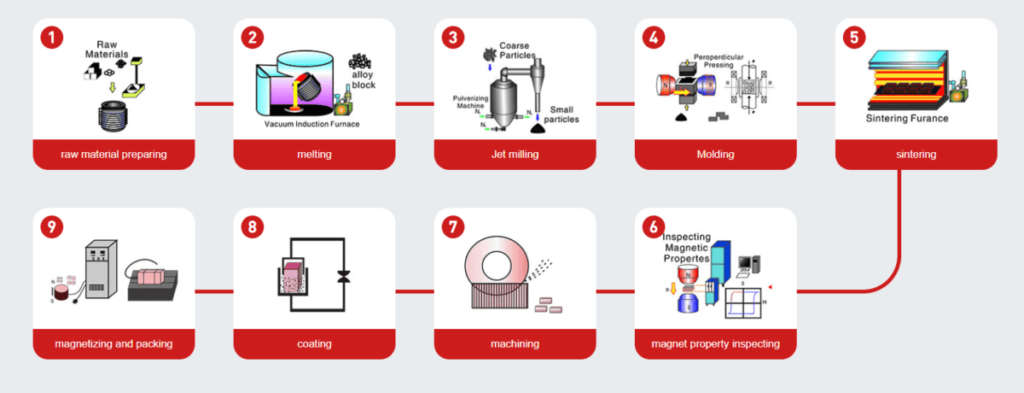
네오디뮴 자석 생산 공정
As part of our detailed introduction to magnet processing, it is essential to understand how raw materials are transformed into powerful energy sources. We manufacture our high-performance permanent magnets using the powder metallurgy process. This highly controlled method turns solid metals into fine powder and back into a dense, solid magnet, allowing us to achieve exceptional magnetic properties.
Here is exactly how we do it, step by step:
Step 1: Material Selection & Vacuum Smelting
Everything begins with raw materials. We precisely weigh out the required rare earth elements, primarily Neodymium, Iron, and Boron. Because these metals are highly reactive, we process them using vacuum induction melting. By melting the alloy in a strictly controlled vacuum environment, we prevent oxidation and guarantee the absolute purity of the base metal.
Step 2: Strip Casting & Hydrogen Decrepitation
Once the alloy is melted, we need to cool it quickly.
- Strip casting process: We pour the molten metal over a chilled spinning wheel, rapidly cooling it into very thin, solid flakes.
- Hydrogen decrepitation: Next, we expose these flakes to hydrogen gas. The metal absorbs the hydrogen and expands, causing the flakes to naturally crack and crumble into a coarse powder. This step makes the material extremely brittle and ready for fine milling.
Step 3: Jet Milling
We take the coarse powder and feed it into a jet mill. Using high-pressure bursts of inert gas, the particles crash into each other until they are reduced to an ultra-fine dust—typically just 3 to 5 microns in size. At this microscopic scale, each individual particle contains only a single magnetic domain, which is crucial for maximizing final performance.
Step 4: Magnetic Alignment and Pressing
This is where the magic happens. The fine powder is loaded into a mold, and we apply a powerful external magnetic field. This field physically rotates and aligns every single powder particle in the same magnetic direction.
- Pressing: While the field is active, we lock this alignment in place by pressing the powder into a solid block.
- We often utilize advanced isostatic pressing techniques to apply uniform pressure from all sides, creating a highly dense “green” compact. This precise alignment is what gives our 네오디뮴 자석 their incredible strength.
Step 5: Sintering and Annealing
The pressed blocks are solid, but they aren’t fully dense or truly magnetic yet.
- Liquid phase sintering: We place the blocks into a vacuum furnace and heat them to just below their melting point. The particles fuse together, shrinking the block and bringing it to near 100% density.
- Annealing: ly, we slowly cool and heat-treat the blocks in stages. This relieves internal mechanical stresses and stabilizes the molecular structure, ensuring the final 네오디뮴 자석의 품질 meets exact performance and durability standards.
Post-Sintering: Machining and Surface Treatment
Once the sintering phase is complete, the raw magnet blocks are extremely hard and brittle. To achieve the exact dimensions required for custom applications, we move to the post-sintering phase. This step is a critical component in any detailed introduction to magnet processing, ensuring the final product meets exact engineering specifications.
Precision Machining
Because permanent magnets lack the malleability of standard metals, traditional machining methods are ineffective. We rely on specialized techniques to shape the material without compromising its magnetic integrity.
- Diamond Grinding: Used to achieve incredibly tight tolerances on flat surfaces and outer diameters.
- Slicing and Cutting: Precision wire cutting shapes raw blocks into specific custom sizes efficiently.
- Drilling: Specialized core drills create precise holes required for complex magnetic assemblies.
This level of precision is especially vital when processing high-performance 네오디뮴 자석, which demand strict dimensional accuracy for seamless integration into EV motors, medical devices, and consumer electronics.
Anti-Corrosion Coatings
Raw sintered NdFeB magnets are highly susceptible to oxidation and corrosion. Without proper protection, they degrade rapidly. Applying robust magnetic surface treatments is non-negotiable for long-term reliability and performance.
- Ni-Cu-Ni (Nickel-Copper-Nickel): The industry standard coating, offering excellent durability and a clean, metallic finish.
- 아연: A highly cost-effective protective layer suitable for standard, lower-temperature environments.
- 에폭시: Provides superior resistance to salt, moisture, and harsh industrial chemicals, making it ideal for demanding automotive and marine applications.
By applying these protective layers under strict ISO 9001 and ISO/TS16949 quality controls, we ensure every processed magnet withstands rigorous environmental conditions while maintaining peak magnetic performance.
The Activation: The Magnetization Process
Up to this stage in rare earth magnet production, the machined metal pieces are essentially just heavy metal. They have the internal structure required for magnetism, but they lack the actual magnetic field. To activate them, we must expose these raw materials to an overwhelming burst of electromagnetic energy. This crucial step is a cornerstone in any detailed introduction to magnet processing.
Turning “Slugs” into Permanent Magnets
We place the unmagnetized “slugs” inside a custom magnetizing fixture. A high-voltage capacitor then discharges a massive pulse of direct current through a coil, generating an intense, instantaneous magnetic field.
This pulse forces the internal magnetic domains of the material to align permanently in the desired direction. We engineer this step precisely based on the specific composition and shape of the magnet. The applied field must be strong enough to achieve total magnetic saturation; otherwise, the final product will suffer from poor coercivity and remanence.
Calibration and Stabilization
Hitting the magnet with a pulse of energy is only half the battle. To ensure reliable performance in demanding environments like EV motors or consumer electronics, we implement strict magnetic calibration and stabilization processes. You can explore more about our testing protocols and industry insights on our magnet engineering blog.
To guarantee our magnets perform flawlessly over their lifespan, we focus on three core areas:
- Thermal Stabilization: We expose the newly magnetized components to controlled temperature cycles. This intentionally removes the weakest magnetic domains, preventing unexpected flux loss when the magnet is deployed in the field.
- Field Calibration: We fine-tune the magnetic output, ensuring the strength and field distribution perfectly match the custom engineering requirements of the project.
- Strict Verification: Every batch is tested against our rigorous ISO 9001, ISO/TS16949, and PPAP Level 3 standards, ensuring absolute consistency across all 50+ of our magnet SKUs.
Beyond Raw Magnets: Advanced Assemblies & Lamination Cores
Our detailed introduction to magnet processing wouldn’t be complete without looking past the bare magnet. For many applications, a raw magnet is just the starting point. We take these components to the next level by engineering them into complete, ready-to-install systems.
The Engineering Advantage of Magnetic Assemblies
Integrating raw magnets into custom magnetic assemblies maximizes their functional potential. By combining high-performance magnets with specialized non-magnetic materials like steel housings or engineered plastics, we can direct and amplify the magnetic field exactly where your application needs it.
When designing these systems, calculating the magnetic flux and surface gauss is a critical step. A well-engineered assembly can significantly boost the effective holding force, improve sensor accuracy, and protect the brittle magnet material from mechanical impacts.
High-Efficiency Lamination Cores
For the electric motor and generator sectors, we pair our permanent magnets with high-efficiency lamination motor cores. This combination is essential for achieving the power density modern industries demand.
Here is why precision lamination matters:
- Reduced Eddy Currents: Stacking thin, insulated electrical steel sheets minimizes energy loss during operation.
- Optimized Field Alignment: Precision stamping ensures the core geometry perfectly aligns with the magnetic field orientation.
- Thermal Stability: Engineered core designs provide better heat dissipation, keeping the motor running efficiently under heavy loads.
By controlling both the magnet production and the final assembly process, we ensure every component works together seamlessly to deliver peak performance.
Detailed Introduction to Magnet Processing: Strict Quality Control
In rare earth magnet production, quality control is the absolute backbone of reliability. We don’t just check the final product; we monitor every variable throughout the entire run, ensuring flawless magnetic calibration and stabilization before anything leaves the facility.
Maintaining ISO & Automotive Standards
Global markets require magnets that will not fail under stress, heat, or heavy use. To guarantee consistent coercivity and remanence, we stick to rigorous international standards.
- Performance Verification: We strictly monitor the B-H demagnetization curve for every single batch to ensure the magnetic field holds up under real-world conditions.
- Global Benchmarks: Our production lines operate under strict ISO certifications, prioritizing zero-defect manufacturing for high-stakes automotive and industrial applications.
To see how these standards are built into our foundation, you can read more about our company history and capabilities.
PPAP Level 3 Compliance
When you are building EV motors or sensitive sensors, you need hard, documented proof of quality. We operate with complete PPAP Level 3 Compliance, offering our partners:
- Full Traceability: Complete material tracking from the initial vacuum induction melting stage all the way to final delivery.
- Process Transparency: We provide detailed control plans, FMEA (Failure Mode and Effects Analysis), and rigorous dimensional inspections.
- Guaranteed Specs: We deliver the data-backed proof you need to know your custom magnetic assemblies will perform exactly as designed, every single time.
Partnering with an Experienced Magnet Manufacturer
Understanding the science is just the beginning. While having a detailed introduction to magnet processing helps you design better products, executing those designs requires a reliable partner. You need a manufacturer that handles the complex steps of rare earth magnet production with precision and consistency.
The NBAEM Advantage
At NBAEM, we don’t just supply magnets; we engineer full-scale magnetic solutions. We own the production process from raw material sourcing to the final custom magnetic assemblies. By keeping strict control over advanced techniques like vacuum induction melting and liquid phase sintering, we guarantee high-performance results for every batch.
Navigating global supply chains can be tough, especially when dealing with market shifts and export regulations on rare earth materials. We leverage our deep industry roots to keep your supply secure and your costs predictable.
Why partner with us?
- End-to-End Manufacturing: Complete in-house capabilities from raw powder to final coating.
- Performance Guarantees: Strict testing ensures the perfect balance of coercivity and remanence.
- Custom Engineering: Tailored magnetic field orientation to match your exact application needs.
Lead Times and Fulfillment
A great product means nothing if it arrives late. We have streamlined our operations to ensure your production lines never stall. We balance speed with quality, meaning you get fully stabilized, production-ready components right on schedule.
- Rapid Prototyping: Fast turnarounds for testing new motor designs or sensor components.
- Flexible Scaling: Seamlessly transition from small batch runs to massive, high-volume manufacturing.
- Global Logistics: Reliable shipping and fulfillment networks built to support international manufacturing hubs.
Detailed Introduction to Magnet Processing: Frequently Asked Questions (FAQs)
What are the common challenges in rare earth magnet production?
Making reliable magnets requires strict environmental control. The primary challenges in rare earth magnet production involve keeping oxygen levels near zero during smelting, preventing micro-cracks during pressing, and maintaining precise temperature control during liquid phase sintering. Even minor variations can drastically impact the final magnetic properties.
How does hydrogen decrepitation improve powder quality?
We use 수소 분해 to break cast alloy into a clean, exceptionally uniform powder. Hydrogen gas forces the alloy’s crystal structure to expand and naturally shatter. This creates a far superior powder compared to mechanical crushing, which is vital for producing high-performance sintered NdFeB magnets. For a closer look at the exact manufacturing steps, you can review how to make NdFeB magnets.
What are the benefits of isostatic pressing techniques?
- Uniform Density: Isostatic pressing techniques apply equal pressure from every direction on the mold.
- Fewer Defects: It minimizes internal flaws and structural weaknesses.
- Better Alignment: It perfectly locks in the magnetic field orientation, leading to a stronger and more reliable final product.
How do we ensure corrosion resistance in NdFeB magnets?
Because raw neodymium oxidizes easily, reliable magnetic surface treatments are mandatory. We protect the core material by applying specialized coatings such as Nickel-Copper-Nickel (NiCuNi), Zinc, or high-grade epoxy resins. Rigorous surface cleaning prior to plating ensures the coating never peels or chips out in the field.
Why is magnetic calibration and stabilization critical?
Magnets must perform predictably over their lifespan. Magnetic calibration and stabilization fine-tune the energy output so every batch matches your exact specifications. This step prevents unexpected performance drops or voltage spikes in sensitive applications like precision sensors or electric motors.
What quality certifications matter in magnet manufacturing?
When vetting a factory, always look for ISO 9001 와 IATF 16949 certifications. These globally recognized standards guarantee that a manufacturer maintains strict, repeatable quality control—from raw material sourcing all the way through to automotive PPAP Level 3 compliance.
How to select a supplier for custom magnetic assemblies?
Choose a partner with deep engineering expertise, not just a raw material vendor. When developing custom magnetic assemblies, your supplier should be able to optimize the B-H demagnetization curve for your specific use case and provide consistent tolerances. You can explore our diverse application capabilities to see how an experienced manufacturer actively supports complex industry demands.

 Korean
  English
  German
  Vietnamese
  Spanish (Mexico)
  Russian
  Turkish
  Polish
  Hindi
Hindi  Thai
Thai  Malay
Malay  Japanese
  French
  Czech
Czech  Danish
  Dutch
Dutch  Finnish
  Italian
  Portuguese (Brazil)
  Portuguese (Portugal)
  Slovenian
  Ukrainian
  Hebrew
  Scottish Gaelic
  Hungarian
  Tagalog
  Spanish (Spain)
  Serbian
  Indonesian
  Slovak
  Dutch (Belgium)
  Persian
  Arabic
  Romanian

댓글 남기기