
Understanding the Core Tech: How Magnetic Switch Sensors Work
At NBAEM, we know that a Magnetic Switch sensor is only as reliable as the magnetic field driving it. Whether you are designing for automotive safety or industrial automation, the interaction between the sensor unit and the permanent magnet is critical. We supply the custom magnetic components—from Sintered Neodymium to Ferrite—that ensure these systems actuate precisely every time.
Reed Switches: The Mechanical Approach
This is the most straightforward technology we encounter. A Reed Switch Actuator consists of two ferrous metal reeds sealed in a glass envelope. When a magnetic field aligns with the switch, the physical force pulls the reeds together to complete the circuit.
- Mekanisme: Physical contact (Mechanical).
- Kelebihan: Zero power consumption in standby; simple design.
- Magnet Requirement: Requires a magnet with a stable field to prevent “chatter” or false switching.
Sensor Effect Hall: The Solid State Solution
Unlike reed switches, a Hall Effect Transducer has no moving parts. It is a Solid State Magnetic Sensor that generates a voltage difference across a conductor when a magnetic field is applied. Because there is no mechanical wear, these are ideal for high-speed switching and harsh environments where vibration is an issue. We often engineer high-strength NdFeB assemblies to trigger these sensors, allowing for smaller, more compact housing designs.
Wiegand & AMR: Advanced Sensing Options
For applications requiring extreme sensitivity or specific pulse generation, engineers turn to Wiegand or Anisotropic Magneto-Resistance (AMR) sensors.
- Wiegand: Uses a specially processed wire that generates a consistent pulse when the magnetic polarity reverses, useful for self-powered counting.
- AMR: Detects changes in resistance based on the angle of the magnetic field, offering higher sensitivity for non-contact position detection.
Comparison of Magnetic Sensor Technologies
| Jenis Sensor | Technology | Key Characteristic | Ideal Magnet Pairing |
|---|---|---|---|
| Reed Switch | Mechanical | Zero power, hermetically sealed | AlNiCo, Ferrite |
| Kesan Hall | Solid State | High durability, vibration resistant | Sintered Neodymium (NdFeB) |
| AMR / Wiegand | Advanced Magnetic | High sensitivity, precise measurement | Samarium Cobalt (SmCo), NdFeB |
The Actuator: Selecting the Right Permanent Magnet
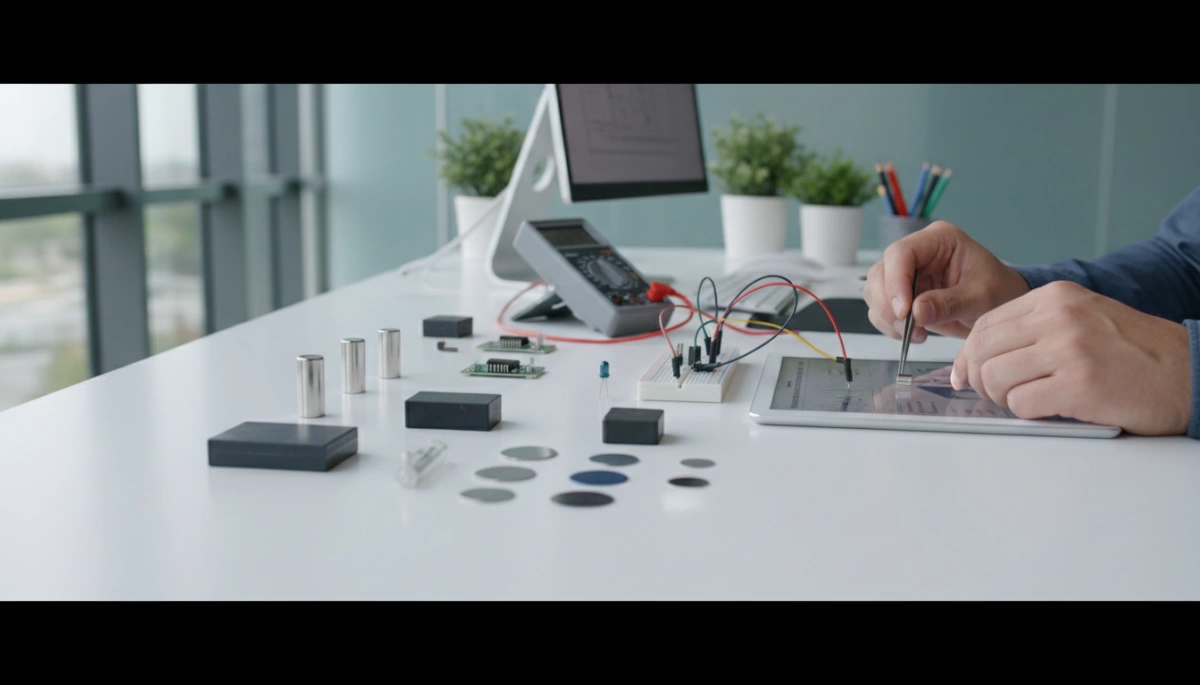
A magnetic switch sensor is useless without its partner: the actuator. You can have the most sophisticated Hall Effect transducer in the world, but if the magnetic field triggering it is weak or inconsistent, your system will fail. The “actuator” in this context is almost always a permanent magnet. Choosing the right material is less about picking the strongest magnet and more about matching the magnetic properties to your specific application environment.
Sintered Neodymium (NdFeB): Power in Small Packages
When space is tight, Sintered Neodymium is the go-to choice. These are the strongest commercially available magnets, meaning you can achieve a high magnetic field strength (Gauss) with a very small footprint. This is crucial for modern electronics where miniaturization is key. If you need a tiny magnet to trigger a switch from a decent distance, NdFeB provides the punch you need. However, they are susceptible to corrosion, so coating them properly is non-negotiable.
Samarium Cobalt (SmCo): Handling the Heat
If your application involves high temperatures—like under the hood of a car or inside industrial machinery—Neodymium might lose its magnetism. This is where a Samarium Cobalt high-temp magnet shines. SmCo magnets are incredibly stable across wide temperature ranges and offer excellent resistance to corrosion without needing heavy plating. They are brittle and more expensive, but for environments where reliability under thermal stress is critical, they are the standard.
Ferrite (Ceramic): The Cost-Effective Choice
Not every project needs the raw power of rare earth magnets. For high-volume consumer goods or simple proximity switch wiring setups where size isn’t a major constraint, Ferrite magnets are the workhorse. They are inexpensive, highly resistant to corrosion, and chemically stable. While their magnetic field strength is lower, they are often perfectly adequate for standard door sensors or basic position detection.
AlNiCo: Stability for Precision Instrumentation
AlNiCo (Aluminum-Nickel-Cobalt) magnets are interesting because they have the best temperature stability of any magnetic material. While their coercive force (resistance to demagnetization) is low, they are excellent for precision applications like sensitive instrumentation where the magnetic output must remain constant despite temperature fluctuations. We often see these used in older, highly specific industrial designs where consistency beats raw power.
Custom Shapes: Why Standard Discs Often Fail
Many engineers make the mistake of assuming a standard off-the-shelf disc magnet will work for every magnetic switch sensor design. Standard shapes often create non-uniform magnetic fields that lead to “dead zones” or double-switching issues.
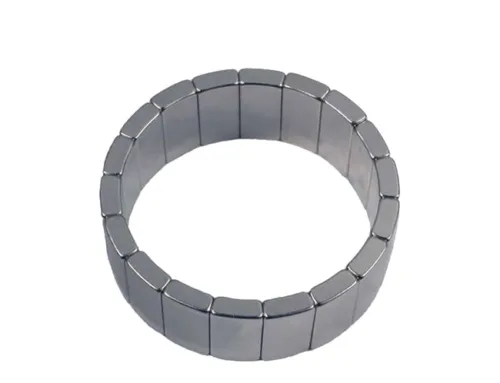
Custom shapes allow us to direct the magnetic flux exactly where the sensor needs it. For example, custom magnet machining allows us to create stepped, countersunk, or rectangular magnets that fit perfectly into a specific housing or slide along a pneumatic cylinder track. A custom shape ensures the switching logic remains reliable, preventing the jittery performance that comes from a misaligned magnetic field.
Wiring and Logic: Getting the Connections Right
Integrating a magnetic switch sensor into your system isn’t just about the magnet; it’s about how the signal is handled. Getting the logic and wiring correct ensures your automation or safety system behaves exactly as intended. At NBAEM, we help engineers match the right magnetic assembly to the specific electrical requirements of their sensors.
Switching Logic: NO vs. NC vs. Bistable
The behavior of the switch in relation to the magnetic field is the first critical decision.
- Normally Open (NO): The circuit is disconnected by default. When a magnet (like our custom NdFeB or Ferrite assemblies) comes within range, the contacts close, completing the circuit. This is standard for most proximity detection.
- Normally Closed (NC): The circuit is active by default. The presence of a magnetic field breaks the connection. These are often used in safety interlocks where a broken wire should trigger a stop.
- Bistable (Latching): These switches maintain their last state (on or off) even after the magnetic field is removed. A reverse polarity field is usually required to flip the state back. This is useful for memory functions or power-saving applications.
Output Types: NPN vs. PNP Integration
For solid-state sensors like Hall Effect transducers, you need to match the output to your controller (PLC) logic.
- NPN (Sinking): The sensor connects the load to the ground (negative) when active. This is common in Asian and US markets.
- PNP (Sourcing): The sensor connects the load to the power (positive) when active. This is the standard for most European industrial automation.
2-Wire vs. 3-Wire Setups Explained
The physical connection affects installation complexity and signal stability.
- 2-Wire: These are simpler to install as they wire in series with the load, much like a mechanical switch. However, they often have a small leakage current and a voltage drop that must be accounted for.
- 3-Wire: These separate the power supply from the output signal. They offer cleaner switching signals and are generally preferred for high-speed or logic-level inputs where stability is paramount.
Our engineering team can assist in designing custom magnetic assemblies that align perfectly with your sensor’s housing and wiring constraints, ensuring reliable actuation regardless of the logic type you choose.
Critical Specs: Sensitivity and Durability
When deploying a magnetic switch sensor, long-term reliability comes down to reading the specifications correctly. You need consistent non-contact position detection that won’t fail when the environment gets tough.
Operating Sensitivity: Pull-in and Drop-out Rates
Understanding your sensor’s sensitivity is the key to preventing false triggers. This process is governed by hysteresis in magnetic switching:
- Pull-in Point: The exact magnetic field strength (Gauss) required to activate the switch.
- Drop-out Point: The lower magnetic threshold where the switch deactivates as the magnet moves away.
- The Buffer Zone: The difference between these two points keeps the sensor from rapidly flickering on and off (chattering) when the magnet hovers right on the edge of the detection zone.
Sensing Distance: How Magnet Grade Impacts the Gap
Your maximum sensing distance relies entirely on the permanent magnet driving the switch. You cannot bridge a large air gap with a weak actuator.
- Sintered Neodymium Magnets: These deliver maximum magnetic force, allowing for wider sensing gaps and much more forgiving installation tolerances.
- High-Heat Stability: If your application involves high temperatures, standard magnets will temporarily lose strength, which shrinks your sensing gap. In these cases, reviewing a Samarium Cobalt magnet data sheet helps you specify a magnet that maintains a steady field and a consistent sensing distance under thermal stress.
Environmental Resistance: IP Ratings and Shock Tolerance
Industrial automation sensors take a beating. To keep your systems running, match the sensor housing to the hazard.
- IP Ratings: If your setup involves water, coolant, or heavy dust, always use a hermetically sealed switch rated IP67 or IP68. This ensures the internal contacts remain entirely isolated from the elements.
- Shock and Vibration: Heavy physical impacts can cause mechanical contacts to bounce and trigger falsely. For high-vibration equipment, like a fast-moving pneumatic cylinder sensor, solid state magnetic sensors offer superior durability because they have zero moving parts to break or rattle.
Real-World Applications: Where Magnetic Switch Sensors Shine
We see our magnetic switch sensor technology hard at work across almost every major industry. Because they offer reliable, non-contact position detection, these sensors are the go-to solution when failure simply isn’t an option. Here is a breakdown of where these components make the biggest impact globally:
Automotive Systems: EV Safety & Fluid Monitoring
Modern vehicles demand bulletproof reliability. In the automotive sector, magnetic switches are built to monitor essential fluid levels and ensure that high-voltage safety interlocks in electric vehicles (EVs) trigger exactly when they need to.
Industrial Automation: Pneumatics & Interlocks
Efficiency and safety are everything on the factory floor. We supply rugged industrial automation sensors designed to keep high-speed production lines moving safely.
- Pneumatic Cylinder Sensor Integration: Used to detect internal piston positions instantly without mechanical wear and tear.
- Machine Safety Interlocks: Ensures protective equipment guards are securely closed before heavy machinery can activate.
Medical Devices: Sterilizable Solutions
Healthcare requires components that can withstand harsh chemical sterilization processes while maintaining pinpoint accuracy. The specialized magnets used in medical devices pair perfectly with hermetically sealed magnetic switches. This combination provides contamination-free, highly accurate position monitoring in ventilators, diagnostic lab equipment, and automated hospital beds.
Smart Home Security: Door & Window Contacts
Every dependable home security system relies heavily on the simplicity and durability of a magnetic switch sensor. Mounted flush on doors and windows, these contacts instantly trigger alarms the moment a magnetic field is broken, offering homeowners 24/7 protection with virtually zero maintenance.
Why Custom Magnetic Assemblies Beat Standard Parts
Off-the-shelf components often fall short when precision and reliability are non-negotiable. For a Magnetic Switch sensor to function correctly in demanding environments, a custom approach is usually superior. At NBAEM, we leverage 14 years of experience to move beyond simple raw material supply, offering engineered solutions that integrate seamlessly into your production line.
The Integration Challenge: Bonding and Housing
Sourcing raw magnets and attempting to integrate them into sensor housings on your own assembly line introduces risk and extra cost. We solve this by manufacturing complete magnetic assemblies. We combine the permanent magnet with metals, plastics, rubber, or stainless steel housings directly at our facility. Whether your application requires a cost-effective ceramic magnet or a high-strength Neodymium piece, we handle the bonding and encapsulation. This streamlines your supply chain and eliminates the failure points often associated with in-house assembly.
Engineering the Field: Simulation and Testing
A Magnetic Switch sensor relies on a specific magnetic flux density to trigger accurately. Our R&D team, consisting of over 10 experts, assists in optimizing these magnetic components. We don’t just cut magnets to size; we engineer the magnetic circuit to ensure the field shape and strength align perfectly with your sensor’s sensitivity requirements. This engineering support is critical for preventing issues like double-switching or dead zones.
Quality Control: PPAP and Tolerance Adherence
For industries like automotive and medical, consistency is critical. We adhere to strict quality management systems, including ISO 9001, ISO 14001, and ISO/TS16949.
- PPAP Level 3: We provide full Production Part Approval Process documentation to ensure process stability.
- Tight Tolerances: Our manufacturing processes ensure that every assembly fits your mechanical specifications exactly.
- Global Standards: We maintain safety stock and export globally to the USA, Europe, and Asia, ensuring your custom magnetic assemblies are delivered on time, every time.
FAQ: Common Questions About Magnetic Switch Sensors
What causes a magnetic switch to stick or fail?
Failure in a magnetic switch sensor often comes down to environmental stress or electrical overload. For mechanical types like reed switches, high inrush currents can cause the contacts to weld together (“stick”). Physical shock can crack the hermetic seal, allowing oxidation. From a magnetic perspective, if the permanent magnet degrades due to high heat or demagnetization, it won’t generate enough flux to activate the sensor. We mitigate this by engineering robust magnetic assemblies that protect the core material from harsh environments.
Can I use any magnet with a standard reed switch?
No, you cannot simply grab any off-the-shelf magnet. The magnetic field strength must match the sensitivity of the switch (usually measured in Ampere-turns).
- Too Strong: Can cause “double switching” or latching when you want momentary action.
- Too Weak: The sensor won’t activate reliably across the required air gap.
- Wrong Material: Temperature fluctuations might weaken the field if the wrong grade is chosen. For applications requiring high stability, we often recommend specific magnet AlNiCo or custom-engineered Neodymium grades.
How do I test a magnetic sensor for accuracy?
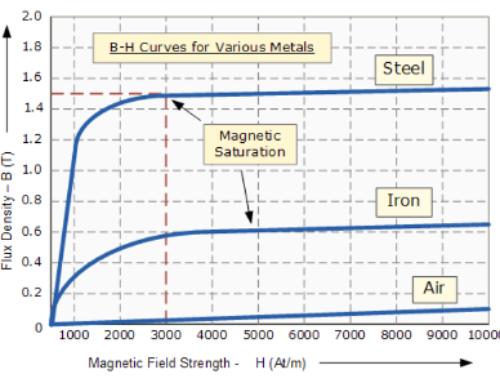
Testing requires mapping the “pull-in” (activation) and “drop-out” (deactivation) points relative to the magnet’s position. You are essentially measuring the hysteresis—the difference between where the switch turns on and where it turns off. To ensure consistent performance, you must understand the magnetic properties of your actuator. Reviewing the BH curve helps engineers predict how the magnet’s field strength will behave under specific operating conditions, ensuring the sensor triggers exactly when intended.
What is the difference between latching and momentary switches?
The difference lies in how the sensor behaves when the magnetic field is removed:
- Momentary: The switch is active only while the magnet is present. Remove the magnet, and it reverts to its default state (Normally Open or Normally Closed).
- Latching: The switch changes state when the magnet passes and stays in that state even after the magnet leaves. It typically requires a magnetic field of opposite polarity to reset.
We design custom magnetic assemblies to support both logic types, ensuring the polarity and field orientation align perfectly with your control system requirements.

 Malay
Malay  English
  German
  Vietnamese
  Spanish (Mexico)
  Russian
  Turkish
  Polish
  Hindi
Hindi  Thai
Thai  Korean
  Japanese
  French
  Czech
Czech  Danish
  Dutch
Dutch  Finnish
  Italian
  Portuguese (Brazil)
  Portuguese (Portugal)
  Slovenian
  Ukrainian
  Hebrew
  Scottish Gaelic
  Hungarian
  Tagalog
  Spanish (Spain)
  Serbian
  Indonesian
  Slovak
  Dutch (Belgium)
  Persian
  Arabic
  Romanian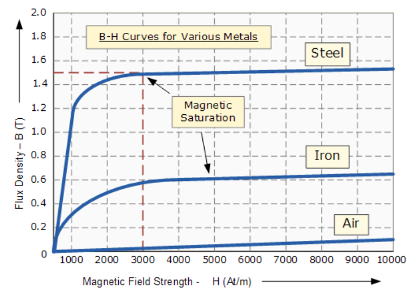

Tinggalkan Sebuah Komen