
Are you struggling with the high assembly costs and physical weak points of traditional multi-piece segmented magnet designs? We see this issue frequently when engineers are trying to optimize a permanent magnet rotor assembly. The most effective solution is usually transitioning to a seamless multipole magnetic ring.
What is a Multipole Magnetic Ring?
At its core, a multipole magnetic ring is a seamless, single-piece magnet that has been magnetized with multiple al
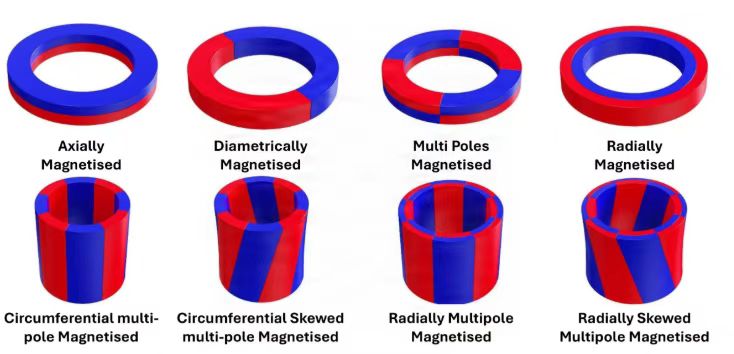
Multipole Magnetic Ring Magnetization orientation
ternating poles (North and South) across its geometry. Instead of manually gluing individual arc magnets together to form a circle, the single ring acts as a complete, multi-pole unit right out of the mold or press.
Mágnesesítési irányok
Magnetic orientation
Depending on your application, we configure the magnetic field in one of three primary ways:
- Radial Orientation: The magnetic field lines radiate inward or outward from the center axis. Radially oriented ring magnets are the industry standard for achieving smooth, uniform magnetic flux in motor applications.
- Axial Orientation: The alternating poles are located on the flat, circular faces of the magnet. An axial multipole hollow ring magnet is precisely what you need for face-coupling devices, magnetic clutches, and certain sensor arrays.
- Planar Magnetization: The poles are arranged across the flat surface to maximize surface magnetic field strength. A planar multipole magnetic ring is highly effective for specialized positioning and tracking sensors.
The Engineering Advantage
Switching from segmented magnets to a single multipole magnetic ring provides clear mechanical and financial benefits:
- Eliminates Weak Spots: Gluing individual arc magnets creates microscopic gaps and structural vulnerabilities. A single-piece ring removes these failure points entirely.
- Reduces Assembly Costs: Handling and aligning one solid ring takes a fraction of the time compared to precisely spacing and bonding dozens of small, opposing magnets.
- Precision and Balance: A seamless ring inherently offers better mechanical balance and tighter magnetic tolerances, leading to smoother, quieter operation in rotating equipment.
Evaluating Manufacturing Processes for Multipole Magnetic Rings
How we manufacture a multipole magnetic ring directly impacts its field strength, physical durability, and your bottom line. We rely on three primary methods to produce custom multi-pole magnets, each tailored to specific operational demands.
Sintered Neodymium Radial Rings
When your application demands maximum power, sintered magnets deliver.
- High Performance: Unmatched magnetic strength for heavy-duty applications.
- Tartósság: Built to withstand harsh, continuous operations.
- Ideal Use Case: Extreme-torque environments where long-term reliability is non-negotiable.
Bonded NdFeB Multipole Rings
If you need precision without the hassle of extra machining steps, bonded rings are the clear solution. Available in both isotropic and anisotropic grades, a bonded NdFeB multipole ring gives us incredible design flexibility.
- Complex Shapes: Easily formed into intricate and custom designs.
- Tight Tolerances: Achieves exact dimensions straight from the mold, eliminating secondary machining.
- Flexible Patterns: Simple to configure highly specific magnetic pole layouts to match your stator.
- Resource: Review our detailed bonded magnet data sheet to match our material grades to your engineering specs.
Injection-Molded Ferrite Magnets
For large-scale production runs focused on efficiency, we utilize injection molding.
- Cost Savings: Significantly lowers manufacturing costs at high volumes.
- Direct Assembly: We can perform direct over-molding right onto motor cores or shafts, saving you an entire assembly step on your production line.
- Sokoldalúság: Injection-molded ferrite magnets provide a highly reliable, budget-friendly solution for standard consumer and industrial applications.
Material Selection Guide for Multipole Applications
Choosing the exact material for your multipole magnetic ring determines the success of your entire assembly. We evaluate three primary materials based on your specific power demands, operating temperatures, and budget constraints.
Neodímium (NdFeB): The High-Power Standard
When you need maximum magnetic strength packed into a tight space, we turn to the neodímium mágnes. It is the undisputed standard for compact, high-power density applications like servo motors and electric vehicle (EV) components.
- Sintered neodymium radial ring: Delivers extreme raw power and high magnetic flux for demanding drives.
- Bonded NdFeB multipole ring: Offers flexible pole patterns and tight tolerances for complex, lightweight designs.
Ferrite / Ceramic: The Cost-Effective Choice
If budget is the driving factor and you have the space to spare, ferrite gets the job done reliably. It is our top recommendation for high-volume consumer electronics, smart appliances, and standard sensors.
- Injection-molded ferrite magnets: Excellent for direct over-molding onto shafts to cut assembly time.
- Strontium ferrite multipole ring: Provides a solid balance of cost savings and dependable magnetic stability for everyday electronics.
Samarium Cobalt (SmCo): Extreme Environment Ready
Standard materials fail under extreme heat. For aerospace components and specialized robotics, SmCo is the mandatory choice for high-performance motor magnets.
- Key Advantage: Exceptional high-temperature stability and natural corrosion resistance, meaning these rings perform flawlessly in harsh environments without needing protective coatings.
Quick Material Breakdown
| Anyag | Primary Focus | Best Advantage | Általános alkalmazások |
|---|---|---|---|
| NdFeB | Compact Power | Legmagasabb mágneses erő | EV parts, precise servo motors |
| Ferrit | Költséghatékonyság | Highly budget-friendly | Home appliances, basic sensors |
| SmCo | Extreme Durability | Heat and corrosion resistance | Aerospace, specialized robotics |
Key Industrial Applications of Multipole Magnetic Rings
We engineer the multipole magnetic ring to solve complex performance challenges across major global industries. By utilizing a seamless, single-piece design, manufacturers see immediate improvements in component precision, durability, and overall efficiency.
Here are the primary applications where these magnetic components make the biggest impact:
- Brushless DC (BLDC) Motors: Smooth, consistent rotation is critical for motor lifespan and efficiency. By integrating seamless BLDC motor magnetic rings, we achieve significant motor cogging torque reduction. Eliminating the physical gaps found in older segmented assemblies results in a much more uniform magnetic field, yielding quieter operation and superior rotational smoothness.
- Magnetic Encoders & Linear Position Sensors: High-precision tracking requires high-density magnetization. We manufacture specific configurations, such as the magnetic encoder ring 72 poles, to guarantee micrometer-level resolution. This exact pole spacing provides the rapid, accurate feedback loops necessary for industrial servos and the specialized magnets used in robotics.
- Automotive & EV Components: Modern electric and standard vehicles demand fail-safe sensor technology. We supply robust multipole magnetic rings for critical safety and operation systems, including ABS sensors, highly precise steering angle sensors, and durable wiper motors. Whether functioning as an isolated sensor or integrated directly into a permanent magnet rotor assembly, these rings deliver the consistent signal strength required to survive harsh, high-vibration automotive environments.
Engineering Considerations for Custom Multipole Magnetic Rings
When we design custom multi-pole magnets for your permanent magnet rotor assembly, hitting exact specifications is non-negotiable. Every mechanical and magnetic detail directly impacts how the component interacts with your broader system.
Dimensional Tolerances
Mechanical fit dictates performance. We focus on extremely tight tolerances to guarantee a seamless integration into your hardware:
- Inner Diameter (ID): Ensures a secure, slip-free fit directly onto the motor shaft.
- Outer Diameter (OD): Maintains the precise, critical air gap between the magnet and the stator.
- Vastagság: Guarantees uniform structural integrity and consistent flux distribution.
Magnetic Pole Pitch & Skew Angles
A magnetic pole pitch tolerance controls your motor’s operational behavior. We engineer specific magnetic waveforms tailored to match your motor stators. Smooth sine waves are perfect for quiet, low-vibration tasks, whereas square waves are built to deliver maximum torque. Applying precise magnetization and demagnetization techniques ensures these pole patterns remain stable under extreme loads. Additionally, we integrate specific skew angles into the design to effectively smooth out rotational forces and reduce cogging.
Protective Surface Coatings
A raw multipole magnetic ring needs armor. We apply industrial-grade surface coatings to shield the magnet from moisture, chemical exposure, and physical wear, extending the lifespan of your application.
Standard Coating Options for Environmental Protection:
| Bevonat típusa | Primary Application | Key Engineering Benefit |
|---|---|---|
| Epoxi | High-humidity and industrial motors | Outstanding corrosion and chemical resistance. |
| Parylen | Micro-electronics and precision sensors | Ultra-thin, pinhole-free coverage without altering dimensions. |
| Ni-Cu-Ni | High-wear and friction environments | Superior physical durability, scratch resistance, and a clean finish. |
Sourcing Custom Multipole Magnets: Why Choose NBAEM?
When your project requires a high-performance multipole magnetic ring, you need a manufacturing partner who understands precision. At NBAEM, we engineer custom multi-pole magnets tailored to the exact demands of global markets. We streamline the entire production flow, taking your concept from the initial design phase all the way through to the final mágnes szerelvény without the hassle.
We cut out complex supply chain bottlenecks so you get exactly what you need, right on schedule. Here is exactly what we bring to the table:
| NBAEM Advantage | What We Deliver to You |
|---|---|
| Expert R&D Support | 14 years of industry experience and a dedicated team of 10+ engineers ready to optimize your magnetic designs for maximum efficiency. |
| Szigorú minőségellenőrzés | Full compliance with ISO 9001, ISO 14001, és ISO/TS16949. We operate as a verified PPAP Level 3 magnet supplier to guarantee consistent, automotive-grade quality. |
| Manufacturing Agility | A true one-stop shop for any permanent magnet rotor assembly. We provide reliable 4-5 week lead times for custom OEM products to keep your production moving. |
Frequently Asked Questions (FAQs) About Multipole Magnetic Rings
What is the difference between radial and axial magnetization in multipole rings?
Radial magnetization flows across the diameter, meaning the magnetic field points outward from the center or inward. This makes radially oriented ring magnets ideal for standard motor rotors requiring uniform magnetic flux to face the stator. Axial magnetization runs along the length of the ring, placing the poles on the flat end faces. We typically see this in an axial multipole hollow ring magnet designed for face-coupling devices and position sensors.
How do multipole magnetic rings reduce motor cogging in BLDC motors?
A seamless multipole magnetic ring offers a perfectly smooth transition between magnetic poles. By eliminating the physical gaps and weak spots found when gluing segmented magnets together, BLDC motor magnetic rings provide massive motor cogging torque reduction. The result is a highly stable, quiet, and smooth rotational performance.
Can bonded NdFeB rings achieve the same strength as sintered rings?
No, they are built for different applications. A bonded NdFeB multipole ring mixes magnetic powder with a polymer binder, which naturally lowers its peak magnetic strength compared to a fully dense sintered neodymium radial ring. However, bonded rings are the go-to choice when you need complex pole configurations or tight tolerances without secondary machining. If you are curious about the core materials that impact this strength, you can review exactly miből készülnek a mágnesek to find the right balance for your design.
What is the typical lead time for custom multipole magnets?
Our standard lead time for producing custom multi-pole magnets is typically 4 to 5 weeks. As an experienced PPAP Level 3 magnet supplier, we use this time to guarantee strict quality control from the initial tooling phase all the way through mass production. You can explore our full production capabilities and dedicated engineering services to see how we handle custom OEM requirements.

 Hungarian
  English
  German
  Vietnamese
  Spanish (Mexico)
  Russian
  Turkish
  Polish
  Hindi
Hindi  Thai
Thai  Malay
Malay  Korean
  Japanese
  French
  Czech
Czech  Danish
  Dutch
Dutch  Finnish
  Italian
  Portuguese (Brazil)
  Portuguese (Portugal)
  Slovenian
  Ukrainian
  Hebrew
  Scottish Gaelic
  Tagalog
  Spanish (Spain)
  Serbian
  Indonesian
  Slovak
  Dutch (Belgium)
  Persian
  Arabic
  Romanian
  Estonian

Hagyj egy hozzászólást