
Looking for a custom Halbach array permanent magnet that delivers stronger field focus, less stray flux, and better performance for your application? You’re in the right place.
As someone who understands how critical magnetic precision is in real-world engineering, I know the difference a well-designed Halbach 배열 can make in motors, sensors, magnetic couplings, maglev systems, and other high-performance assemblies.
In this guide, you’ll see what matters most when choosing a custom Halbach array permanent magnet solution, including geometry, material selection, thermal limits, and manufacturing feasibility.
Let’s get into it.
How Does a Custom Halbach Array Permanent Magnet Work?
We design custom Halbach array permanent magnet assemblies to manipulate magnetic fields with extreme precision. By rotating the magnetization direction of adjacent magnet segments in a repeating pattern—typically shifting 90 degrees from block to block—we redirect the magnetic flux to concentrate along a single preferred side.
Magnetization Direction and Field Concentration Explained
-
- Spatial Vector Rotation: Standard magnet assemblies align poles in parallel. A custom Halbach array design systematically rotates the orientation of magnetization across neighboring segments.
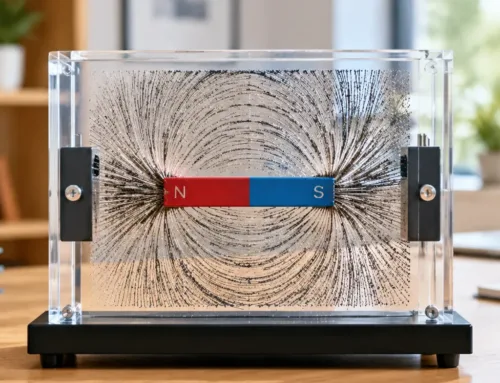
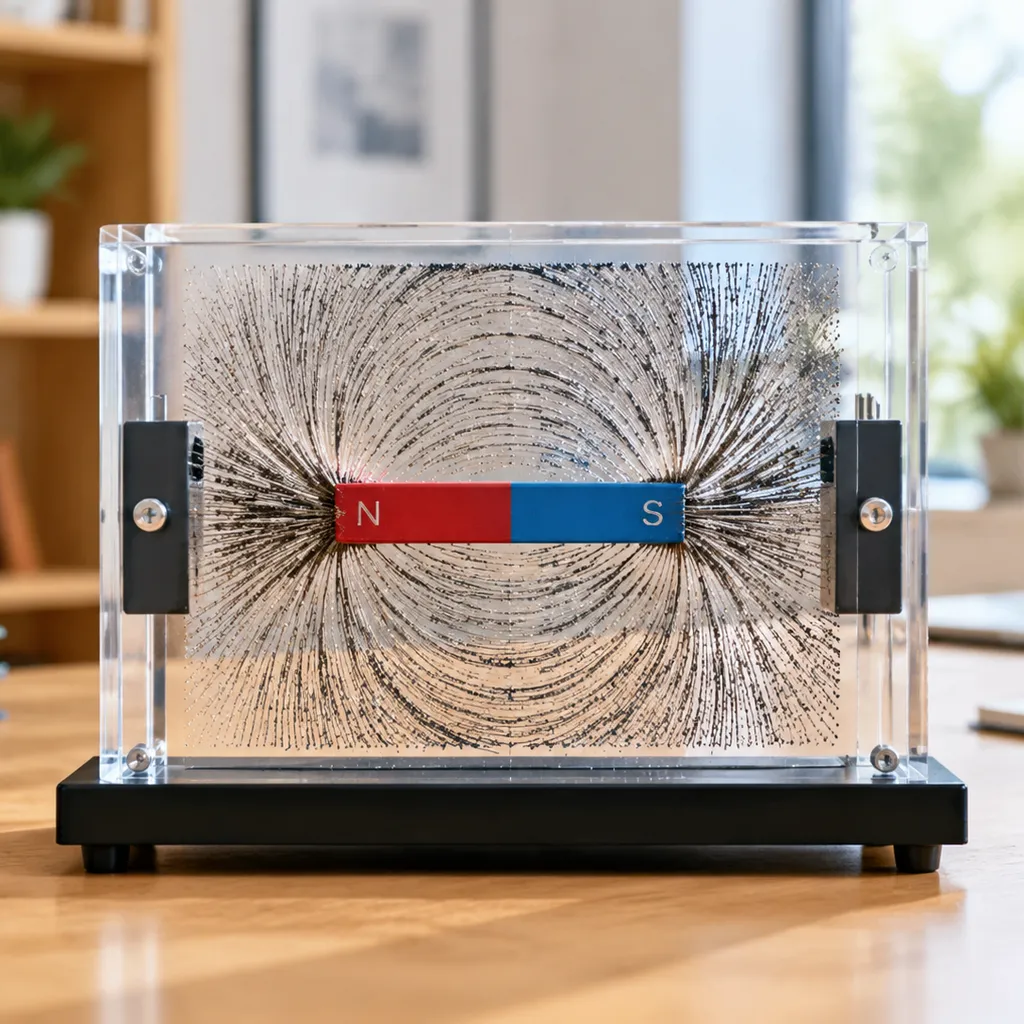
- Flux Density Amplification: This spatial rotation forces magnetic field lines to loop tightly together on the active working face, creating a localized high-intensity field.
One-Sided Flux Enhancement vs Opposite Side Cancellation
-
- Active Face Reinforcement: On the primary working surface, magnetic field vectors combine constructively, increasing flux density by up to 40% over conventional magnet layouts of equal volume.
- Back-Side Cancellation: On the reverse face, destructive interference produces near-total magnetic field cancellation, preventing stray field interference without adding heavy shielding materials.
Linear vs Cylindrical Halbach Array Configurations
We manufacture two foundational geometries tailored to your mechanical footprint:
| 구성 | Field Behavior | Primary Application |
|---|---|---|
| Linear Halbach Array Assembly | Planar arrangement generating a focused magnetic field along a flat surface. | Maglev systems, linear drive tracks, and scientific instrumentation. |
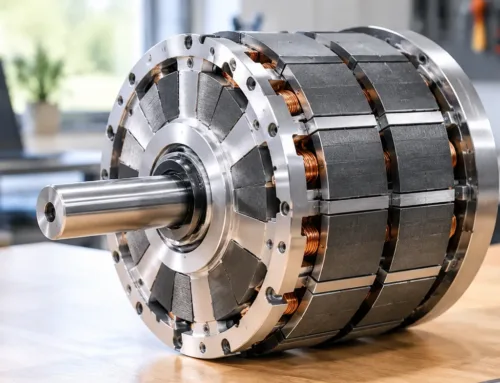
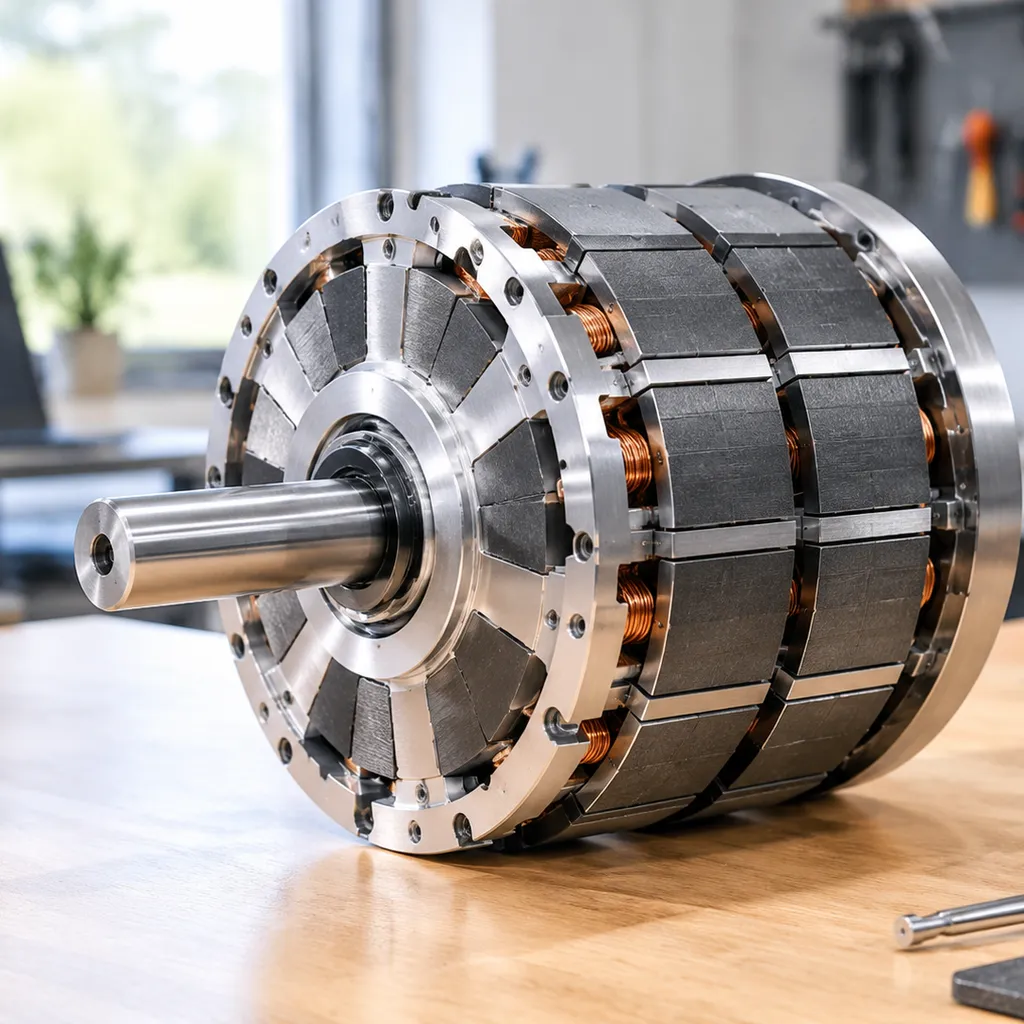
| Halbach Cylinder Magnet | Annular assembly focusing an intense field entirely inside (or outside) the rotor bore. | High-efficiency electric motors, magnetic couplings, and particle optics. |
Key Benefits of a Custom Halbach Array Permanent Magnet
When we design a custom halbach array permanent magnet, we unlock magnetic efficiency that standard off-the-shelf magnets simply cannot match. By directing nearly all magnetic flux to one side, customized magnetic assembly engineering eliminates dead weight and maximizes power output in compact footprints.
Key Advantages at a Glance
-
- Maximizing Magnetic Flux Density in Tight Spaces: By utilizing high flux density neodymium magnets in a one-sided flux halbach array, we can boost field strength by up to 40% compared to conventional magnet configurations without increasing physical dimensions.
- Eliminating Heavy External Magnetic Shielding: Natural magnetic field cancellation on the non-working side provides inherent magnetic shielding reduction. You no longer need heavy steel back-plates to contain stray flux.
- Tailoring Magnetic Field Gradients: We fine-tune field gradients to meet exact system specs, whether you are engineering custom linear actuators, sensors, or optimizing magnetic coupling in transformer systems for high-efficiency energy transfer.
- Drastic Weight Reduction for Aerospace & Portable Devices: Stripping away heavy iron enclosures cuts total system weight significantly, making these assemblies ideal for drones, satellite positioning, and portable medical electronics.
Standard Magnets vs. Custom Halbach Arrays
| Performance Metric | Standard Permanent Magnet Assembly | Custom Halbach Array Permanent Magnet |
|---|---|---|
| Flux Concentration | Symmetrical (split between both sides) | Focused almost entirely on one working side |
| Shielding Needs | Heavy iron or steel backing required | Minimal or zero extra shielding needed |
| Power-to-Weight Ratio | 중간 | Exceptionally High |
| Field Customization | Fixed, basic field shapes | Fully tailored field strength and gradients |
Choosing Materials for Custom Halbach Magnet Assemblies
Selecting the right alloy is the most important step when building a custom halbach array permanent magnet. Operating temperature, environmental exposure, and flux density targets determine which material delivers the best performance. Before finalizing your design, evaluating the best magnet materials for Halbach arrays helps avoid thermal demagnetization and structural failure.
| 소재 유형 | Max Energy Product ($BH_{max}$) | 작동 온도 범위 | Primary Advantage |
|---|---|---|---|
| 네오디뮴 (NdFeB) | 35 – 52 MGOe | 220°C까지 | Maximum flux density in minimal footprint |
| 사마륨 코발트 (SmCo) | 18 – 32 MGOe | Up to 350°C | Extreme thermal stability & corrosion resistance |
Neodymium (NdFeB) for Maximum Flux Performance
When space is tight and maximum magnetic strength is mandatory, high flux density neodymium magnets are our primary choice. NdFeB provides the highest magnetic field concentration per unit volume, making it ideal for high-torque motors, compact actuators, and portable precision devices operating below 150°C.
Samarium Cobalt (SmCo) for High-Temperature Stability
For harsh thermal conditions or severe corrosive environments, we utilize Samarium Cobalt. Exploring SmCo 자석이 어떤 용도로 사용되는지 highlights their essential role in aerospace sensors, military drives, and downhole tools. A SmCo Halbach array retains its magnetic field strength at elevated temperatures without risk of demagnetization.
Protective Coatings and Custom Enclosure Options
Standard rare-earth alloys chip easily and corrode when exposed to humidity or chemical vapors. We customize structural enclosures and apply specialized surface treatments to keep assemblies durable:
-
- Surface Coatings: Ni-Cu-Ni, resin epoxy, Parylene, and passivation treatments to stop oxidation.
- Structural Sleeves: Stainless steel (316L), titanium, or aluminum shells built to contain intense mechanical repulsive forces.
- Hermetic Sealing: Fully potted or laser-welded housings engineered for subsea, liquid-submerged, or high-vacuum applications.
Engineering & Design Considerations for Custom Halbach Arrays
Building a high-performance custom halbach array permanent magnet requires precise physical planning, structural engineering, and accurate flux modeling. We evaluate three core factors during the engineering phase to ensure maximum field output and long-term mechanical reliability.
Calculating Segment Angles and Field Strength
Field distribution depends directly on magnet segment orientation (typically 45° or 90° rotation steps). Finer rotation angles produce a smoother field profile and stronger concentration, but they increase manufacturing complexity. We calculate the exact strength of the Halbach array magnet field using advanced finite element analysis (FEA) to align geometry, material grade, and circuit orientation with target field requirements.
Managing High Repulsive Forces During Assembly
Halbach designs force permanent magnets into unnatural orientations where like poles push against each other. These strong repulsive forces make manual placement dangerous and prone to misalignments.
-
- Custom Fixturing: We design non-magnetic hydraulic fixtures and alignment guide channels to safely press magnets into position.
- Structural Bonding: High-shear structural epoxies paired with titanium or non-magnetic stainless steel housings lock segments firmly in place.
- Precision Pressing: Controlled mechanical loading prevents brittle magnet materials from chipping or cracking under pressure.
Manufacturing Tolerances and Air Gap Optimization
Air gaps between individual magnet blocks or between the array surface and your operating target diminish field intensity rapidly. Tight dimensional control is crucial for high flux concentration.
| Design Variable | Tolerances & Specifications | Functional Impact |
|---|---|---|
| Dimensional Tolerances | ±0.02 mm to ±0.05 mm | Minimizes unwanted micro-gaps between adjacent magnetic blocks. |
| Air Gap Minimization | Designed < 0.2 mm where possible | Maximizes usable magnetic flux density on the working surface. |
| Angular Accuracy | Magnetization vector within ±1° | Eliminates field distortion and asymmetrical magnetic profiles. |
Common Applications for Custom Halbach Arrays
We engineer each custom halbach array permanent magnet assembly to solve tough field-concentration challenges across high-tech industries. By directing flux entirely to one side while eliminating magnetic leakage on the other, these specialized configurations unlock key performance gains that conventional magnet setups cannot match.
High-Efficiency Electric Motors and Brushless Actuators
In modern halbach array motor design, concentrating magnetic strength directly toward the stator coils dramatically boosts overall torque density. We utilize high flux density neodymium magnets to eliminate heavy iron back-plates, reducing dynamic rotor weight and improving power efficiency. Similar contactless magnetic transfer techniques are also used in heavy-duty mining magnetic coupling systems to handle extreme operational loads without mechanical contact or wear.
Magnetic Levitation and Linear Drive Systems
Linear propulsion systems require maximum thrust with minimal dead weight:
Linear Halbach Array Assembly: Generates powerful passive levitation and guidance forces for Maglev transit.
High-Speed Linear Drives: Delivers smooth, continuous thrust for automated factory conveyances and precision actuators.
Energy Savings: Eliminates extra structural mass, directly lowering overall system power requirements.
Particle Accelerators and Specialized Laboratory Equipment
Advanced beam-focusing systems rely on highly uniform field geometries. We construct custom halbach cylinder magnet structures to focus, guide, and manipulate charged particle beams. The inherent field containment allows research facilities to maintain strong, highly targeted fields within a compact footprint without adding heavy magnetic shielding.
Medical Imaging and Precision Sensing Devices
-
- Portable MRI Systems: Leveraging one-sided flux halbach array configurations allows manufacturers to build lightweight, point-of-care MRI scanners.
- Precision Field Sensing: Delivers exceptionally uniform magnetic zones critical for high-resolution position sensors and navigation tools.
- Integrated Interference Control: Prevents stray magnetic fields from disrupting adjacent electronic components.
Frequently Asked Questions About Custom Halbach Arrays
3D and Circular Magnetic Field Customization
Yes, we routinely engineer custom halbach array permanent magnet setups with complex 3D or circular geometry. While a linear halbach array assembly directs magnetic flux onto a single flat plane, a halbach cylinder magnet routes the augmented field either entirely inside the bore (for motor stators and beam focusing) or entirely on the outside perimeter. Custom segment angles allow us to shape magnetic field gradients into multipole, spherical, or localized 3D flux paths tailored to exact air gap requirements.
Custom Halbach Arrays vs. Standard Magnet Assemblies
| 특징 | Custom Halbach Array | Standard Magnet Assembly |
|---|---|---|
| Flux Distribution | Single-sided enhancement via magnetic field cancellation | Equal field strength spread on both sides |
| Shielding Needs | Minimal to zero external back-iron required | Heavy steel backing plates needed |
| Weight & Size | Lightweight, compact design for high-payload setups | Bulkier and heavier due to external shielding |
| 자기장 강도 | 최종 사용자 및 최종 용도 증명서 2x higher flux density on the working side | Limited by standard pole alignment |
Lead Times and Primary Cost Drivers
Production timelines for custom magnet assemblies generally range from 3 to 6 weeks for prototypes, depending on material availability and fixture manufacturing.
-
- Assembly Tooling & Forces: Managing strong repulsive forces between adjacent magnet segments requires rigid bonding jigs. Understanding why Halbach arrays are hard to assemble highlights why specialized containment fixtures drive initial setup costs.
- Material Grade: Choosing high flux density neodymium magnets keeps costs lower for room-temperature uses, whereas opting for an SmCo halbach array increases cost for high-temperature stability.
- Dimensional Tolerances: Machining sub-millimeter segment angles and tight air gaps increases precision grinding cycles.
- Protective Coatings: Custom plating (Ni-Cu-Ni, Epoxy, or Parylene) for corrosion resistance adds manufacturing processing steps.


 Korean
  English
  German
  Vietnamese
  Spanish (Mexico)
  Russian
  Turkish
  Polish
  Hindi
Hindi  Thai
Thai  Malay
Malay  Japanese
  French
  Czech
Czech  Danish
  Dutch
Dutch  Finnish
  Italian
  Portuguese (Brazil)
  Portuguese (Portugal)
  Slovenian
  Ukrainian
  Hebrew
  Scottish Gaelic
  Hungarian
  Tagalog
  Spanish (Spain)
  Serbian
  Indonesian
  Slovak
  Dutch (Belgium)
  Persian
  Arabic
  Romanian
  Estonian
  Greek
Greek  Bulgarian

댓글 남기기