
Ever wonder why the magnets inside high-performance motors aren’t just standard, flat blocks? If you are building or designing motors, you know that squeezing out every drop of efficiency is the ultimate goal. The secret to hitting those performance targets comes down to physics, geometry, and getting the fit exactly right.
Why Are Curved Magnets Used in Motors?
To understand why we use curved magnets, you have to look at the space where the actual work happens.
The Magnetic Air Gap Explained
In every electric motor, there is a tiny, physical space between the rotating part (the permanent magnet rotor) and the stationary part (the stator). This is known as the magnetic air gap.
While this gap is absolutely necessary so the parts can spin without grinding against each other, it is a massive hurdle for magnetic energy. Air does not conduct a magnetic field well. To maximize BLDC motor efficiency, we need this gap to be as tight and as uniform as possible.
The Geometry Problem
Here is the issue: rotors and stators are round. If we try to mount standard flat magnets onto a circular rotor, we create a severe geometry problem.
- Uneven Spacing: The distance between a flat magnet and the curved stator wall is completely inconsistent.
- Energy Loss: The corners of a flat magnet might sit close to the stator, but the flat center sits too far away.
- Weakened Field: Because magnetic strength drops off incredibly fast across a distance, that uneven gap causes a massive loss of power.
Arc Segment Magnets: The Solution
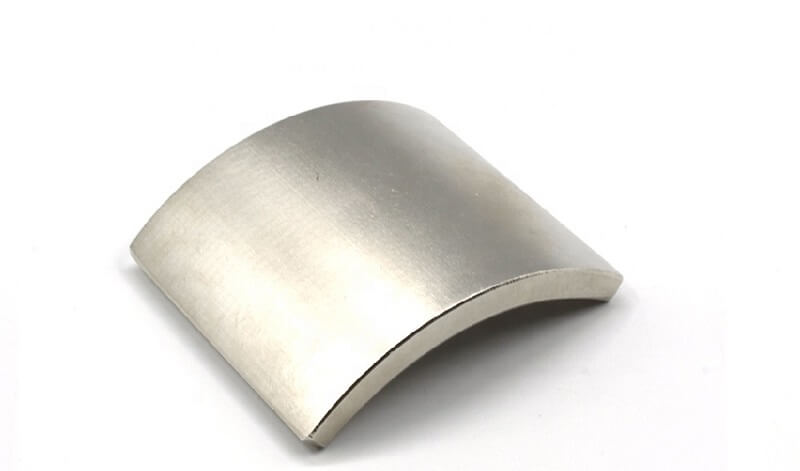
แม่เหล็กเซกเมนต์
This is exactly why we use arc segment magnets. By manufacturing curved magnets that perfectly match the exact radius of the rotor, we completely eliminate the uneven spacing issue.
When the curve of the magnet hugs the curve of the motor wall, the magic happens.
The Ultimate Benefit
Using a curved shape instantly transforms the performance of the motor by optimizing the air gap.
| คุณสมบัติ | Flat Magnets | Curved Magnets |
|---|---|---|
| Air Gap Shape | Uneven and inconsistent | Perfectly uniform |
| Energy Transfer | High loss in the center | Maximum efficiency |
| Radial Flux Density | Weak | สูงมาก |
By ensuring a perfectly consistent distance between the rotor and the stator, the magnetic field hits the stator with full, uniform strength.
- Consistent Power: The uniform gap maximizes the radial flux density.
- Less Waste: More magnetic energy translates directly into mechanical power rather than being lost in the air gap.
- Higher Efficiency: Your motor runs better, pulls stronger, and wastes significantly less energy.
Torque Density and Magnetic Flux Optimization with Curved Magnets
Flux Concentration
When we build a permanent magnet rotor, we need the magnetic energy to hit the motor stator exactly right. Flat magnets tend to scatter this energy at the edges. By using curved magnets, we focus the magnetic field directly and evenly across the magnetic air gap. This precise geometry creates a highly concentrated and uniform radial flux density. Because this concentrated field is subjected to intense operational stresses, understanding the exact dynamics of magnetization and demagnetization for permanent magnets is essential to ensure the motor doesn’t lose its punch over time.
Delivering Higher Torque
Better flux concentration directly translates into raw power.
- Instant Power: High-torque electric motors rely entirely on this tightly focused magnetic energy to generate immediate rotational force.
- Performance Demands: For demanding applications like EV motor components, you need maximum output from a tight space. Curved shapes guarantee the motor delivers that necessary torque without hesitation.
Maximum Space Utilization
Inside a motor casing, every single millimeter counts. You simply cannot afford dead space.
- The Perfect Fit: Arc segment magnets naturally hug the circular shape of the rotor.
- Zero Wasted Room: Flat magnet blocks leave awkward, useless air pockets inside a cylindrical housing. Curved designs pack the maximum amount of active magnetic material into the exact same footprint.
- Peak Efficiency: This incredibly tight, space-saving packaging is a major reason why modern designs achieve such high BLDC motor efficiency without increasing the physical size of the motor itself.
Why Are Curved Magnets Used in Motors? Reducing Noise and Vibration
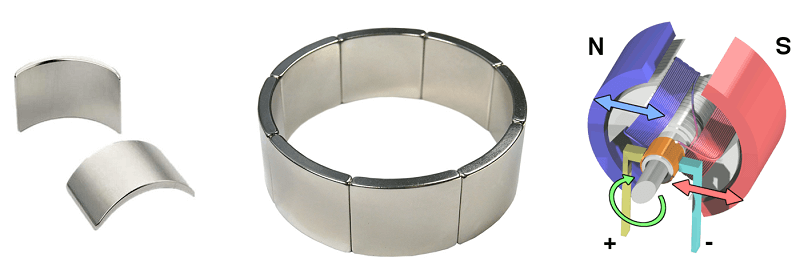
Understanding Cogging Torque
When operating an electric motor, smooth rotation is the ultimate goal. However, many motors experience a jerky, stuttering feeling, especially at low speeds. This phenomenon is known as cogging.
- The Cause: It occurs when the magnets on a permanent magnet rotor naturally try to snap and lock into alignment with the iron teeth of the stator.
- The Problem: This harsh motor stator interaction—particularly when the magnetic flux interacts abruptly with the lamination cores—creates severe vibration, mechanical stress, and loud operational noise.
The Smooth Transition of Arc Segment Magnets
This is exactly why curved magnets are used in motors. Flat magnets create sudden, abrupt magnetic pulls. Arc segment magnets solve this by changing the physical geometry of the magnetic field.
- Gradual Alignment: The curved shape ensures that the leading edge of the magnet does not align with the stator tooth all at once.
- Magnetic Field Uniformity: Instead of a sharp magnetic snap, the curve creates a gradual, smooth transition as the rotor turns. This specific geometry is the primary driver for effective cogging torque reduction.
The Result
By utilizing curved magnets, we immediately achieve a significantly quieter and far more stable motor design.
- Zero Jerkiness: Completely eliminates the rough rotational stepping effect.
- Less Wear and Tear: Reduces long-term mechanical fatigue on the motor shaft, bearings, and surrounding housing.
- Premium Performance: This exceptionally smooth, silent operation is mandatory for high-end, precision applications. It is particularly crucial when engineering advanced EV motor components, where eliminating cabin noise and drivetrain vibration is a strict requirement.
Managing Heat: Eddy Currents in Curved Magnets
The Heat Problem
High-speed electric motors generate massive amounts of heat. As the permanent magnet rotor spins rapidly, fluctuating magnetic fields induce small electrical currents inside the magnets themselves. This phenomenon is known as eddy current loss.
If the curved magnets used in motors get too hot, they begin to lose their magnetic strength. This thermal degradation is a major enemy of BLDC motor efficiency and can cause total failure in high-demand applications like EV motor components.
The “Bread Loaf” Technique
To stop overheating, we rely on advanced segmentation and smart physical geometry.
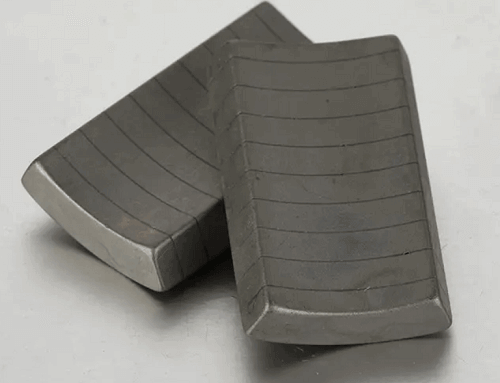
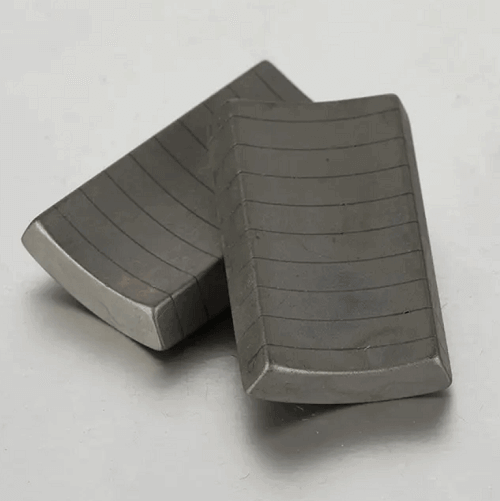
- Laminated Motor Magnets: Instead of using one solid block of material, we slice the curved magnet into thin layers. We then bond these layers back together using high-performance insulating glue. This insulation breaks the electrical conductivity path, instantly slashing eddy current losses.
- Bread Loaf Geometry: We often shape these arc segment magnets so they are thicker in the center and subtly thinner at the edges—resembling a loaf of bread. This specific curve optimizes the magnetic field distribution, keeping the motor running much cooler while maintaining torque.
NBAEM Expertise
Building laminated, heat-resistant curved magnets is a highly technical process. At NBAEM, our specialized magnet assembly services และ precision magnetic grinding ensure that every sliced segment fits together flawlessly without compromising the material’s structural integrity. We build magnets designed to survive harsh, high-temperature motor environments. If you are engineering a high-heat application and need to compare thermal tolerances, our คู่มือแม่เหล็กแรร์เอิร์ธของเรา outlines exactly which materials perform best under thermal stress.
Material Matters: What Are These Curved Magnets Made Of?
The shape is crucial, but the raw power comes from the material itself. You can have the most perfectly engineered arc, but if the material is weak, your motor performance will suffer. When we manufacture curved magnets for high-performance applications, we typically rely on three main material families, each serving a specific purpose.
Sintered Neodymium (NdFeB)
This is the heavyweight champion of the magnet world. Sintered Neodymium offers the highest magnetic strength available today. If you are building a compact, high-torque electric motor for an EV or a precision drone, this is usually the go-to material. Because they are so powerful, we can make the arc segments thinner while still maintaining a massive magnetic field. However, Neodymium is sensitive to corrosion, which is why we often apply specialized เคลือบแม่เหล็ก layers like Nickel or Epoxy to protect the assembly.
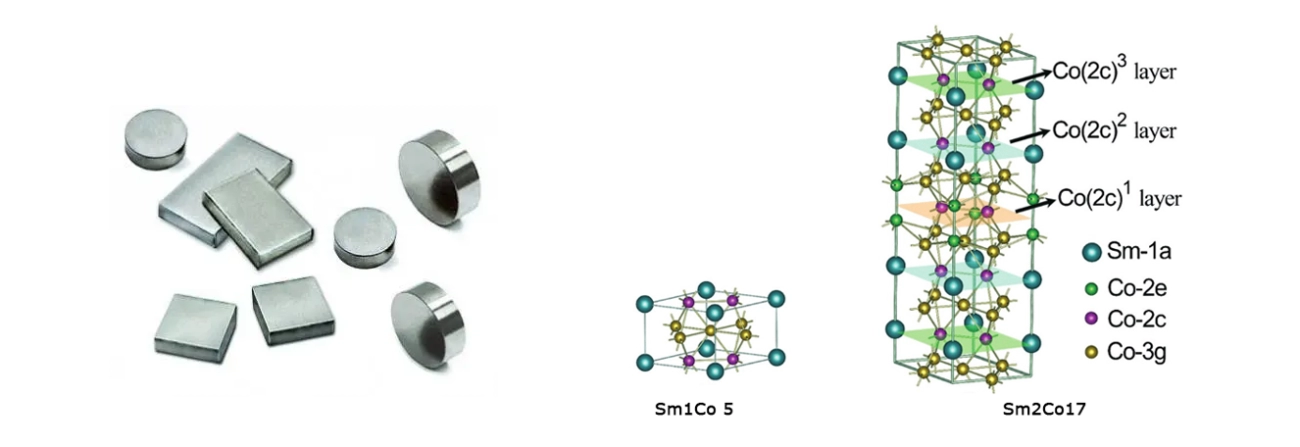
แซมเมอเรียมโคบอลต์ (SmCo)
While not quite as strong as Neodymium, Samarium Cobalt is the clear winner when things get hot. Standard magnets lose strength as temperatures rise, but SmCo is incredibly stable in high-heat environments. We often recommend these for industrial servo motors or aerospace applications where the motor might run at extreme temperatures that would demagnetize a standard Neodymium magnet.
เฟอร์ไรต์
Don’t underestimate the classics. Ferrite (ceramic) magnets are much cheaper and highly resistant to corrosion. They don’t pack the same punch as rare earth magnets, so the curved segments need to be larger to achieve the same flux. You will typically find these in automotive auxiliary motors—like windshield wipers or seat adjusters—where cost-efficiency is more critical than raw power density.
Why Are Curved Magnets Used in Motors Hard to Make?
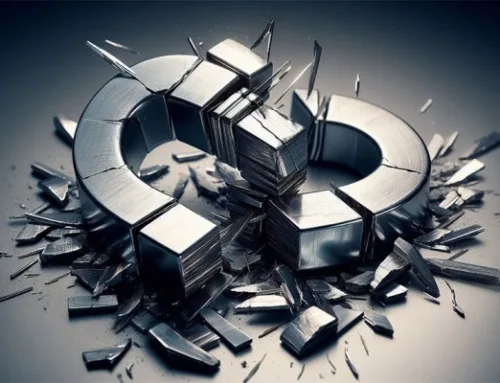
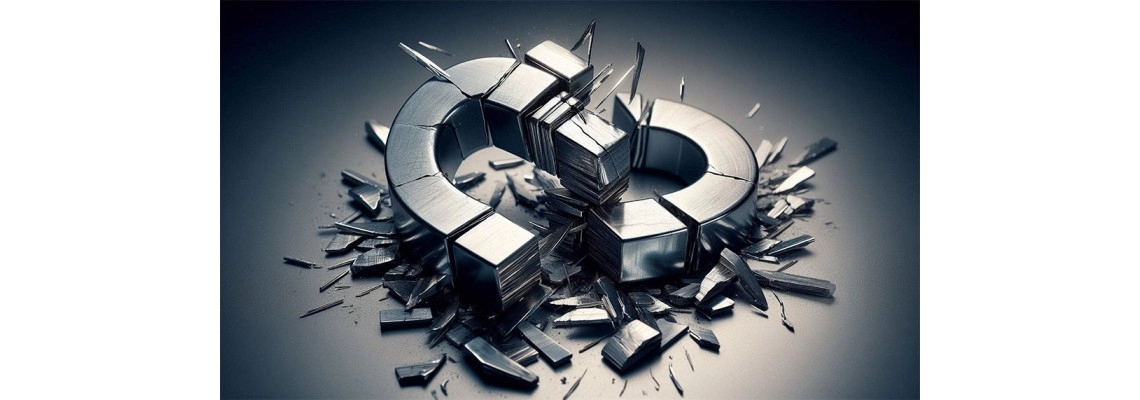
Producing perfect arc segment magnets is a tough engineering challenge. While the performance benefits are obvious, the actual manufacturing process requires shaping incredibly hard yet fragile materials without degrading their magnetic properties.
Why Shaping is Difficult
- Extreme Brittleness: Top-tier materials like sintered Neodymium magnets chip, crack, and break easily during standard machining.
- Zero Margin for Error: The exact curve is critical. Even a microscopic deviation in the radius can ruin the magnetic air gap, leading to heavy efficiency losses.
- Complex Tooling Requirements: Crafting a precisely curved or entirely รูปร่างของแม่เหล็กที่แตกต่างกัน demands custom tooling, slow feed rates, and specialized cooling to prevent heat damage during production.
The NBAEM Advantage
At NBAEM, we built our manufacturing process to solve these exact production headaches. We don’t just supply raw materials; we engineer ready-to-use solutions.
- Precision Magnetic Grinding: We utilize state-of-the-art grinding technology to lock in the exact arc required for your permanent magnet rotor, ensuring a flawless fit every single time.
- Magnet Assembly Services: Handling brittle magnets on an assembly line slows you down. We offer complete assembly services, delivering finished components that drop right into your production line.
- Proven Reliability: Whether you are designing compact consumer electronics or building high-torque electric motors, our components are tested to survive the most demanding การใช้งานในอุตสาหกรรม.
We bypass the manufacturing hurdles for you, delivering the exact shape, strict tolerance, and magnetic strength you need to build a more efficient motor.
 Thai
Thai  English
  German
  Vietnamese
  Spanish (Mexico)
  Russian
  Turkish
  Polish
  Hindi
Hindi  Malay
Malay  Korean
  Japanese
  French
  Czech
Czech  Danish
  Dutch
Dutch  Finnish
  Italian
  Portuguese (Brazil)
  Portuguese (Portugal)
  Slovenian
  Ukrainian
  Hebrew
  Scottish Gaelic
  Hungarian
  Tagalog
  Spanish (Spain)
  Serbian
  Indonesian
  Slovak
  Dutch (Belgium)
  Persian
  Arabic
  Romanian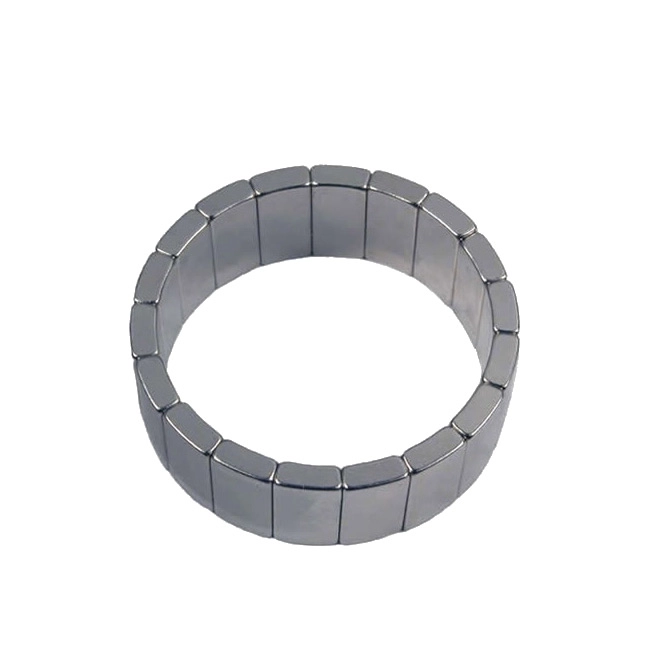
แสดงความคิดเห็น