
You probably already know that Halbach arrays are unmatched for creating a strong, one-sided magnetic field. But when you actually sit down to figure out как да се изчисли поток от Halbach масив, the ideal textbook math quickly collides with real-world engineering. Between complex boundary geometries, air gaps, and magnet segmentation losses, manual calculations can become a nightmare. In this guide, we break down the exact analytical formulas for linear, cylindrical, and spherical arrays, and show you exactly when to transition to FEA software simulations. Let’s dive right in.
What is a Halbach Array and Why Does It Matter?
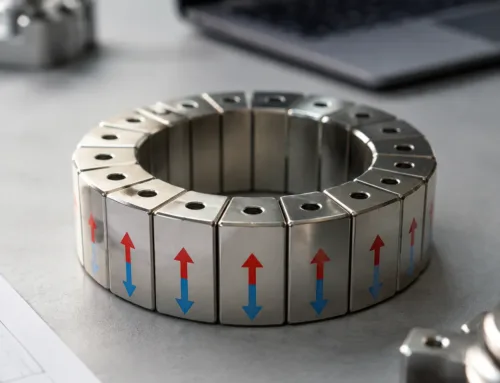
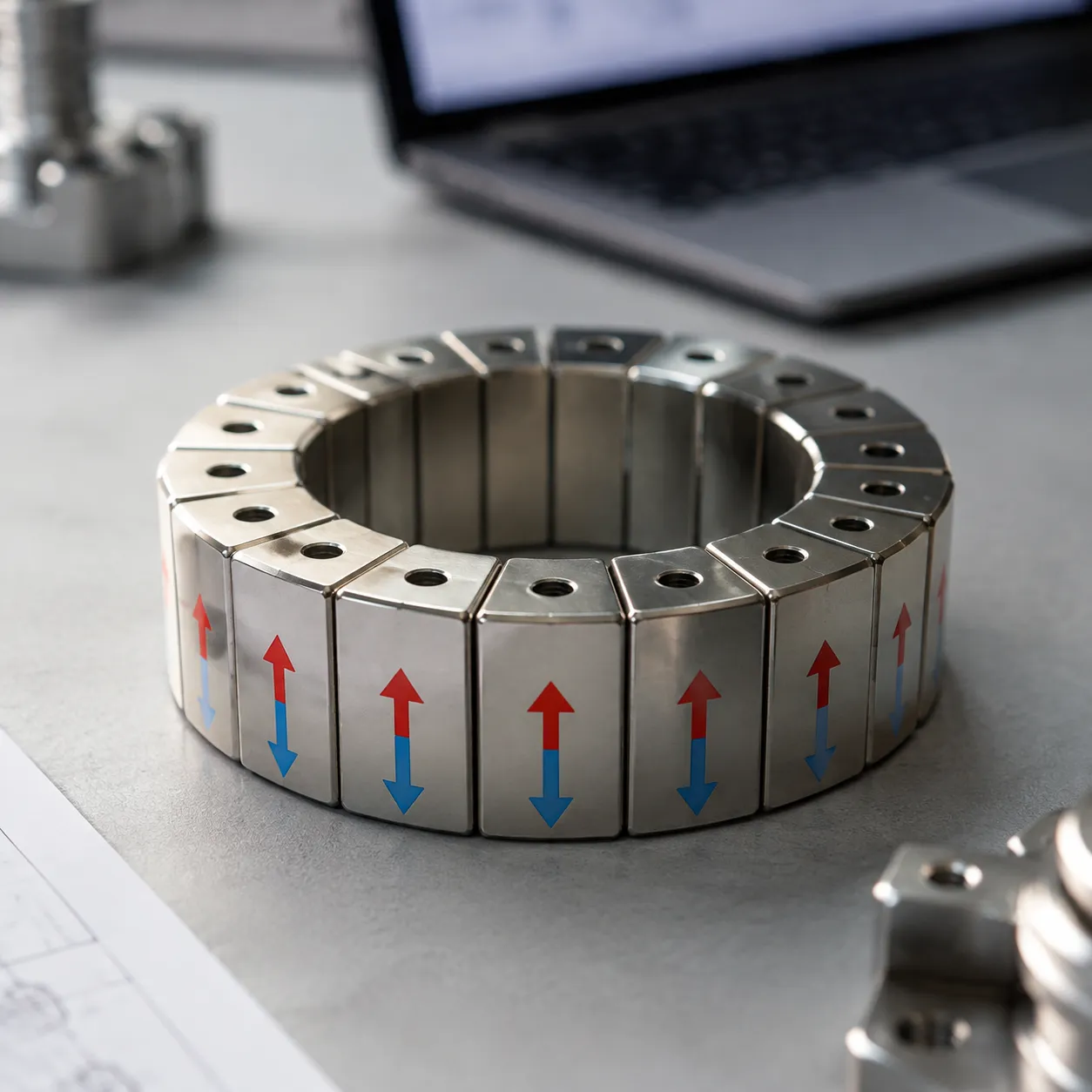
If you have ever tried pushing two strong magnets together, you know they fight back. Now, imagine arranging a row of magnets so their magnetic fields cooperate to do something seemingly impossible: completely cancel out the magnetic field on one side while doubling the strength on the other.
That is exactly what a Halbach array does.
Standard Magnet Array: ↑ ↓ ↑ ↓ ↑ ↓ (Equal fields on both sides)
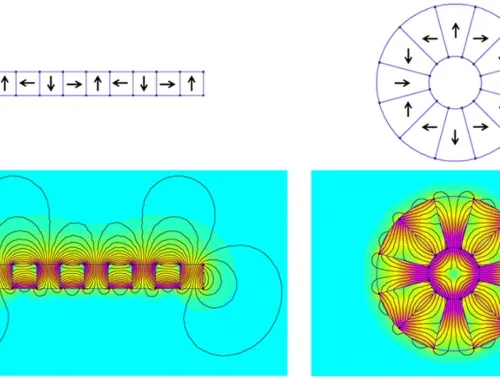
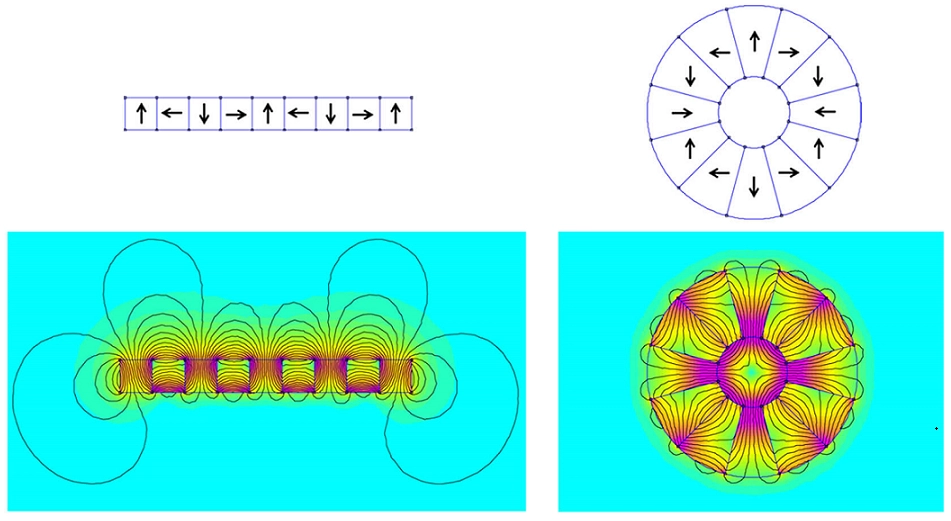
Halbach Magnet Array: → ↑ ← ↓ → ↑ (Strong field on top, zero field on bottom)
By rotating the magnetization vector of each consecutive block by 90 degrees, we create a spatially rotating magnetic field. This unique orientation channels the magnetic flux lines away from the “weak side” and crams them all into the “strong side.”
Maximizing Flux Efficiency
In standard permanent magnet assemblies, magnetic flux leaks in all directions, requiring heavy steel backplates to redirect the field. We use Halbach arrays because they eliminate this dead weight.
-
- One-sided enhancement: The strong side achieves nearly twice the magnetic flux density of a traditional array.
- Near-zero leakage: The weak side is virtually non-magnetic, allowing components to sit flush against the array without interference.
- Намаляване на теглото: No heavy iron or steel backing is required to contain the flux lines.
High-Performance Applications
This optimized distribution of потенциална магнитна плътност makes the Halbach configuration a cornerstone of modern high-efficiency engineering.
| Приложение | Как работи | Ключова полза |
|---|---|---|
| Linear Motors | Eliminates iron backing tracks entirely. | Faster acceleration, higher payload efficiency. |
| Maglev Trains | Creates passive levitation tracks over aluminum sheets. | Stable, frictionless high-speed travel. |
| High-Efficiency Generators | Concentrates flux directly onto the stator windings. | Maximum power output with minimal weight. |
Understanding how to manipulate this strong side magnetic field enhancement is the first step toward building lighter, more powerful magnetic systems.
Key Factors That Dictate Magnetic Flux Density
When we look at a magnetic flux density calculation for a Halbach array, we cannot treat it like a standard permanent magnet layout. Several critical variables dictate exactly how much field enhancement you achieve on the strong side.
Magnet Grade and Remanence (Br)
The foundational limit of your array’s power comes down to the raw material. Remanence (Br) measures the residual magnetism left inside the material after the external magnetization field is removed. Higher remanence values scale up your final flux density. For instance, stepping up from standard N42 neodymium blocks to premium options changes the output significantly. If you are pushing boundaries for high-efficiency applications, understanding the разликата между магнитите N52 и N55 cURL Too many subrequests by single Worker invocation. To configure this limit, refer to https://developers.cloudflare.com/workers/wrangler/configuration/#limits
cURL Too many subrequests by single Worker invocation. To configure this limit, refer to https://developers.cloudflare.com/workers/wrangler/configuration/#limits
cURL Too many subrequests by single Worker invocation. To configure this limit, refer to https://developers.cloudflare.com/workers/wrangler/configuration/#limits
Дебелина: cURL Too many subrequests by single Worker invocation. To configure this limit, refer to https://developers.cloudflare.com/workers/wrangler/configuration/#limits
cURL Too many subrequests by single Worker invocation. To configure this limit, refer to https://developers.cloudflare.com/workers/wrangler/configuration/#limits cURL Too many subrequests by single Worker invocation. To configure this limit, refer to https://developers.cloudflare.com/workers/wrangler/configuration/#limits
cURL Too many subrequests by single Worker invocation. To configure this limit, refer to https://developers.cloudflare.com/workers/wrangler/configuration/#limits
cURL Too many subrequests by single Worker invocation. To configure this limit, refer to https://developers.cloudflare.com/workers/wrangler/configuration/#limits
cURL Too many subrequests by single Worker invocation. To configure this limit, refer to https://developers.cloudflare.com/workers/wrangler/configuration/#limits cURL Too many subrequests by single Worker invocation. To configure this limit, refer to https://developers.cloudflare.com/workers/wrangler/configuration/#limits
cURL Too many subrequests by single Worker invocation. To configure this limit, refer to https://developers.cloudflare.com/workers/wrangler/configuration/#limits cURL Too many subrequests by single Worker invocation. To configure this limit, refer to https://developers.cloudflare.com/workers/wrangler/configuration/#limits
cURL Too many subrequests by single Worker invocation. To configure this limit, refer to https://developers.cloudflare.com/workers/wrangler/configuration/#limits
cURL Too many subrequests by single Worker invocation. To configure this limit, refer to https://developers.cloudflare.com/workers/wrangler/configuration/#limits
cURL Too many subrequests by single Worker invocation. To configure this limit, refer to https://developers.cloudflare.com/workers/wrangler/configuration/#limits
cURL Too many subrequests by single Worker invocation. To configure this limit, refer to https://developers.cloudflare.com/workers/wrangler/configuration/#limits
cURL Too many subrequests by single Worker invocation. To configure this limit, refer to https://developers.cloudflare.com/workers/wrangler/configuration/#limits
-
- cURL Too many subrequests by single Worker invocation. To configure this limit, refer to https://developers.cloudflare.com/workers/wrangler/configuration/#limits cURL Too many subrequests by single Worker invocation. To configure this limit, refer to https://developers.cloudflare.com/workers/wrangler/configuration/#limits
- cURL Too many subrequests by single Worker invocation. To configure this limit, refer to https://developers.cloudflare.com/workers/wrangler/configuration/#limits cURL Too many subrequests by single Worker invocation. To configure this limit, refer to https://developers.cloudflare.com/workers/wrangler/configuration/#limits
- cURL Too many subrequests by single Worker invocation. To configure this limit, refer to https://developers.cloudflare.com/workers/wrangler/configuration/#limits cURL Too many subrequests by single Worker invocation. To configure this limit, refer to https://developers.cloudflare.com/workers/wrangler/configuration/#limits
cURL Too many subrequests by single Worker invocation. To configure this limit, refer to https://developers.cloudflare.com/workers/wrangler/configuration/#limits
cURL Too many subrequests by single Worker invocation. To configure this limit, refer to https://developers.cloudflare.com/workers/wrangler/configuration/#limits
This analytical model assumes an ideal scenario, giving us the absolute maximum theoretical performance on the enhanced side of the array. The factor of $\frac{\sqrt{2}}{\pi}$ stems from the fundamental Fourier harmonic components of a 4-block segmented array.
According to verified engineering data on what is the strength of the Halbach array magnet field, a perfectly optimized configuration can nearly double the flux density on its strong side compared to a traditional north-south alternating layout. This math gives us a highly accurate baseline before we introduce real-world air gaps or housing tolerances into the physical assembly.
Step-by-Step Guide: How to Calculate Flux from a Halbach Array
Calculating the magnetic flux density of a Halbach array involves breaking down the physical geometry and magnetic traits into a manageable math model. Here is the exact process we use to get an accurate hand calculation before moving to simulation software.
Step 1: Gather Physical Dimensions and Magnetic Properties
First, collect the hard data for your specific permanent magnet assembly. You need the magnet thickness ($d$), the total length of one full magnetic cycle or repeat period ($\lambda$), and the remanence ($B_r$) of the material. For example, if you use high-grade rare earth neodymiums, your remanence value will typically sit between 1.2 and 1.48 Tesla. If you are still sourcing your components, learning как да изберете подходящ магнит за вашите уреди can help you lock down the exact material grades and specifications required for your project.
Step 2: Calculate the Wavenumber or Spatial Frequency
Next, determine the spatial frequency ($k$), which represents how fast the magnetic field repeats over a given distance. This is also called the wavenumber. Calculate this by dividing $2\pi$ by your array period ($\lambda$):
cURL Too many subrequests by single Worker invocation. To configure this limit, refer to https://developers.cloudflare.com/workers/wrangler/configuration/#limits
This value is crucial because it dictates how rapidly the strong side magnetic field enhancement builds up and how quickly it decays as you move away from the surface.
Step 3: Solve for the Ideal Surface Flux Density
With your spatial frequency and material traits ready, calculate the peak theoretical surface flux density ($B_0$) directly at the array surface on the strong side. For an ideal linear Halbach array formula, the equation is:
$B_0 = B_r · (1 – e⁻kd)$
This number gives you the absolute maximum magnetic flux density calculation possible right against the faces of the magnets, assuming perfect block alignment and zero manufacturing gaps.
Step 4: Account for Air Gap Distance
In real engineering applications, your rotor or stator will not touch the magnet surface. To find the actual operating flux density at a specific air gap distance ($z$), apply the exponential decay formula:
$B(z) = B_0 · e⁻kz$
This final step shows exactly how much usable magnetic field remains at your working clearance distance, which is the baseline metric needed to calculate linear motor thrust or generator efficiency.
Where Analytical Formulas Fall Short: Real-World Complications
Hand calculations give us a great starting point, but building a physical permanent magnet assembly comes with harsh engineering realities. Idealized equations assume infinitely long arrays and perfect materials. In the workshop, we have to deal with physical limitations that alter our predicted magnetic flux density calculation.
Edge Effects and Flux Distortion
Analytical math assumes your array goes on forever. In real life, your array stops. At the boundaries of a finite Halbach array, the magnetic field behaves poorly. These end effects cause the magnetic field lines to flare outward, severely distorting the flux density at the edges. If your application relies on a perfectly uniform field across the entire length of the track, you must overshoot your physical array length to keep the weak edge zones away from your active area.
Mechanical Tolerances and Flux Leakage
Putting a Halbach array together is notoriously difficult because the magnets want to repel each other furiously during assembly. Imperfect magnet alignment and tiny mechanical tolerances create microscopic gaps between the blocks.
-
- Glue Line Gaps: Even a fraction of a millimeter of excess epoxy pushes the magnets apart, weakening the overall strong side magnetic field enhancement.
- Angular Misalignment: If a block is rotated even slightly off its ideal 90-degree orientation, you get immediate flux leakage and a drop in peak performance.
When to Switch to Finite Element Analysis (FEA) Software
If you are designing a low-cost prototype or a basic linear track, hand formulas get you close enough. However, you should drop the pen and switch to Finite Element Analysis magnetism software when:
-
- You are designing complex geometries like a multi-axis Halbach cylinder flux path.
- Your system has tight tolerances where a 5% drop in flux density causes system failure.
- cURL Too many subrequests by single Worker invocation. To configure this limit, refer to https://developers.cloudflare.com/workers/wrangler/configuration/#limits
Често задавани въпроси
cURL Too many subrequests by single Worker invocation. To configure this limit, refer to https://developers.cloudflare.com/workers/wrangler/configuration/#limits
cURL Too many subrequests by single Worker invocation. To configure this limit, refer to https://developers.cloudflare.com/workers/wrangler/configuration/#limits
cURL Too many subrequests by single Worker invocation. To configure this limit, refer to https://developers.cloudflare.com/workers/wrangler/configuration/#limits
cURL Too many subrequests by single Worker invocation. To configure this limit, refer to https://developers.cloudflare.com/workers/wrangler/configuration/#limits
cURL Too many subrequests by single Worker invocation. To configure this limit, refer to https://developers.cloudflare.com/workers/wrangler/configuration/#limits
cURL Too many subrequests by single Worker invocation. To configure this limit, refer to https://developers.cloudflare.com/workers/wrangler/configuration/#limits магнитни материали за халбахови масиви cURL Too many subrequests by single Worker invocation. To configure this limit, refer to https://developers.cloudflare.com/workers/wrangler/configuration/#limits
cURL Too many subrequests by single Worker invocation. To configure this limit, refer to https://developers.cloudflare.com/workers/wrangler/configuration/#limits
cURL Too many subrequests by single Worker invocation. To configure this limit, refer to https://developers.cloudflare.com/workers/wrangler/configuration/#limits


 Bulgarian
 English
 German
 Vietnamese
 Spanish (Mexico)
 Russian
 Turkish
 Polish
 Hindi
 Thai
 Malay
 Korean
 Japanese
 French
 Czech
 Danish
 Dutch
 Finnish
 Italian
 Portuguese (Brazil)
 Portuguese (Portugal)
 Slovenian
 Ukrainian
 Hebrew
 Scottish Gaelic
 Hungarian
 Tagalog
 Spanish (Spain)
 Serbian
 Indonesian
 Slovak
 Dutch (Belgium)
 Persian
 Arabic
 Romanian
 Estonian
 Greek


Оставете коментар