
Βασικά της Κρίσιμης Θέσης σε Υλικά
Σε κρυσταλλικά υλικά, τα άτομα arranged σε μια ιδιαίτερα τακτοποιημένη επαναλαμβανόμενη δομή που ονομάζεται κρύσταλλος πλέγμα. Ωστόσο, αυτά τα υλικά σπάνια αποτελούν μεμονωμένο κρύσταλλο. Αντίθετα, αποτελούνται από πολλά μικρά κρύσταλλα που ονομάζονται κόκκοι. Each grain has its own crystal orientation, and the regions where grains meet are known as grain boundaries.
Grain boundaries are the interfaces where the crystal orientation changes. They act as distinct zones with different properties compared to the grains themselves. There are several types of grain boundaries, mainly categorized by the angle between the adjoining grains:
- High-angle grain boundaries: These have a large misorientation (typically above 15 degrees). They are more disordered and have higher energy, making them important pathways for processes like diffusion.
- Low-angle grain boundaries: These have a small misorientation (below 15 degrees) and consist of arrays of dislocations. They are less disordered than high-angle boundaries.
- Special boundaries: These include coincident site lattice (CSL) boundaries, which have particularly ordered atomic arrangements and often lower energy and different diffusion characteristics.
The internal structure of grain boundaries is less orderly compared to the grains, with a higher atomic disorder and more free volume. This unique structure allows grain boundaries to serve as faster pathways for atomic movement, or diffusion, compared to the bulk crystal lattice. Because atoms at grain boundaries are less tightly packed and have more defects, they can migrate more easily, making grain boundaries a key feature in understanding material behavior like strength, corrosion resistance, and diffusion rates.
Τι είναι η Δια diffusion στα Όρια Στρώματος (Κρυσταλλικών Ορίων)
Grain boundary diffusion is the movement of atoms along the boundaries between grains in a crystalline material. Unlike bulk lattice diffusion, where atoms move through the well-ordered crystal structure, grain boundary diffusion happens in the less ordered, more open spaces at the grain edges.
Diffusion is faster along grain boundaries because these boundaries have more defects, extra space, and disturbed atomic arrangements. This creates easier paths for atoms to slip through compared to the tight, regularly spaced atoms inside the grain itself. Think of it like walking through a crowded room (bulk diffusion) versus moving through a wide, empty hallway between rooms (grain boundary diffusion).
This faster atomic movement makes grain boundaries crucial pathways for processes like corrosion, sintering, and material aging. Understanding this difference helps in predicting how materials behave in real-world applications.
Mechanism of Grain Boundary Diffusion
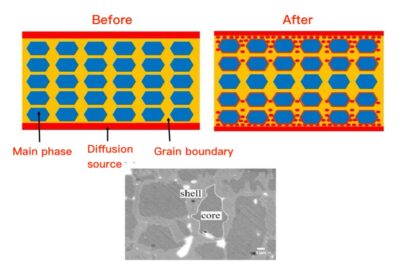
At the atomic level, grain boundary diffusion happens because atoms have more space and less order at the grain boundaries compared to the inside of grains (bulk lattice). This means atoms can jump or move more easily along these boundaries, which act as faster highways for diffusion.
Why Diffusion is Easier at Grain Boundaries
- Atomic Structure: Grain boundaries are regions where the crystal structure is irregular. This disorder creates more open spaces, called free volume.
- Free Volume: Extra spaces between atoms make it easier for atoms to slip through.
- Defect Density: Boundaries contain plenty of defects like dislocations and vacancies that lower the energy barrier for atomic movement.
How It Differs From Bulk Diffusion
| Χαρακτηριστικό | Grain Boundary Diffusion | Volume (Lattice) Diffusion |
|---|---|---|
| Pathway | Irregular grain boundaries | Well-ordered crystal lattice |
| Atomic Mobility | Higher due to open structure | Lower because atoms are tightly packed |
| Activation Energy | Lower, making diffusion easier | cURL Too many subrequests by single Worker invocation. To configure this limit, refer to https://developers.cloudflare.com/workers/wrangler/configuration/#limits |
| cURL Too many subrequests by single Worker invocation. To configure this limit, refer to https://developers.cloudflare.com/workers/wrangler/configuration/#limits | cURL Too many subrequests by single Worker invocation. To configure this limit, refer to https://developers.cloudflare.com/workers/wrangler/configuration/#limits | cURL Too many subrequests by single Worker invocation. To configure this limit, refer to https://developers.cloudflare.com/workers/wrangler/configuration/#limits |
cURL Too many subrequests by single Worker invocation. To configure this limit, refer to https://developers.cloudflare.com/workers/wrangler/configuration/#limits
cURL Too many subrequests by single Worker invocation. To configure this limit, refer to https://developers.cloudflare.com/workers/wrangler/configuration/#limits
cURL Too many subrequests by single Worker invocation. To configure this limit, refer to https://developers.cloudflare.com/workers/wrangler/configuration/#limits
cURL Too many subrequests by single Worker invocation. To configure this limit, refer to https://developers.cloudflare.com/workers/wrangler/configuration/#limits
cURL Too many subrequests by single Worker invocation. To configure this limit, refer to https://developers.cloudflare.com/workers/wrangler/configuration/#limits
cURL Too many subrequests by single Worker invocation. To configure this limit, refer to https://developers.cloudflare.com/workers/wrangler/configuration/#limits
cURL Too many subrequests by single Worker invocation. To configure this limit, refer to https://developers.cloudflare.com/workers/wrangler/configuration/#limits
cURL Too many subrequests by single Worker invocation. To configure this limit, refer to https://developers.cloudflare.com/workers/wrangler/configuration/#limits
- cURL Too many subrequests by single Worker invocation. To configure this limit, refer to https://developers.cloudflare.com/workers/wrangler/configuration/#limitscURL Too many subrequests by single Worker invocation. To configure this limit, refer to https://developers.cloudflare.com/workers/wrangler/configuration/#limits
- cURL Too many subrequests by single Worker invocation. To configure this limit, refer to https://developers.cloudflare.com/workers/wrangler/configuration/#limitscURL Too many subrequests by single Worker invocation. To configure this limit, refer to https://developers.cloudflare.com/workers/wrangler/configuration/#limits
cURL Too many subrequests by single Worker invocation. To configure this limit, refer to https://developers.cloudflare.com/workers/wrangler/configuration/#limits cURL Too many subrequests by single Worker invocation. To configure this limit, refer to https://developers.cloudflare.com/workers/wrangler/configuration/#limitscURL Too many subrequests by single Worker invocation. To configure this limit, refer to https://developers.cloudflare.com/workers/wrangler/configuration/#limits cURL Too many subrequests by single Worker invocation. To configure this limit, refer to https://developers.cloudflare.com/workers/wrangler/configuration/#limits:
- cURL Too many subrequests by single Worker invocation. To configure this limit, refer to https://developers.cloudflare.com/workers/wrangler/configuration/#limitscURL Too many subrequests by single Worker invocation. To configure this limit, refer to https://developers.cloudflare.com/workers/wrangler/configuration/#limits
- cURL Too many subrequests by single Worker invocation. To configure this limit, refer to https://developers.cloudflare.com/workers/wrangler/configuration/#limitscURL Too many subrequests by single Worker invocation. To configure this limit, refer to https://developers.cloudflare.com/workers/wrangler/configuration/#limits
- cURL Too many subrequests by single Worker invocation. To configure this limit, refer to https://developers.cloudflare.com/workers/wrangler/configuration/#limits: Grain boundary diffusion dominates because lattice diffusion is very slow.
These models help predict how materials will behave under different conditions, such as temperature changes or mechanical stress. This is crucial for designing materials with better durability, especially when grain boundary effects strongly influence processes like corrosion or creep. Overall, measuring and modeling grain boundary diffusion gives us a practical roadmap for improving performance in metals, alloys, and magnetic materials.
Practical Implications and Applications of Grain Boundary Diffusion
Grain boundary diffusion plays a crucial role in many material processes like sintering, creep, corrosion, and embrittlement. Because grain boundaries offer faster atomic pathways compared to the bulk lattice, diffusion along these boundaries can significantly affect how materials behave under heat and stress.
In sintering, grain boundary diffusion helps particles fuse together more efficiently, improving density and mechanical strength. During creep—where materials slowly deform under constant stress—grain boundary diffusion enables atoms to move more easily, influencing long-term durability. However, in corrosion and embrittlement, this faster diffusion along grain boundaries can lead to weak spots, making materials more vulnerable to failure.
For magnetic materials, especially those manufactured at NBAEM, controlling grain boundary diffusion is essential. It directly impacts magnetic properties by affecting grain structure and purity. Managing diffusion helps enhance magnetic performance, mechanical strength, and the overall lifespan of magnets. This is particularly important in high-performance magnetic materials where stability and durability are key.
By understanding and optimizing grain boundary diffusion, NBAEM ensures its magnets maintain excellent quality, combining strong magnetic performance with mechanical resilience. This knowledge supports innovations in material design that meet the demanding needs of the U.S. market for reliable, high-quality magnetic components. For more insight into magnetic materials, see What Is High-Performance SmCo Magnets και What Is Permanent Magnet.
Grain Boundary Diffusion in Magnetic Materials
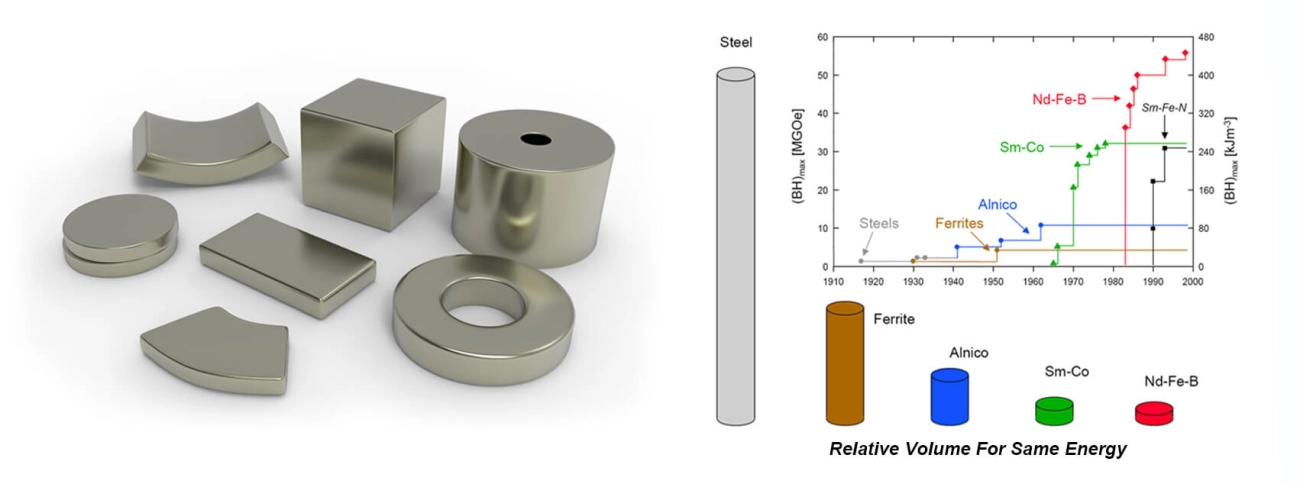
Grain boundary diffusion plays a unique role in magnetic materials, impacting their magnetic domains and overall performance. Unlike bulk diffusion, movement along grain boundaries can alter the arrangement of atoms and magnetic domain walls more rapidly. This can either enhance or degrade magnetic properties depending on the material and processing conditions.
One challenge is that excessive grain boundary diffusion can lead to unwanted changes in magnetic alignment, causing reduced coercivity or magnetization. On the flip side, controlled diffusion at grain boundaries can improve the uniformity of magnetic domains, boosting the stability and strength of magnets.
For example, in rare-earth magnets like SmCo and NdFeB, managing grain boundary diffusion helps maintain a fine grain structure, which is critical for high magnetic performance and thermal stability. This is essential in applications requiring strong, reliable magnets, such as electric motors or data storage devices.
Understanding and controlling grain boundary diffusion also aids in minimizing magnetic aging and enhancing resistance to corrosion and embrittlement, common problems in the magnetic materials industry. These advantages make grain boundary diffusion a key factor in producing high-performance magnets tailored for demanding US markets.
To learn more about the basics of magnets and magnetic poles, check out what is a rare-earth magnet και what are magnetic poles.

 Greek
 English
 German
 Vietnamese
 Spanish (Mexico)
 Russian
 Turkish
 Polish
 Hindi
 Thai
 Malay
 Korean
 Japanese
 French
 Czech
 Danish
 Dutch
 Finnish
 Italian
 Portuguese (Brazil)
 Portuguese (Portugal)
 Slovenian
 Ukrainian
 Hebrew
 Scottish Gaelic
 Hungarian
 Tagalog
 Spanish (Spain)
 Serbian
 Indonesian
 Slovak
 Dutch (Belgium)
 Persian
 Arabic
 Romanian
 Estonian
 Bulgarian

Αφήστε ένα σχόλιο