
If you’re working with Magnit NdFeB, understanding their density isn’t just a detail—it’s a game changer. Why? Because NdFeB magnet density directly impacts performance, strength, and how well they fit your application. Whether you’re an engineer designing precision motors, a buyer sourcing reliable materials, or a hobbyist fine-tuning a project, knowing the ins and outs of NdFeB magnet density helps you make smarter choices. In this guide, we’ll cut through the noise and get straight to what matters about density—how it’s measured, why it varies, and what it means for your magnets’ real-world power. Ready to get the facts on one of the most crucial properties of these powerful magnets? Let’s dive in.
Apa itu Kepadatan Magnet NdFeB
Kepadatan in the context of NdFeB magnets refers to the mass of the magnet material per unit volume, typically expressed in grams per cubic centimeter (g/cm³). It reflects how tightly the atoms are packed within the neodymium-iron-boron alloy, influencing both the weight and performance of the magnet.
Typical Density Range of NdFeB Magnets
NdFeB magnets generally have a density ranging from 7.4 to 7.6 g/cm³, depending on their specific composition and manufacturing process. This density is higher than many other permanent magnet materials, contributing to their powerful magnetic properties despite their relatively small size.
| Jenis Magnet | Typical Density (g/cm³) |
|---|---|
| NdFeB | 7.4 – 7.6 |
| SmCo (Samarium Cobalt) | 8.0 – 8.4 |
| AlNiCo | 7.2 – 7.4 |
| Ferrit | 5.0 – 5.3 |
Difference Between Density and Related Properties
- Density vs. Volume Mass: While often used interchangeably, volume mass specifically refers to the total mass per volume including any voids or pores, whereas density typically assumes a solid, uniform material.
- Density vs. Magnetic Flux Density: Density is a physical property related to mass and volume, whereas magnetic flux density (measured in Tesla or Gauss) describes the strength of the magnetic field produced by the magnet.
- Density vs. Weight and Size: Density influences the weight of the magnet but is independent of its physical dimensions.
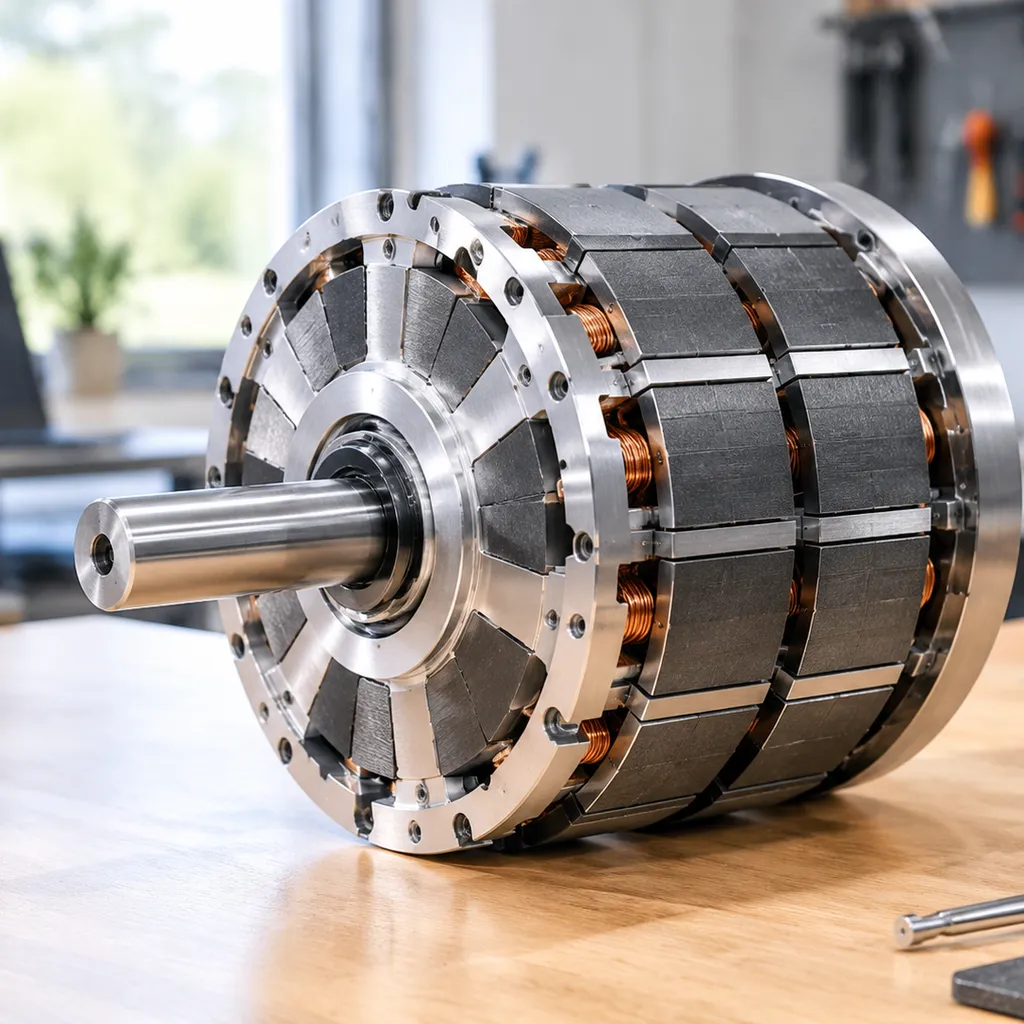
Understanding NdFeB magnet density helps in designing compact, efficient magnets for high-performance applications including motors, sensors, and electronic devices. For more on the production and physical characteristics of NdFeB magnets, visit NBAEM’s guide on cara membuat magnet NdFeB.
Factors Influencing the Density of NdFeB Magnets
Several factors shape the density of NdFeB magnets, starting with their composition. The exact mix of neodymium, iron, boron, and other alloying elements changes the overall weight and compactness of the magnet. Tweaking these proportions can adjust the density to match specific needs.
Manufacturing steps also play a big role. Processes like sintering—where powdered metals are heated to fuse particles—and compaction, which presses the material into shape, impact how tightly packed the magnet material becomes. More effective sintering and compaction generally create magnets with higher density.
Porosity and the magnet’s microstructure are key too. If the magnet has tiny pores or gaps inside, it lowers the density because those pockets take up space without adding weight. The finer and more uniform the microstructure, the denser and stronger the magnet usually is.
Together, these factors determine the physical density and influence the magnet’s performance in real-world uses.
The Relationship Between Density and Magnetic Performance
Density plays a crucial role in how well NdFeB magnets perform. Higher density means fewer pores and voids inside the magnet, which directly impacts key magnetic properties like magnetic flux density, coercivity, and energy product.
- Magnetic flux density (Br) tends to be higher in denser magnets, resulting in stronger magnetic fields.
- Coercivity (resistance to demagnetization) also improves because a compact internal structure supports better magnetic stability.
- cURL Too many subrequests by single Worker invocation. To configure this limit, refer to https://developers.cloudflare.com/workers/wrangler/configuration/#limitscURL Too many subrequests by single Worker invocation. To configure this limit, refer to https://developers.cloudflare.com/workers/wrangler/configuration/#limits
cURL Too many subrequests by single Worker invocation. To configure this limit, refer to https://developers.cloudflare.com/workers/wrangler/configuration/#limits
cURL Too many subrequests by single Worker invocation. To configure this limit, refer to https://developers.cloudflare.com/workers/wrangler/configuration/#limits
cURL Too many subrequests by single Worker invocation. To configure this limit, refer to https://developers.cloudflare.com/workers/wrangler/configuration/#limits What is a Permanent Magnet cURL Too many subrequests by single Worker invocation. To configure this limit, refer to https://developers.cloudflare.com/workers/wrangler/configuration/#limits
cURL Too many subrequests by single Worker invocation. To configure this limit, refer to https://developers.cloudflare.com/workers/wrangler/configuration/#limits
cURL Too many subrequests by single Worker invocation. To configure this limit, refer to https://developers.cloudflare.com/workers/wrangler/configuration/#limits
cURL Too many subrequests by single Worker invocation. To configure this limit, refer to https://developers.cloudflare.com/workers/wrangler/configuration/#limits
- Magnit NdFeB cURL Too many subrequests by single Worker invocation. To configure this limit, refer to https://developers.cloudflare.com/workers/wrangler/configuration/#limits
- Magnet SmCocURL Too many subrequests by single Worker invocation. To configure this limit, refer to https://developers.cloudflare.com/workers/wrangler/configuration/#limits
- magnet AlNiCo cURL Too many subrequests by single Worker invocation. To configure this limit, refer to https://developers.cloudflare.com/workers/wrangler/configuration/#limits
- Magnet ferit cURL Too many subrequests by single Worker invocation. To configure this limit, refer to https://developers.cloudflare.com/workers/wrangler/configuration/#limits
cURL Too many subrequests by single Worker invocation. To configure this limit, refer to https://developers.cloudflare.com/workers/wrangler/configuration/#limits
cURL Too many subrequests by single Worker invocation. To configure this limit, refer to https://developers.cloudflare.com/workers/wrangler/configuration/#limits Aplikasi magnet permanen dalam teknologi modern.
cURL Too many subrequests by single Worker invocation. To configure this limit, refer to https://developers.cloudflare.com/workers/wrangler/configuration/#limits
cURL Too many subrequests by single Worker invocation. To configure this limit, refer to https://developers.cloudflare.com/workers/wrangler/configuration/#limits
-
cURL Too many subrequests by single Worker invocation. To configure this limit, refer to https://developers.cloudflare.com/workers/wrangler/configuration/#limits
cURL Too many subrequests by single Worker invocation. To configure this limit, refer to https://developers.cloudflare.com/workers/wrangler/configuration/#limits
-
Aerospace and Defense Industries
Weight is a big factor in aerospace. Using NdFeB magnets with optimized density helps reduce overall component weight while maintaining or improving magnetic strength—vital for sensors, actuators, and defense-related electronics.
Each of these applications depends on carefully controlled magnet density to deliver best-in-class performance and meet strict industry standards. For more on magnetic components in motors, check out our guide on understanding drone motor structure and magnetic components.
Quality Control and Testing of Magnet Density at NBAEM
At NBAEM, ensuring consistent NdFeB magnet density is a top priority. Our quality assurance process includes thorough checks at every manufacturing stage to maintain uniform physical properties. This consistency is crucial because density directly affects the magnet’s strength and reliability in use.
We use advanced equipment to measure and analyze magnet density precisely. Techniques like Archimedes’ method and high-precision scanners help us detect variations, porosity, and any manufacturing defects early on. This allows us to deliver products that meet tight density specifications and perform reliably in demanding applications.
NBAEM also follows strict internal standards for density and related physical properties. Our ongoing commitment to quality means regular calibration of equipment and continuous training for our team, making sure every batch of NdFeB magnets meets industry benchmarks and customer expectations. For more on magnet strength testing, you can visit our guide on cara mengukur kekuatan magnet.
FAQs about NdFeB Magnet Density
What causes density variability in NdFeB magnets?
Density can vary due to differences in raw materials, alloy composition, and manufacturing processes like sintering and compaction. Even slight changes in these factors affect the final product’s density and magnetic performance.
How is the density of NdFeB magnets measured accurately?
Advanced techniques like the Archimedes method and X-ray computed tomography help ensure precise density measurements, factoring in porosity and microstructural differences. NBAEM uses state-of-the-art equipment to maintain consistent quality.
Does density affect the design of NdFeB magnets?
Yes, density influences magnet strength, size, and weight. Higher density usually means better magnetic properties, allowing for smaller or lighter magnets in devices like motors and sensors without sacrificing power.
How do I choose the right density grade for my application?
- High-density magnets are best for applications demanding maximum strength and efficiency, like electric vehicles or wind turbines.
- Standard density magnets suit general electronics and consumer devices where cost-effectiveness matters.
- Lower density options might be used where weight savings are critical, but magnetic output can be compromised.
Can I get customized density specifications?
Absolutely. NBAEM offers customization options to match specific density and performance needs, ensuring your application performs optimally.
NBAEM Commitment to High Quality NdFeB Magnets
At NBAEM, we focus on delivering NdFeB magnets with precise density specifications to meet diverse industry needs. Our product range covers standard and high-density neodymium magnets that provide consistent magnetic strength and durability.
We also offer customization to adjust density and magnetic performance based on your specific applications, whether it’s for electric vehicles, electronics, or renewable energy projects. Our tailored solutions ensure you get the right balance of weight, size, and magnetic power.

 Indonesian
 English
 German
 Vietnamese
 Spanish (Mexico)
 Russian
 Turkish
 Polish
 Hindi
 Thai
 Malay
 Korean
 Japanese
 French
 Czech
 Danish
 Dutch
 Finnish
 Italian
 Portuguese (Brazil)
 Portuguese (Portugal)
 Slovenian
 Ukrainian
 Hebrew
 Scottish Gaelic
 Hungarian
 Tagalog
 Spanish (Spain)
 Serbian
 Slovak
 Dutch (Belgium)
 Persian
 Arabic
 Romanian
 Estonian
 Greek
 Bulgarian

Tinggalkan Komentar