
Are you struggling with encoder failures in high-vibration, oily, or dusty environments?
Selecting the right magnetic encoder ring is the difference between a high-performance motion control system and costly mechanical downtime. As a specialist in high-precision magnetic solutions, I know that transitioning from fragile optical sensors to robust magnetic sensing is a game-changer for industrial automation e robotics.
In this guide, you’ll learn exactly how to evaluate pole pitch, optimize air gap tolerances, and select the ideal multipole magnet ring para o teu BLDC motor feedback. Whether you need absolute position feedback or high-speed incremental magnetic encoder performance, this technical breakdown has you covered.
Let’s dive right in.
How Magnetic Encoder Rings Work
In high-precision motion control, the magnetic encoder ring serves as the critical bridge between mechanical rotation and digital intelligence. We rely on these components because they provide a non-contact, wear-free method of tracking movement, even in environments where traditional optical sensors would fail.
The Physics of Magnetic Sensing
We utilize two primary technologies to detect the magnetic field generated by the ring:
- Sensores de Efeito Hall: These sensors detect the voltage change created when a magnetic field passes through a semiconductor. They are incredibly robust, cost-effective, and the industry standard for high-speed motor feedback.
- Magnetoresistive (MR) Sensors: These measure changes in electrical resistance within a magnetic field. We use MR technology when the application demands higher sensitivity and superior resolution, as it can detect much finer transitions than standard Hall sensors.
Understanding the Multipole Structure
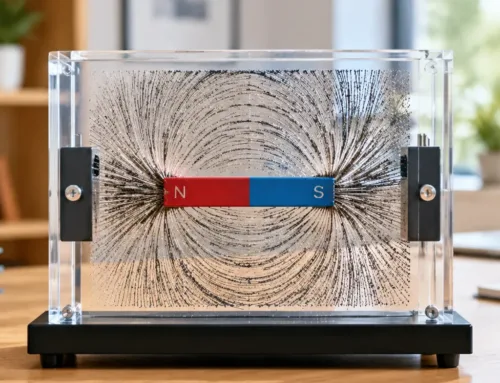
The “intelligence” of the system lies in the multipole magnet ring. Unlike a standard magnet with just one North and one South pole, these rings feature a precise sequence of alternating poles.
- Pole Pitch: This is the distance between the centers of two adjacent poles. A tighter pole pitch allows for higher resolution.
- N/S Transitions: As the ring rotates, the sensor tracks the transitions between North and South poles.
- Magnetic Flux Density: Our sensors monitor the strength and direction of the magnetic flux. By analyzing the sine and cosine waves generated during rotation, we can determine the exact position of the shaft.
Signal Translation: Incremental vs. Absolute
The sensor converts the physical fluxo magnético into electrical signals that your controller can interpret. We categorize these into two distinct feedback types:
- Incremental Magnetic Encoder: This tracks relative movement. It generates pulses (A and B channels) to determine speed and direction. If the power is cut, the system must return to a “home” position to recalibrate.
- Absolute Position Feedback: This provides a unique digital code for every specific angle. It knows its exact position the moment it is powered on, making it the preferred choice for robotics and safety-critical industrial automation.
By leveraging these magnetic principles, we ensure that your motion control system receives high-speed, reliable data without the risk of mechanical wear or environmental interference.
Key Components and Materials of a Magnetic Encoder Ring
A high-performance magnetic encoder ring relies on the synergy between its structural substrate and the magnetic medium. We carefully select these components to ensure the ring maintains its integrity under high-speed rotation and thermal stress.
Substrate Materials: Steel Carriers vs. Aluminum Hubs
The carrier or hub provides the mechanical foundation for the magnetic track. Choosing the right substrate is critical for mounting stability and rotational balance.
- Steel Carriers: These are preferred for their high mechanical strength and thermal expansion coefficients that closely match motor shafts, preventing slippage or loosening at high temperatures.
- Aluminum Hubs: Ideal for weight-sensitive applications where low inertia is critical for rapid acceleration and deceleration in high-dynamic motion control.
Magnetic Mediums: Neodymium, Ferrite, and Bonded Options
The choice of magnetic material dictates the signal strength and resolution of the magnetic encoder ring.
- Sintered Neodymium: The gold standard for high-resolution feedback, offering maximum magnetic flux density for applications with tight air gap tolerances.
- Rubber-Bonded Magnets: These offer excellent flexibility and impact resistance. Our high-quality ímanes ligados provide a versatile, cost-effective solution for complex ring geometries and large-diameter targets.
- Ferrite: A reliable, corrosion-resistant option for environments where cost-efficiency is a priority and extreme magnetic strength is not required.
The NBAEM Advantage: Material Stability
We prioritize long-term stability by using high-grade magnetic materials that resist demagnetization over time. Understanding how long magnets last is central to our engineering process, ensuring our rings deliver consistent pulses over millions of cycles. Our focus on material purity and advanced manufacturing means less signal drift and higher reliability for your industrial automation components.
Magnetic Encoder Ring vs. Optical: The Superior Choice for Harsh Environments
Choosing a magnetic encoder ring over an optical alternative is a strategic move for any high-performance application. Optical encoders are notoriously fragile; a single speck of dust or a drop of oil can cause a total system failure. In contrast, our magnetic solutions are built to withstand the toughest operating conditions.
- Unmatched Resilience: Magnetic fields penetrate through contaminants. Our rings provide consistent angular position sensing even when exposed to heavy dust, grease, moisture, and extreme vibrations.
- Zero Wear and Tear: The non-contact nature of the rotary encoder ring ensures there is no physical friction. This leads to an indefinite lifespan compared to mechanical or optical parts that degrade over time.
- Compact Form Factor: We design these rings to be incredibly slim, allowing for seamless integration into modern ímanes usados na indústria automation and robotics where space is at a premium.
- Lower Total Cost of Ownership (TCO): While the initial investment is competitive, the long-term savings are significant. You eliminate the need for frequent cleaning, recalibration, and expensive replacement parts.
The reliability of our quality Neodymium magnets ensures that your motion control system maintains peak accuracy without the downtime associated with delicate sensors. This durability makes them the industry standard for BLDC motor feedback in demanding environments where failure is not an option.
Technical Specifications for Your Magnetic Encoder Ring
To get the best performance out of a magnetic encoder ring, you need to nail the technical specs. It’s not just about picking a size; it’s about how the densidades de fluxo magnético interacts with your sensor under real-world conditions. We focus on these core variables to ensure your system remains precise and reliable.
Key Performance Metrics
| Especificação | Impact on Performance |
|---|---|
| Pole Pitch | Determines the resolution; smaller pitch equals higher precision. |
| Pole Pairs | Dictates the number of pulses per revolution (PPR). |
| Tolerância de Espaço de Ar | The critical distance between the ring and sensor for signal clarity. |
| Estabilidade Térmica | Resistance to magnetic degradation at high operating temperatures. |
- Pole Pitch and Resolution: We design the pole pitch to match your sensor’s requirements. A tighter pitch increases the resolution of your motion control system, allowing for finer angular position sensing and smoother motor control.
- Air Gap Requirements: O air gap tolerance is the “make or break” factor. If the sensor is too far from the magnetic target wheel, the signal drops; too close, and you risk mechanical interference. We typically aim for a balance that allows for slight axial runout without losing signal integrity.
- Accuracy vs. Repeatability: Accuracy is how close you are to the true position, while repeatability is your ability to return to that exact spot every time. For most robotics and industrial tasks, high repeatability is often more critical than absolute accuracy for consistent performance.
- Thermal Stability: Heat is the enemy of magnetism. Understanding how long magnets last under thermal stress is vital, as magnetic degradation can lead to signal drift. We ensure our rings maintain their magnetic strength across your specific operating temperature range to prevent system failure and maintain long-term reliability.
Leading Applications for Magnetic Encoder Rings

We provide magnetic encoder rings for industries that demand high-speed precision and rugged durability. From high-torque motors to delicate robotic joints, our technology ensures seamless performance across diverse applications where traditional sensors often fail.
Automotive and EV Innovation
The shift toward electric vehicles (EVs) has made the magnetic encoder ring a critical component for modern vehicle architecture. We focus on delivering reliability for:
- Motor Speed Sensing: Providing real-time feedback for traction motors to optimize power efficiency.
- Steering Angles: Enabling high-resolution angular position sensing for electronic power steering (EPS) systems.
- Transmission Control: Ensuring smooth gear transitions in hybrid and electric drivetrains.
Robotics and Collaborative Robots (Cobots)
In robotics, space is a premium and precision is non-negotiable. Our rings are integrated into:
- Joint Position Feedback: Delivering accurate data for robotic arm articulation and safety stops.
- BLDC Motor Control: Enhancing the commutation of brushless DC motors for smoother motion.
- Motion Control Systems: Supporting high-speed pick-and-place operations with zero-lag feedback.
Industrial Automation and AGVs
Modern smart factories rely on synchronization and autonomous movement to maintain throughput.
- CNC Machining: Maintaining tight tolerances in high-speed spindle applications through precise magnetic target wheel integration.
- Conveyor Synchronization: Keeping multiple production lines in perfect harmony.
- Automated Guided Vehicles (AGVs): Utilizing multipole magnets for precise navigation and wheel speed tracking in warehouse environments.
Energia Renovável
We support the global energy transition by providing robust sensing solutions for:
- Turbinas Eólicas: Managing pitch control and nacelle positioning to maximize energy capture in harsh offshore environments.
- Solar Tracking: Ensuring solar arrays follow the sun’s path with high-accuracy feedback, even in extreme temperatures.
Installation and Integration Best Practices for Magnetic Encoder Rings
To get the most out of a magnetic encoder ring, the installation process must be as precise as the sensor itself. We focus on three core areas to ensure your system delivers peak performance from day one.
Secure Mounting Methods
Choosing the right attachment method depends on your motor’s speed and the operating environment. We typically utilize three primary techniques:
- Press-fit: The most reliable method for high-speed applications, ensuring the ring stays centered under intense centrifugal force.
- Adhesive Bonding: Ideal for lightweight assemblies where mechanical fasteners would add too much bulk.
- Mechanical Clamping: Best for systems that require occasional maintenance or adjustment, allowing for easy removal without damaging the magnetic target wheel.
Precision Alignment and Runout
Alignment is where many integrations fail. To maintain accurate angular position sensing, we must minimize eccentricity e axial runout. If the ring is off-center, the air gap tolerance fluctuates, causing signal distortion. We recommend using high-precision shafts to ensure the multipole magnet ring rotates perfectly true, which is a standard requirement for high-performance magnets used in robot joints and precision drives.
Shielding Against External EMI
In busy industrial settings, Electromagnetic Interference (EMI) from high-voltage cables or nearby motors can mess with your data. We mitigate this by:
- Strategic Placement: Keeping the sensor and ring away from high-current paths.
- Magnetic Shielding: Using specialized housings to block stray fields.
- Differential Signaling: Implementing sensors that can cancel out common-mode noise.
Proper integration ensures that your magnetic encoder ring provides a clean, reliable signal for BLDC motor feedback and complex motion control, regardless of the surrounding electrical noise.
Customizing Your Magnetic Encoder Ring for Peak Performance
Standard components often fall short when dealing with specialized motor designs or unique spatial constraints. A one-size-fits-all magnetic encoder ring rarely maximizes the efficiency of a high-torque system or a compact robotic joint. We focus on delivering bespoke solutions that align perfectly with your specific engineering requirements rather than forcing your design to fit a catalog part.
Why Off-the-Shelf Isn’t Always Enough
Generic rings may lack the precise pole density or magnetic field strength required for high-resolution feedback. Customization ensures that the magnetic encoder ring integrates seamlessly with your sensor choice and housing limits.
- Specific Torque Requirements: We adjust the ring dimensions and mass to ensure it doesn’t interfere with the motor’s dynamic balance or torque output.
- Targeted Pole Counts: Whether you need high-resolution incremental feedback or specific absolute positioning, we customize the pole pitch to match your sensor’s capabilities.
- Optimized Dimensions: Custom inner and outer diameters allow for press-fit or adhesive mounting in tight spaces where standard rings simply won’t fit.
NBAEM’s Tailored Magnetic Solutions
We provide a comprehensive range of high-performance magnetic products designed to meet the rigorous demands of modern motion control. Our expertise allows us to manipulate magnetic properties to suit your specific application, ensuring long-term signal stability and accuracy.
By maintaining strict control over the magnetization and demagnetization processes, we guarantee that every magnetic encoder ring leaving our facility meets the exact flux density specifications required for your project. This level of customization reduces the need for complex software compensation and improves the overall reliability of your encoder system.
| Customization Feature | Benefit to Your System |
|---|---|
| Material Selection | Choose between Neodymium or Ferrite based on cost and temperature needs. |
| Pole Geometry | Optimized transitions for reduced signal jitter and higher accuracy. |
| Carrier Integration | Custom steel or aluminum hubs for simplified mechanical installation. |
| Protective Coatings | Enhanced resistance to corrosion in harsh industrial environments. |
Frequently Asked Questions about Magnetic Encoder Rings
What is the difference between incremental and absolute magnetic encoders?
The choice between these two depends entirely on your system’s startup requirements and complexity. An incremental magnetic encoder tracks changes in position by generating pulses as the multipole magnet ring rotates. It requires a “home” sequence to establish a reference point every time the power is cycled. In contrast, an absolute position feedback system knows exactly where it is the moment it turns on, as each position on the magnetic encoder ring has a unique digital code.
How does temperature affect magnetic ring performance?
Temperature is a critical factor in magnetic stability. As heat increases, the densidades de fluxo magnético typically drops, which can lead to signal loss if the sensor isn’t calibrated for the shift. We focus heavily on the qualidade dos ímãs de neodímio to ensure our rings maintain high coercive force and resist demagnetization in extreme industrial environments. Understanding the specific BH curve of the material helps us predict and prevent performance degradation in high-heat applications like BLDC motor feedback.
Can magnetic encoders work near high-voltage cables?
Yes, they are remarkably resilient. While high-voltage lines generate electromagnetic interference (EMI), a well-designed rotary encoder ring system uses differential signaling and proper shielding to filter out noise. Because the sensing is based on a physical magnetic field rather than light, it is often more reliable in electrically “noisy” environments than optical alternatives, provided the air gap tolerance is correctly maintained.
What is the typical lifespan of a magnetic encoder ring?
Because a magnetic encoder ring operates on a non-contact principle, there is zero mechanical wear between the target wheel and the Hall effect sensor.
- Mechanical Wear: None (no friction).
- Environmental Degradation: Minimal, especially when using rubber-bonded or ímãs de Neodímio sinterizados with protective coatings.
- Longevity: In most industrial automation components, the magnetic ring will outlast the bearings of the motor it is attached to, often performing reliably for decades.


 Portuguese (Portugal)
  English
  German
  Vietnamese
  Spanish (Mexico)
  Russian
  Turkish
  Polish
  Hindi
Hindi  Thai
Thai  Malay
Malay  Korean
  Japanese
  French
  Czech
Czech  Danish
  Dutch
Dutch  Finnish
  Italian
  Portuguese (Brazil)
  Slovenian
  Ukrainian
  Hebrew
  Scottish Gaelic
  Hungarian
  Tagalog
  Spanish (Spain)
  Serbian
  Indonesian
  Slovak
  Dutch (Belgium)
  Persian
  Arabic
  Romanian
  Estonian
  Greek
Greek  Bulgarian


Deixar um Comentário