
What Is the Best Magnet Type for 3D Prints?
When deciding what magnets do you use for 3D prints, the short answer is almost always neodymium (NdFeB) rare-earth magnets. 3D printed assemblies usually have tight space constraints, thin walls, and precise tolerances. You need maximum holding power in the smallest possible footprint, and neodymium delivers the highest magnetic strength per cubic millimeter of any commercially available material.
While neodymium handles 90% of maker projects, other materials have niche roles depending on budget, heat exposure, and overall part volume.
| نوع المغناطيس | قوة الشد | Size Profile | Best 3D Print Application |
|---|---|---|---|
| النِدْيِميوم (NdFeB) | عالي جدًا | Ultra-compact | Lids, tool holders, quick-release mounts, miniatures |
| فيرايت ( ceramic ) | منخفض إلى معتدل | Bulky | Large workshop fixtures, low-cost fridge novelty prints |
| ساماريوم كوبالت (SmCo) | عالي | Compact | High-heat engine bays, heated printer chambers (>150°C) |
| Flexible Rubber/Strips | منخفض جدًا | Flat / Sheet | Swappable signage, light decorative panels |
Neodymium magnets: the usual choice for compact parts
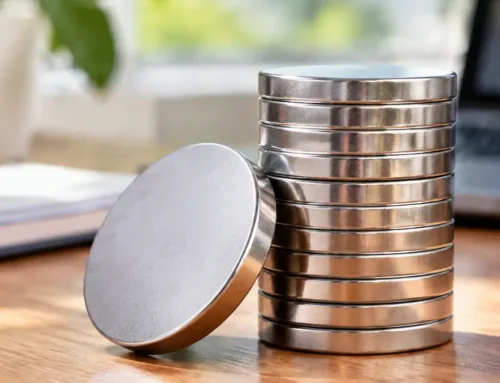
Neodymium magnets for 3D printing are the industry standard for functional prints. Because 3D printed walls add distance between mating magnetic faces, you need strong field penetration to bridge that gap.
-
- Maximum force in tight spaces: A tiny 6x3mm disc magnet can hold a print enclosure door shut without adding unnecessary bulk to your CAD model.
- Predictable standard sizes: Standard disc shapes drop cleanly into round slicer-generated pockets without requiring custom geometry.
- Secure mechanical engagement: Their strong pull provides an authoritative, satisfying snap for modular accessories, removable lids, and swappable printer toolheads.
Ferrite magnets: when a larger, lower-cost magnet may work
Ferrite (ceramic) magnets offer a fraction of the pull force of rare-earth magnets. In a direct ferrite vs neodymium magnets comparison, a ferrite block must be several times larger to match the holding power of a standard neodymium disc.
-
- Budget-driven bulk prints: Ferrite costs significantly less when producing large quantities of non-critical items.
- مقاومة التآكل: Ferrite does not rust when exposed to moisture or outdoor environments, even without protective plating.
- Design penalty: You must model thick, bulky housings to fit them, making them impractical for compact or sleek 3D printed parts.
Other magnet types and when to consider them
Beyond standard discs and blocks, specific projects demand specialized magnetic materials:
-
- سماريوم كوبالت (SmCo): When we design functional parts that operate inside heated enclosures, near hotends, or around automotive engines, standard neodymium loses its magnetic strength quickly. SmCo handles extreme temperatures well above 250°C without permanent loss of magnetic pull.
- Flexible magnetic sheets: cURL Too many subrequests by single Worker invocation. To configure this limit, refer to https://developers.cloudflare.com/workers/wrangler/configuration/#limits
cURL Too many subrequests by single Worker invocation. To configure this limit, refer to https://developers.cloudflare.com/workers/wrangler/configuration/#limits
cURL Too many subrequests by single Worker invocation. To configure this limit, refer to https://developers.cloudflare.com/workers/wrangler/configuration/#limits cURL Too many subrequests by single Worker invocation. To configure this limit, refer to https://developers.cloudflare.com/workers/wrangler/configuration/#limitscURL Too many subrequests by single Worker invocation. To configure this limit, refer to https://developers.cloudflare.com/workers/wrangler/configuration/#limits
cURL Too many subrequests by single Worker invocation. To configure this limit, refer to https://developers.cloudflare.com/workers/wrangler/configuration/#limits
cURL Too many subrequests by single Worker invocation. To configure this limit, refer to https://developers.cloudflare.com/workers/wrangler/configuration/#limits
-
- cURL Too many subrequests by single Worker invocation. To configure this limit, refer to https://developers.cloudflare.com/workers/wrangler/configuration/#limits cURL Too many subrequests by single Worker invocation. To configure this limit, refer to https://developers.cloudflare.com/workers/wrangler/configuration/#limits
- cURL Too many subrequests by single Worker invocation. To configure this limit, refer to https://developers.cloudflare.com/workers/wrangler/configuration/#limits cURL Too many subrequests by single Worker invocation. To configure this limit, refer to https://developers.cloudflare.com/workers/wrangler/configuration/#limits
- cURL Too many subrequests by single Worker invocation. To configure this limit, refer to https://developers.cloudflare.com/workers/wrangler/configuration/#limits cURL Too many subrequests by single Worker invocation. To configure this limit, refer to https://developers.cloudflare.com/workers/wrangler/configuration/#limits
cURL Too many subrequests by single Worker invocation. To configure this limit, refer to https://developers.cloudflare.com/workers/wrangler/configuration/#limits
cURL Too many subrequests by single Worker invocation. To configure this limit, refer to https://developers.cloudflare.com/workers/wrangler/configuration/#limits
| درجة المغناطيس | القوة النسبية | cURL Too many subrequests by single Worker invocation. To configure this limit, refer to https://developers.cloudflare.com/workers/wrangler/configuration/#limits |
|---|---|---|
| N35 | متوسط | cURL Too many subrequests by single Worker invocation. To configure this limit, refer to https://developers.cloudflare.com/workers/wrangler/configuration/#limits |
| N42 | cURL Too many subrequests by single Worker invocation. To configure this limit, refer to https://developers.cloudflare.com/workers/wrangler/configuration/#limits | Everyday functional brackets, tool caddies, swappable parts |
| N52 | Maximum | Compact spaces requiring maximum grip through embedded plastic layers |
Manufacturer pull ratings reflect ideal bench tests against raw, thick steel. In practical 3D printing, plastic gaps, print layer textures, and lateral shearing forces will reduce effective holding force.
Consider Coating and Environment
Raw magnet material rusts quickly if exposed to the air. Standard rare-earth magnets for 3D prints feature a triple-layer Nickel-Copper-Nickel (Ni-Cu-Ni) coating, which works well for indoor applications. For humid or outdoor settings, look for epoxy or plastic-coated options to prevent moisture intrusion.
Heat limits are equally critical. Standard neodymium grades permanently lose magnetic strength when exposed to temperatures above 80°C (176°F). Similar to the selection factors detailed in our guide on كيفية اختيار المغناطيس المناسب لأجهزتك, verifying the thermal envelope ensures your magnets withstand heated printer enclosures, hot car interiors, or warm mechanical housings without degaussing.
How Much Holding Force Do You Need?
When deciding what magnets do you use for 3D prints, holding force is usually the first spec makers look at. However, relying purely on the advertised rating on a spec sheet often leads to latches that pop open or tool holders that slide right off. Calculating the required magnetic retention for magnets for 3D printed parts means accounting for working loads, gravity, and the mechanical leverage acting against the joint.
Real-World Holding Force vs Theoretical Pull Force
The advertised pull force from manufacturers reflects an absolute ideal scenario: vertical separation from a flat, ground-steel plate with zero gap. In functional printing projects, your parts operate in far messier conditions.
When evaluating ما هي القوة المغناطيسية in a practical assembly, the actual usable grip depends on the contact surface and pull angle:
| cURL Too many subrequests by single Worker invocation. To configure this limit, refer to https://developers.cloudflare.com/workers/wrangler/configuration/#limits | Theoretical Rating | Real-World Output | Practical Application Impact |
|---|---|---|---|
| Direct Pull (Magnet to Steel) | 100% | 70% – 90% | Good for direct vertical lids and magnetic latches. |
| Magnet-to-Magnet Contact | 100%+ | 85% – 95% | Strongest alignment, but requires matched polarity. |
| Shear Force (Sliding sideways) | 100% | 15% – 30% | Magnets slide easily on smooth plastics without mechanical stops. |
| Embedded (Through 0.8mm wall) | 100% | 20% – 40% | Magnetic flux drops off sharply with distance. |
Key Factors That Weaken Magnetic Grip in Prints
We regularly see parts fail not because the magnet was defective, but because the print geometry compromised the magnetic field:
-
- Plastic Layer Gaps: Every 0.2 mm layer line between mating faces acts as an air gap. A print covering a magnet with just two perimeter walls can cut usable pull strength by more than half.
- Shear Loads: Neodymium magnets resist pulling forces well, but slide effortlessly across smooth surfaces. If your print experiences lateral force, add physical alignment pins, ribs, or interlocking lips to handle the shear load.
- Layer Line Texture: cURL Too many subrequests by single Worker invocation. To configure this limit, refer to https://developers.cloudflare.com/workers/wrangler/configuration/#limits
- cURL Too many subrequests by single Worker invocation. To configure this limit, refer to https://developers.cloudflare.com/workers/wrangler/configuration/#limits cURL Too many subrequests by single Worker invocation. To configure this limit, refer to https://developers.cloudflare.com/workers/wrangler/configuration/#limits
cURL Too many subrequests by single Worker invocation. To configure this limit, refer to https://developers.cloudflare.com/workers/wrangler/configuration/#limits
cURL Too many subrequests by single Worker invocation. To configure this limit, refer to https://developers.cloudflare.com/workers/wrangler/configuration/#limits
-
- cURL Too many subrequests by single Worker invocation. To configure this limit, refer to https://developers.cloudflare.com/workers/wrangler/configuration/#limits cURL Too many subrequests by single Worker invocation. To configure this limit, refer to https://developers.cloudflare.com/workers/wrangler/configuration/#limits 2x cURL Too many subrequests by single Worker invocation. To configure this limit, refer to https://developers.cloudflare.com/workers/wrangler/configuration/#limits
- cURL Too many subrequests by single Worker invocation. To configure this limit, refer to https://developers.cloudflare.com/workers/wrangler/configuration/#limits cURL Too many subrequests by single Worker invocation. To configure this limit, refer to https://developers.cloudflare.com/workers/wrangler/configuration/#limits cURL Too many subrequests by single Worker invocation. To configure this limit, refer to https://developers.cloudflare.com/workers/wrangler/configuration/#limits cURL Too many subrequests by single Worker invocation. To configure this limit, refer to https://developers.cloudflare.com/workers/wrangler/configuration/#limits
- cURL Too many subrequests by single Worker invocation. To configure this limit, refer to https://developers.cloudflare.com/workers/wrangler/configuration/#limits cURL Too many subrequests by single Worker invocation. To configure this limit, refer to https://developers.cloudflare.com/workers/wrangler/configuration/#limits
cURL Too many subrequests by single Worker invocation. To configure this limit, refer to https://developers.cloudflare.com/workers/wrangler/configuration/#limits
cURL Too many subrequests by single Worker invocation. To configure this limit, refer to https://developers.cloudflare.com/workers/wrangler/configuration/#limits
cURL Too many subrequests by single Worker invocation. To configure this limit, refer to https://developers.cloudflare.com/workers/wrangler/configuration/#limits
cURL Too many subrequests by single Worker invocation. To configure this limit, refer to https://developers.cloudflare.com/workers/wrangler/configuration/#limits
| cURL Too many subrequests by single Worker invocation. To configure this limit, refer to https://developers.cloudflare.com/workers/wrangler/configuration/#limits | cURL Too many subrequests by single Worker invocation. To configure this limit, refer to https://developers.cloudflare.com/workers/wrangler/configuration/#limits | cURL Too many subrequests by single Worker invocation. To configure this limit, refer to https://developers.cloudflare.com/workers/wrangler/configuration/#limits | Typical Use Case |
|---|---|---|---|
| cURL Too many subrequests by single Worker invocation. To configure this limit, refer to https://developers.cloudflare.com/workers/wrangler/configuration/#limits | cURL Too many subrequests by single Worker invocation. To configure this limit, refer to https://developers.cloudflare.com/workers/wrangler/configuration/#limits | cURL Too many subrequests by single Worker invocation. To configure this limit, refer to https://developers.cloudflare.com/workers/wrangler/configuration/#limits | cURL Too many subrequests by single Worker invocation. To configure this limit, refer to https://developers.cloudflare.com/workers/wrangler/configuration/#limits |
| Glued (Adhesive) | +0.20 mm to +0.30 mm | +0.20 mm (glue gap) | Removable lids, high-shear applications |
| Fully Embedded | +0.30 mm to +0.40 mm | +0.20 mm to +0.40 mm | Enclosed prints paused mid-cycle |
Choose a Pocket Depth and Wall Thickness
Magnetic flux drops off sharply with distance according to the inverse-square rule. Even a thin layer of plastic between two magnets significantly degrades holding strength:
-
- Mating Face Wall Thickness: Keep the barrier between mating magnets down to 0.4 mm–0.8 mm (1 to 2 line widths). Going thicker than 1.2 mm drastically weakens the grip.
- Structural Backing: Maintain at least 1.2 mm to 1.6 mm of solid infill or perimeters behind the magnet pocket to prevent the magnet from ripping through the back wall under tension.
- cURL Too many subrequests by single Worker invocation. To configure this limit, refer to https://developers.cloudflare.com/workers/wrangler/configuration/#limits For direct magnet-to-magnet contact, size the depth so the magnet sits 0.1 mm below the print surface. This protects the brittle plating from direct impact damage while maximizing pull force.
For projects relying on multi-magnet arrays or rotational alignment, reviewing a أنواع التفاف مغناطيسي ودليل الاختيار provides practical insight into how spacing and array layouts influence mechanical transfer.
Plan Polarity and Orientation
Reversing a magnet inside an embedded or glued pocket ruins the print. We follow a strict polarity control process before pressing parts together:
-
- Keep a Master Reference Magnet: Mark the north pole of a dedicated setup magnet with bright paint or permanent marker.
- Mark Every Magnet Before Assembly: Touch each magnet to your reference block and dot the exposed side with a marker so polarity is obvious at a glance.
- Use a 3D Printed Insertion Jig: Print a small plastic push-stick with an embedded magnet oriented in the reverse direction. This holds your target magnet flat and drives it straight into the pocket with the correct face forward every time.
Three Ways to Install Magnets in 3D Prints
Choosing what magnets do you use for 3D prints is only half the battle; how you mount them determines whether your part holds up under repeated use. We rely on three primary installation methods depending on the mechanical stress, aesthetic needs, and printer setup.
Pause the Print and Embed the Magnet
Embedding locks the magnet completely inside the print. It produces a seamless, factory-molded look and keeps the magnet from ever pulling out of its socket.
-
- Slicer pause: Add a pause command at the final open layer of the cavity before bridging begins.
- Nozzle clearance: Add at least 0.2 mm vertical clearance above the magnet so the hotend does not collide with it when resuming.
- Ferrous attraction risk: Standard steel nozzles will attract loose magnets out of the slot as the printhead passes over. Secure the magnet with a drop of glue or hold it down with blue painter’s tape before resuming.
- cURL Too many subrequests by single Worker invocation. To configure this limit, refer to https://developers.cloudflare.com/workers/wrangler/configuration/#limits cURL Too many subrequests by single Worker invocation. To configure this limit, refer to https://developers.cloudflare.com/workers/wrangler/configuration/#limits cURL Too many subrequests by single Worker invocation. To configure this limit, refer to https://developers.cloudflare.com/workers/wrangler/configuration/#limits cURL Too many subrequests by single Worker invocation. To configure this limit, refer to https://developers.cloudflare.com/workers/wrangler/configuration/#limits
cURL Too many subrequests by single Worker invocation. To configure this limit, refer to https://developers.cloudflare.com/workers/wrangler/configuration/#limits
cURL Too many subrequests by single Worker invocation. To configure this limit, refer to https://developers.cloudflare.com/workers/wrangler/configuration/#limits
-
- cURL Too many subrequests by single Worker invocation. To configure this limit, refer to https://developers.cloudflare.com/workers/wrangler/configuration/#limits cURL Too many subrequests by single Worker invocation. To configure this limit, refer to https://developers.cloudflare.com/workers/wrangler/configuration/#limits
- cURL Too many subrequests by single Worker invocation. To configure this limit, refer to https://developers.cloudflare.com/workers/wrangler/configuration/#limits cURL Too many subrequests by single Worker invocation. To configure this limit, refer to https://developers.cloudflare.com/workers/wrangler/configuration/#limits
- cURL Too many subrequests by single Worker invocation. To configure this limit, refer to https://developers.cloudflare.com/workers/wrangler/configuration/#limits cURL Too many subrequests by single Worker invocation. To configure this limit, refer to https://developers.cloudflare.com/workers/wrangler/configuration/#limits
- cURL Too many subrequests by single Worker invocation. To configure this limit, refer to https://developers.cloudflare.com/workers/wrangler/configuration/#limits cURL Too many subrequests by single Worker invocation. To configure this limit, refer to https://developers.cloudflare.com/workers/wrangler/configuration/#limits
cURL Too many subrequests by single Worker invocation. To configure this limit, refer to https://developers.cloudflare.com/workers/wrangler/configuration/#limits
cURL Too many subrequests by single Worker invocation. To configure this limit, refer to https://developers.cloudflare.com/workers/wrangler/configuration/#limits
-
- cURL Too many subrequests by single Worker invocation. To configure this limit, refer to https://developers.cloudflare.com/workers/wrangler/configuration/#limits cURL Too many subrequests by single Worker invocation. To configure this limit, refer to https://developers.cloudflare.com/workers/wrangler/configuration/#limits
- cURL Too many subrequests by single Worker invocation. To configure this limit, refer to https://developers.cloudflare.com/workers/wrangler/configuration/#limits cURL Too many subrequests by single Worker invocation. To configure this limit, refer to https://developers.cloudflare.com/workers/wrangler/configuration/#limits
- cURL Too many subrequests by single Worker invocation. To configure this limit, refer to https://developers.cloudflare.com/workers/wrangler/configuration/#limits cURL Too many subrequests by single Worker invocation. To configure this limit, refer to https://developers.cloudflare.com/workers/wrangler/configuration/#limits
- cURL Too many subrequests by single Worker invocation. To configure this limit, refer to https://developers.cloudflare.com/workers/wrangler/configuration/#limits cURL Too many subrequests by single Worker invocation. To configure this limit, refer to https://developers.cloudflare.com/workers/wrangler/configuration/#limits
cURL Too many subrequests by single Worker invocation. To configure this limit, refer to https://developers.cloudflare.com/workers/wrangler/configuration/#limits
When deciding what magnets do you use for 3D prints, heat tolerance and filament behavior dictate your success. Standard neodymium magnets lose their magnetic strength quickly when exposed to temperatures common in 3D printing and heated enclosures.
Operating Temperatures vs Printing Temperatures
Standard neodymium (NdFeB) magnets carry an “N” rating (such as N42 or N52) and feature a maximum operating temperature of 80°C (176°F). Pushing them past this limit causes permanent loss of magnetic pull force.
-
- Heated beds: Printing ABS, ASA, or Nylon requires bed temperatures between 90°C and 110°C. Embedding a standard N-grade magnet directly against the bottom layers will degrade its field strength before the print finishes.
- Nozzle contact: Molten plastic exits at 200°C to 280°C, but brief contact during bridging generally will not overheat the magnet core.
- Ambient chamber heat: Active heated chambers can easily cross the 80°C threshold, making standard neodymium unsuitable.
| Magnet Grade Suffix | الحد الأقصى للحرارة التشغيلية | Ideal Filament Match |
|---|---|---|
| Standard (N) | 80°C (176°F) | PLA, PETG, TPU |
| M | 100°C (212°F) | High-temp PETG, lightweight ABS |
| H | 120°C (248°F) | ABS, ASA, PC-ABS blends |
| SH | 150°C (302°F) | Nylon (PA), Polycarbonate (PC) |
Filament Shrinkage and Thermal Pocket Stability
Different 3D printing filaments shrink at different rates as they cool from extrusion temperature to room temperature. This directly impacts the fit of your magnet pockets:
-
- PLA: Shrinks minimally (0.2%–0.4%). Magnet pockets stay true to CAD dimensions with standard clearances (0.10 mm to 0.15 mm).
- PETG: Moderate shrinkage and slight flex. Great for press-fit designs because the material yields slightly without snapping.
- ABS / ASA: High shrinkage (1.0%–1.8%). If you size a pocket too tight, thermal contraction will squeeze the magnet and cause perimeter layer separation or visible outer-wall bulging.
- Reinforced Filaments (CF/GF): High stiffness with low thermal shrinkage, but zero flexibility. Press-fits require wider offsets to avoid cracking brittle pocket walls.
Preventing Permanent Demagnetization Under Heat
Heating a magnet past its maximum operating temperature causes irreversible flux loss. Much like evaluating the الفرق بين المغناطيس الدائم السطحي والمغناطيس الدائم الداخلي layouts for thermal stability in mechanical systems, enclosing a magnet within dense plastic creates an insulating barrier that traps heat.
To protect your magnets during hot builds:
-
- Select high-temperature grades: Specify SH (up to 150°C) or UH cURL Too many subrequests by single Worker invocation. To configure this limit, refer to https://developers.cloudflare.com/workers/wrangler/configuration/#limits
- cURL Too many subrequests by single Worker invocation. To configure this limit, refer to https://developers.cloudflare.com/workers/wrangler/configuration/#limits cURL Too many subrequests by single Worker invocation. To configure this limit, refer to https://developers.cloudflare.com/workers/wrangler/configuration/#limits
- cURL Too many subrequests by single Worker invocation. To configure this limit, refer to https://developers.cloudflare.com/workers/wrangler/configuration/#limits cURL Too many subrequests by single Worker invocation. To configure this limit, refer to https://developers.cloudflare.com/workers/wrangler/configuration/#limits
Common Mistakes to Avoid
cURL Too many subrequests by single Worker invocation. To configure this limit, refer to https://developers.cloudflare.com/workers/wrangler/configuration/#limits
cURL Too many subrequests by single Worker invocation. To configure this limit, refer to https://developers.cloudflare.com/workers/wrangler/configuration/#limits
cURL Too many subrequests by single Worker invocation. To configure this limit, refer to https://developers.cloudflare.com/workers/wrangler/configuration/#limits
-
- cURL Too many subrequests by single Worker invocation. To configure this limit, refer to https://developers.cloudflare.com/workers/wrangler/configuration/#limits cURL Too many subrequests by single Worker invocation. To configure this limit, refer to https://developers.cloudflare.com/workers/wrangler/configuration/#limits
- cURL Too many subrequests by single Worker invocation. To configure this limit, refer to https://developers.cloudflare.com/workers/wrangler/configuration/#limits cURL Too many subrequests by single Worker invocation. To configure this limit, refer to https://developers.cloudflare.com/workers/wrangler/configuration/#limits cURL Too many subrequests by single Worker invocation. To configure this limit, refer to https://developers.cloudflare.com/workers/wrangler/configuration/#limits cURL Too many subrequests by single Worker invocation. To configure this limit, refer to https://developers.cloudflare.com/workers/wrangler/configuration/#limits
cURL Too many subrequests by single Worker invocation. To configure this limit, refer to https://developers.cloudflare.com/workers/wrangler/configuration/#limits
cURL Too many subrequests by single Worker invocation. To configure this limit, refer to https://developers.cloudflare.com/workers/wrangler/configuration/#limits
-
- cURL Too many subrequests by single Worker invocation. To configure this limit, refer to https://developers.cloudflare.com/workers/wrangler/configuration/#limits cURL Too many subrequests by single Worker invocation. To configure this limit, refer to https://developers.cloudflare.com/workers/wrangler/configuration/#limits cURL Too many subrequests by single Worker invocation. To configure this limit, refer to https://developers.cloudflare.com/workers/wrangler/configuration/#limits cURL Too many subrequests by single Worker invocation. To configure this limit, refer to https://developers.cloudflare.com/workers/wrangler/configuration/#limits
- cURL Too many subrequests by single Worker invocation. To configure this limit, refer to https://developers.cloudflare.com/workers/wrangler/configuration/#limits cURL Too many subrequests by single Worker invocation. To configure this limit, refer to https://developers.cloudflare.com/workers/wrangler/configuration/#limits
cURL Too many subrequests by single Worker invocation. To configure this limit, refer to https://developers.cloudflare.com/workers/wrangler/configuration/#limits
cURL Too many subrequests by single Worker invocation. To configure this limit, refer to https://developers.cloudflare.com/workers/wrangler/configuration/#limits
-
- Mark your reference stack: Keep your supply in a single stack and mark the top pole of every magnet with a permanent marker.
- Use an assembly jig: Use an existing mating part or a dedicated alignment tool to press the magnet into place. This physically prevents reverse installation before the glue bonds.
Thick Plastic Barriers Between Mating Surfaces
Magnetic force drops off sharply over distance following the inverse-square law. Embedding a magnet beneath thick infill or top layers significantly degrades holding power.
-
- Limit face layers: If you embed magnets beneath a solid top skin, keep the covering shell between 0.4 mm and 0.8 mm (one to two perimeters or top layers).
- Prioritize flush contact: Direct magnet-to-magnet contact delivers 100% of the rated holding strength. Every additional 0.5 mm of plastic barrier can cut usable pull force by more than half.
Cracking Thin Print Walls with Oversized Magnets
Pressing an interference-fit magnet into an undersized pocket places heavy tensile stress perpendicular to the layer lines, leading directly to delamination.
-
- Reinforce surrounding walls: Maintain a minimum exterior wall thickness of 1.2 mm to 1.6 mm (3 to 4 perimeters) around any magnet pocket.
- Distribute insertion force: Never strike rare-earth magnets directly with a metal hammer. Use an arbor press, a smooth-jaw clamp, or hand pressure against a flat surface to seat the magnet evenly without fracturing the surrounding print walls.
Magnet Safety for 3D Printing Projects
When deciding what magnets do you use for 3D prints, rare-earth neodymium discs are almost always the top choice. However, their high pull force brings specific workshop hazards that we need to manage during printing and assembly.
Pinch Risks and Brittle Impact Chipping
Neodymium magnets are sintered metal ceramics. They are remarkably strong but extremely brittle.
-
- Skin Pinches: Uncontrolled snapping between two bare magnets can easily pinch skin and cause blood blisters.
- Shattering Shards: When two magnets slam together at high speed, they do not bend—they shatter. Flying sharp flakes can cause eye injuries.
- Separation Technique: Always slide magnets apart sideways from a stack rather than pulling them straight off.
- Eye Protection: Wear basic safety glasses when working with stacks of magnets larger than 10 mm in diameter.
Swallowing Hazards for Children and Pets
Loose rare-earth magnets pose a severe, life-threatening internal hazard if swallowed:
-
- Internal Pinching: If more than one magnet is ingested, they attract through intestinal walls, cutting off blood flow and causing rapid perforations.
- cURL Too many subrequests by single Worker invocation. To configure this limit, refer to https://developers.cloudflare.com/workers/wrangler/configuration/#limits cURL Too many subrequests by single Worker invocation. To configure this limit, refer to https://developers.cloudflare.com/workers/wrangler/configuration/#limits
- cURL Too many subrequests by single Worker invocation. To configure this limit, refer to https://developers.cloudflare.com/workers/wrangler/configuration/#limits cURL Too many subrequests by single Worker invocation. To configure this limit, refer to https://developers.cloudflare.com/workers/wrangler/configuration/#limits
cURL Too many subrequests by single Worker invocation. To configure this limit, refer to https://developers.cloudflare.com/workers/wrangler/configuration/#limits
cURL Too many subrequests by single Worker invocation. To configure this limit, refer to https://developers.cloudflare.com/workers/wrangler/configuration/#limits
-
- cURL Too many subrequests by single Worker invocation. To configure this limit, refer to https://developers.cloudflare.com/workers/wrangler/configuration/#limits cURL Too many subrequests by single Worker invocation. To configure this limit, refer to https://developers.cloudflare.com/workers/wrangler/configuration/#limits
- cURL Too many subrequests by single Worker invocation. To configure this limit, refer to https://developers.cloudflare.com/workers/wrangler/configuration/#limits cURL Too many subrequests by single Worker invocation. To configure this limit, refer to https://developers.cloudflare.com/workers/wrangler/configuration/#limits
- cURL Too many subrequests by single Worker invocation. To configure this limit, refer to https://developers.cloudflare.com/workers/wrangler/configuration/#limits cURL Too many subrequests by single Worker invocation. To configure this limit, refer to https://developers.cloudflare.com/workers/wrangler/configuration/#limits cURL Too many subrequests by single Worker invocation. To configure this limit, refer to https://developers.cloudflare.com/workers/wrangler/configuration/#limitscURL Too many subrequests by single Worker invocation. To configure this limit, refer to https://developers.cloudflare.com/workers/wrangler/configuration/#limits
cURL Too many subrequests by single Worker invocation. To configure this limit, refer to https://developers.cloudflare.com/workers/wrangler/configuration/#limits
cURL Too many subrequests by single Worker invocation. To configure this limit, refer to https://developers.cloudflare.com/workers/wrangler/configuration/#limits
cURL Too many subrequests by single Worker invocation. To configure this limit, refer to https://developers.cloudflare.com/workers/wrangler/configuration/#limits
cURL Too many subrequests by single Worker invocation. To configure this limit, refer to https://developers.cloudflare.com/workers/wrangler/configuration/#limits
-
- cURL Too many subrequests by single Worker invocation. To configure this limit, refer to https://developers.cloudflare.com/workers/wrangler/configuration/#limits cURL Too many subrequests by single Worker invocation. To configure this limit, refer to https://developers.cloudflare.com/workers/wrangler/configuration/#limits
- Protective Coatings: قياسي cURL Too many subrequests by single Worker invocation. To configure this limit, refer to https://developers.cloudflare.com/workers/wrangler/configuration/#limits cURL Too many subrequests by single Worker invocation. To configure this limit, refer to https://developers.cloudflare.com/workers/wrangler/configuration/#limits
- cURL Too many subrequests by single Worker invocation. To configure this limit, refer to https://developers.cloudflare.com/workers/wrangler/configuration/#limits cURL Too many subrequests by single Worker invocation. To configure this limit, refer to https://developers.cloudflare.com/workers/wrangler/configuration/#limits ما المواد المغناطيسية هي الأنسب لمصفوفات هالباخ cURL Too many subrequests by single Worker invocation. To configure this limit, refer to https://developers.cloudflare.com/workers/wrangler/configuration/#limits
Checking working temperature limits and pull test methods
Standard rare-earth magnets quickly lose their magnetic field if exposed to heat beyond their rating.
| Magnet Suffix | Max Operating Temperature | Recommended 3D Printing Use Case |
|---|---|---|
| Standard (No suffix) | 80°C (176°F) | Ambient PLA prints, display models, standard latches |
| M | 100°C (212°F) | Heated bed contact zones, enclosed ABS/PETG parts |
| H / SH | 120°C – 150°C (248°F – 302°F) | Enclosed builds, automotive mounts, heated functional tools |
Check how the supplier tests pull force. Advertised holding force is almost universally measured on a ground, flat steel plate in direct contact under laboratory conditions. Sliding force (shear) is usually only 15% to 30% of direct vertical pull force, so factor this reduction into your enclosure latches.
Sourcing batch consistency for repeatable production
If you run batch production or print modular assemblies, consistency matters more than raw strength.
-
- Uniform Outer Diameters: A run of 100 disc magnets for 3D printing should hold a tolerance within ±0.05 mm. Broader swings will force you to re-calibrate slicing tolerances between print jobs.
- Axial Polarity Alignment: Ensure the supplier packages axial magnets stacked cleanly in a column with matching orientation. Jumbled bulk bags make it easy to mix up north and south poles during rapid assembly runs.
- Reputable Sourcing: Avoid unbranded, multi-vendor marketplaces for functional prototypes. Buy from dedicated magnet vendors who publish verified technical data sheets, working temperature ceilings, and genuine flux ratings.
الأسئلة الشائعة
Are neodymium magnets the best choice for most 3D prints?
Yes. When makers ask what magnets do you use for 3D prints, neodymium magnets (NdFeB) are almost always the answer. They deliver the highest pull force per millimeter of space, making them the industry standard for 3D printed enclosure magnets, tool holders, and modular prints where internal cavity space is limited. Ferrite magnets are far too weak and bulky for compact functional parts.
Can you pause a 3D print to add a magnet?
Yes. Pause-and-insert magnet printing is one of the cleanest ways to conceal hardware inside a print.
Add a pause command at the target layer in your slicer just before the cavity roof closes.
Drop the magnet into the cavity.
Ensure the magnet sits completely flush or slightly sub-flush to avoid colliding with the nozzle.
Secure the magnet with a drop of glue so the magnetic pull from a steel nozzle does not yank the magnet out of the pocket before the printer bridges the top layer.
How much clearance should a magnet pocket have?
For standard FDM setups, we recommend a magnet pocket tolerance of +0.10 mm to +0.20 mm on the pocket diameter and +0.10 mm to +0.15 mm on pocket depth. This accommodates standard perimeter expansion, corner bulging, and typical manufacturing variances in disc magnets for 3D printing.
cURL Too many subrequests by single Worker invocation. To configure this limit, refer to https://developers.cloudflare.com/workers/wrangler/configuration/#limits
cURL Too many subrequests by single Worker invocation. To configure this limit, refer to https://developers.cloudflare.com/workers/wrangler/configuration/#limits
cURL Too many subrequests by single Worker invocation. To configure this limit, refer to https://developers.cloudflare.com/workers/wrangler/configuration/#limits cURL Too many subrequests by single Worker invocation. To configure this limit, refer to https://developers.cloudflare.com/workers/wrangler/configuration/#limits
PLA: cURL Too many subrequests by single Worker invocation. To configure this limit, refer to https://developers.cloudflare.com/workers/wrangler/configuration/#limits
cURL Too many subrequests by single Worker invocation. To configure this limit, refer to https://developers.cloudflare.com/workers/wrangler/configuration/#limits cURL Too many subrequests by single Worker invocation. To configure this limit, refer to https://developers.cloudflare.com/workers/wrangler/configuration/#limits
cURL Too many subrequests by single Worker invocation. To configure this limit, refer to https://developers.cloudflare.com/workers/wrangler/configuration/#limits
cURL Too many subrequests by single Worker invocation. To configure this limit, refer to https://developers.cloudflare.com/workers/wrangler/configuration/#limits
cURL Too many subrequests by single Worker invocation. To configure this limit, refer to https://developers.cloudflare.com/workers/wrangler/configuration/#limits cURL Too many subrequests by single Worker invocation. To configure this limit, refer to https://developers.cloudflare.com/workers/wrangler/configuration/#limits
cURL Too many subrequests by single Worker invocation. To configure this limit, refer to https://developers.cloudflare.com/workers/wrangler/configuration/#limits cURL Too many subrequests by single Worker invocation. To configure this limit, refer to https://developers.cloudflare.com/workers/wrangler/configuration/#limits
cURL Too many subrequests by single Worker invocation. To configure this limit, refer to https://developers.cloudflare.com/workers/wrangler/configuration/#limits cURL Too many subrequests by single Worker invocation. To configure this limit, refer to https://developers.cloudflare.com/workers/wrangler/configuration/#limits
cURL Too many subrequests by single Worker invocation. To configure this limit, refer to https://developers.cloudflare.com/workers/wrangler/configuration/#limits
cURL Too many subrequests by single Worker invocation. To configure this limit, refer to https://developers.cloudflare.com/workers/wrangler/configuration/#limits
cURL Too many subrequests by single Worker invocation. To configure this limit, refer to https://developers.cloudflare.com/workers/wrangler/configuration/#limits
cURL Too many subrequests by single Worker invocation. To configure this limit, refer to https://developers.cloudflare.com/workers/wrangler/configuration/#limits 80°C (176°F)cURL Too many subrequests by single Worker invocation. To configure this limit, refer to https://developers.cloudflare.com/workers/wrangler/configuration/#limits what type of magnets are used for microwave magnetscURL Too many subrequests by single Worker invocation. To configure this limit, refer to https://developers.cloudflare.com/workers/wrangler/configuration/#limits
cURL Too many subrequests by single Worker invocation. To configure this limit, refer to https://developers.cloudflare.com/workers/wrangler/configuration/#limits
https://forum.bambulab.com/t/magnets-in-prints/76022
https://www.microcenter.com/site/mc-news/article/3d-printing-hardware.aspx
 Arabic
 English
 German
 Vietnamese
 Spanish (Mexico)
 Russian
 Turkish
 Polish
 Hindi
 Thai
 Malay
 Korean
 Japanese
 French
 Czech
 Danish
 Dutch
 Finnish
 Italian
 Portuguese (Brazil)
 Portuguese (Portugal)
 Slovenian
 Ukrainian
 Hebrew
 Scottish Gaelic
 Hungarian
 Tagalog
 Spanish (Spain)
 Serbian
 Indonesian
 Slovak
 Dutch (Belgium)
 Persian
 Romanian
 Estonian
 Greek
 Bulgarian

اترك تعليقًا