
Most people use magnets every day, but few understand their different types. Choosing the right magnet starts with knowing what options exist.
There are several types of magnets: permanent, temporary, and electromagnets. Each behaves differently depending on its structure and how it is energized.
In this article, I will break down the most common types of magnets, their properties, and where they are typically used, so you can make smarter material choices.
What are the 4 types of magnets?
You might have heard about neodymium or ceramic magnets, but those are just part of the full picture. Let’s look at the four major types.
The four main types of permanent magnets are neodymium, samarium cobalt, alnico, and ferrite. Each has unique strengths, weaknesses, and ideal use cases.
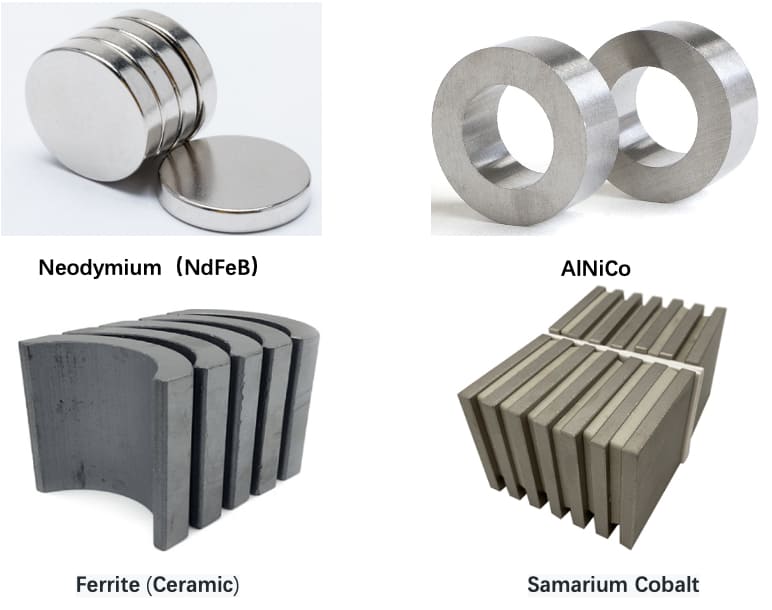
Four types of magnets(Neodymium-AlNiCo-Ferrite(ceramic)-SmCO
Understanding the 4 Main Types of Permanent Magnets
These magnet types are used in everything from cell phones to motors. Here’s a closer look:
| Magneeditüüp | Tugevus | Tempereatuuri vastupidavus | Korrosioonikindlus | Maksumus |
|---|---|---|---|---|
| Neodüma (NdFeB) | Väga Kõrge | Keskmine | Madal (vajab katet) | Medium–High |
| Samariumi koobalt | Kõrge | Kõrge | Kõrge | Kõrge |
| Alnico | Keskmine | Väga Kõrge | Madal | Keskmine |
| Ferriit (Savinik) | Low–Medium | Kõrge | Kõrge | Madal |
- NdFeB is the strongest and used in EVs and headphones.
- SmCo excels in high-temp, harsh environments.
- Alnico provides stable performance in musical gear.
- Ferriit is affordable and commonly used in everyday products.
What are the 3 main types of magnets?
Not every magnet is permanent. Some only work when electricity flows. That changes how we use them.
The three main types of magnets are permanent magnets, temporary magnets, and electromagnets. They differ by how they gain and lose magnetism.
Exploring Permanent, Temporary, and Electromagnets
- Püsivad magnetid retain magnetism over time. Common examples include NdFeB and ferrite magnets.
- Temporary Magnets become magnetic only when near a magnetic field. Soft iron is often used in this role.
- Elektromagnetid require electric current. When power flows through a coil wrapped around a core, the core becomes magnetic. Turn off the current, and the magnetism disappears.
Real-World Examples
| Magneeditüüp | Example Use |
|---|---|
| Püsiv magnet | Headphones, motors, fridge seals |
| Ajutine magnet | Electromagnetic chucks, lifting tools |
| Elektromagnet | MRI machines, electric bells |
Each magnet type has unique behavior. I often use permanent magnets for customer motor assemblies. But when clients need a switchable field or safety control, electromagnets are better.
What are the 7 types of magnetism?
Most people think magnetism is simple—objects attract or repel. In reality, magnetism shows up in seven unique ways.
The seven types of magnetism are: diamagnetism, paramagnetism, ferromagnetism, antiferromagnetism, ferrimagnetism, superparamagnetism, and metamagnetism.
A Breakdown of the Seven Types of Magnetism
These categories help explain why materials behave differently when exposed to magnetic fields.
| Magnetism Type | Magnetiline reageerimine | Tavalised materjalid |
|---|---|---|
| Diamagnetism | Weak repulsion from magnetic fields | Bismuth, Copper |
| Paramagnetism | cURL Too many subrequests by single Worker invocation. To configure this limit, refer to https://developers.cloudflare.com/workers/wrangler/configuration/#limits | cURL Too many subrequests by single Worker invocation. To configure this limit, refer to https://developers.cloudflare.com/workers/wrangler/configuration/#limits |
| Ferromagnetism | cURL Too many subrequests by single Worker invocation. To configure this limit, refer to https://developers.cloudflare.com/workers/wrangler/configuration/#limits | cURL Too many subrequests by single Worker invocation. To configure this limit, refer to https://developers.cloudflare.com/workers/wrangler/configuration/#limits |
| Antiferromagnetism | cURL Too many subrequests by single Worker invocation. To configure this limit, refer to https://developers.cloudflare.com/workers/wrangler/configuration/#limits | cURL Too many subrequests by single Worker invocation. To configure this limit, refer to https://developers.cloudflare.com/workers/wrangler/configuration/#limits |
| cURL Too many subrequests by single Worker invocation. To configure this limit, refer to https://developers.cloudflare.com/workers/wrangler/configuration/#limits | cURL Too many subrequests by single Worker invocation. To configure this limit, refer to https://developers.cloudflare.com/workers/wrangler/configuration/#limits | Magnetite |
| cURL Too many subrequests by single Worker invocation. To configure this limit, refer to https://developers.cloudflare.com/workers/wrangler/configuration/#limits | cURL Too many subrequests by single Worker invocation. To configure this limit, refer to https://developers.cloudflare.com/workers/wrangler/configuration/#limits | cURL Too many subrequests by single Worker invocation. To configure this limit, refer to https://developers.cloudflare.com/workers/wrangler/configuration/#limits |
| cURL Too many subrequests by single Worker invocation. To configure this limit, refer to https://developers.cloudflare.com/workers/wrangler/configuration/#limits | cURL Too many subrequests by single Worker invocation. To configure this limit, refer to https://developers.cloudflare.com/workers/wrangler/configuration/#limits | cURL Too many subrequests by single Worker invocation. To configure this limit, refer to https://developers.cloudflare.com/workers/wrangler/configuration/#limits |
cURL Too many subrequests by single Worker invocation. To configure this limit, refer to https://developers.cloudflare.com/workers/wrangler/configuration/#limits
Järeldus
cURL Too many subrequests by single Worker invocation. To configure this limit, refer to https://developers.cloudflare.com/workers/wrangler/configuration/#limits


 Estonian
 English
 German
 Vietnamese
 Spanish (Mexico)
 Russian
 Turkish
 Polish
 Hindi
 Thai
 Malay
 Korean
 Japanese
 French
 Czech
 Danish
 Dutch
 Finnish
 Italian
 Portuguese (Brazil)
 Portuguese (Portugal)
 Slovenian
 Ukrainian
 Hebrew
 Scottish Gaelic
 Hungarian
 Tagalog
 Spanish (Spain)
 Serbian
 Indonesian
 Slovak
 Dutch (Belgium)
 Persian
 Arabic
 Romanian
 Greek
 Bulgarian


cURL Too many subrequests by single Worker invocation. To configure this limit, refer to https://developers.cloudflare.com/workers/wrangler/configuration/#limits
cURL Too many subrequests by single Worker invocation. To configure this limit, refer to https://developers.cloudflare.com/workers/wrangler/configuration/#limits
cURL Too many subrequests by single Worker invocation. To configure this limit, refer to https://developers.cloudflare.com/workers/wrangler/configuration/#limits
cURL Too many subrequests by single Worker invocation. To configure this limit, refer to https://developers.cloudflare.com/workers/wrangler/configuration/#limits
cURL Too many subrequests by single Worker invocation. To configure this limit, refer to https://developers.cloudflare.com/workers/wrangler/configuration/#limits