
What is Remanence?
Ever wondered why a magnet stays magnetized long after it’s removed from a magnetic field? That’s remanence at work.
Remanence, or residual magnetization (Br), is the level of magnetism a permanent magnet retains after the external magnetic field is removed.
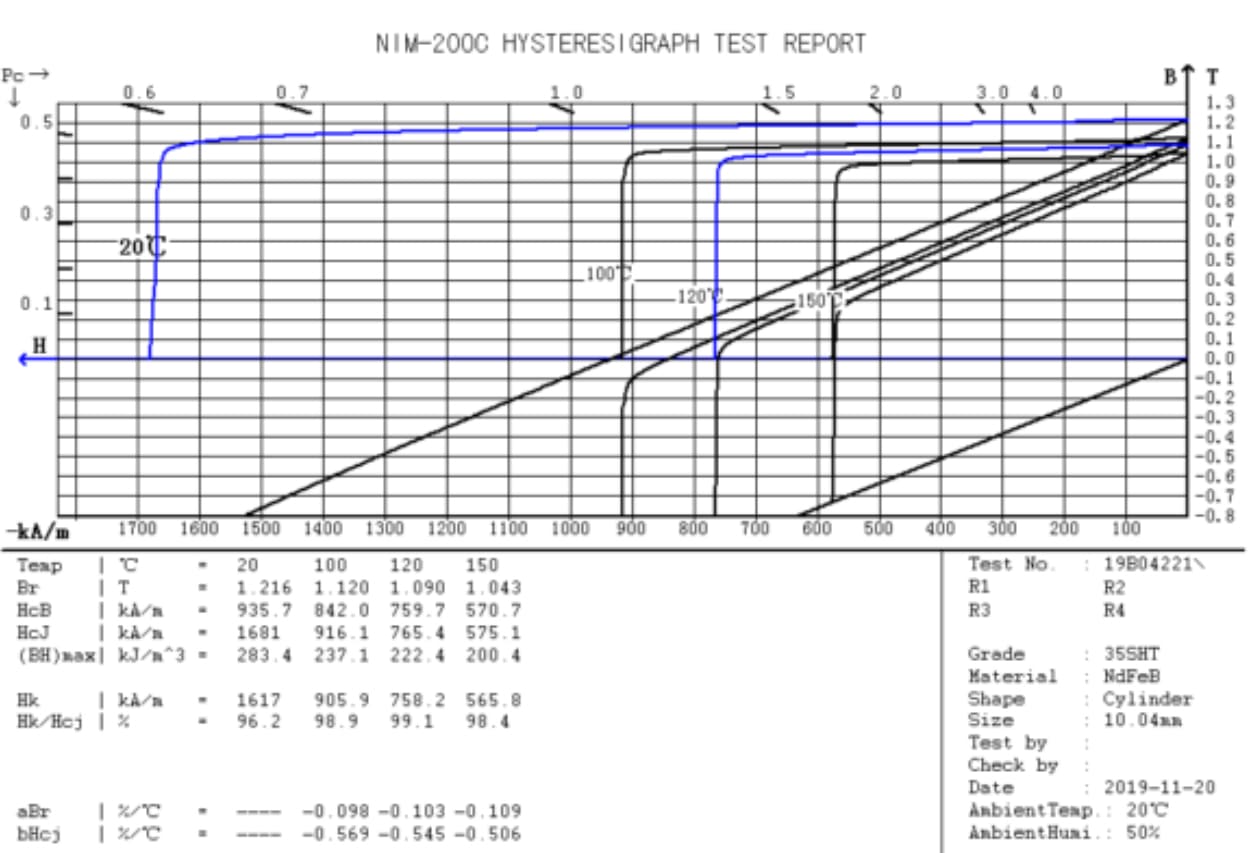
35SH BH curve
Let’s dive deeper into this essential property of permanent magnets and how it relates to coercivity.
what is remanence(Br)?
Magnets don’t just “forget” their magnetism. Remanence shows how much magnetism remains in a material.
Remanence (Br) is measured in Tesla or Gauss and indicates the strength of magnetism retained when the magnet is no longer exposed to an external magnetic field.
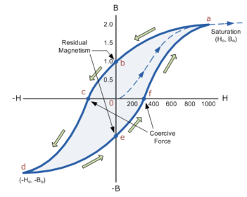
kurva histeresis magnetik
The science of remanence
Remanence (Br) reflects how strongly a permanent magnet holds onto its magnetic properties after magnetizing. The magnet’s material composition, structure, and domain alignment determine its remanence.
1. Why Br Matters
Br is critical for applications that need a stable magnetic field without ongoing power. For example, in motors or generators, higher remanence means more consistent performance.
| Faktor | High Remanence (Br) Magnets | Low Remanence (Br) Magnets |
|---|---|---|
| Jenis Material | NdFeB, SmCo | Alnico, Ferrite |
| Field Strength | Kuat | Weaker |
| Application Suitability | Motor, sensor, speaker | Low-cost applications |
2. How Br is Measured
Br is measured by magnetizing the sample to saturation, removing the external field, and recording the remaining magnetization.
3. Material Considerations
Materials like cURL Too many subrequests by single Worker invocation. To configure this limit, refer to https://developers.cloudflare.com/workers/wrangler/configuration/#limits offer high Br values, making them ideal for applications requiring strong, lasting magnetism. SmCo magnets also have high Br but with better temperature stability. On the other hand, Ferrite magnets have lower Br but are inexpensive and corrosion-resistant.
In my business, I’ve seen customers switch from Ferrite to NdFeB magnets for high-performance devices like drones and EVs because they need high Br for efficiency and compact design.
Kesimpulan
Remanence tells us how well a permanent magnet retains its magnetism after magnetizing. It’s key for choosing the right magnet for any application.
 Indonesian
 English
 German
 Vietnamese
 Spanish (Mexico)
 Russian
 Turkish
 Polish
 Hindi
 Thai
 Malay
 Korean
 Japanese
 French
 Czech
 Danish
 Dutch
 Finnish
 Italian
 Portuguese (Brazil)
 Portuguese (Portugal)
 Slovenian
 Ukrainian
 Hebrew
 Scottish Gaelic
 Hungarian
 Tagalog
 Spanish (Spain)
 Serbian
 Slovak
 Dutch (Belgium)
 Persian
 Arabic
 Romanian
 Estonian
 Greek
 Bulgarian

[…] Understanding and respecting these critical safety thresholds not only protects other shipments and transport systems but also keeps your cargo from being delayed or rejected. For insights on how magnets retain their power during transport, see our explanation of remanence. […]