
Anisotroper magnet vs isotroper magnet?
Heb je je ooit afgevraagd waarom sommige magneten sterker zijn in één richting dan in andere? Laten we duiken in anisotrope en isotrope magneten.
Anisotrope magneten zijn ontworpen voor sterkte in één richting, terwijl isotrope magneten flexibiliteit bieden maar met lagere magnetische prestaties.
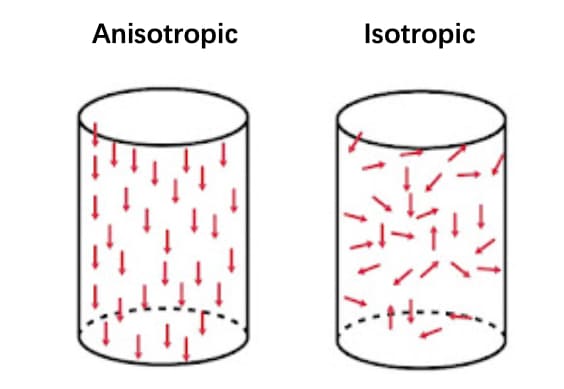
Anisotropic vs Isotropic
Magnets are everywhere—in motors, sensors, and even medical equipment. Knowing their orientation and properties can make a big difference in choosing the right one.
What is meant by magnetic anisotropy?
Magnets may look simple, but their inner structure can be complex. Magnetic anisotropy defines how a magnet’s properties change with direction.
Magnetic anisotropy means a material has a preferred direction of magnetization, often achieved through special manufacturing processes.
Dive deeper: Understanding anisotropy
Magnetic anisotropy comes from the arrangement of magnetic domains inside a material. In an anisotropic magnet, these domains align in a single direction, creating a stronger magnetic field along that axis. This is achieved by applying a magnetic field during manufacturing, which locks the alignment of magnetic grains.
| Factor | Isotrope Magneten | Anisotrope Magneten |
|---|---|---|
| Grain alignment | Random | Aligned |
| Magnetisatie | Any direction | One direction |
| Kracht | Lager | Hoger |
| Fabricage | Simpler | Complex |
From my experience, clients in the motor and sensor industries often choose anisotropic magnets because they provide higher energy output in the desired direction. However, they must ensure proper alignment in their devices to maximize performance.
What is the difference between isotropic and anisotropic magnets?
Choosing the right magnet can make or break your project. So, how do isotropic and anisotropic magnets differ?
Isotropic magnets can be magnetized in any direction but are weaker, while anisotropic magnets have a set magnetization direction and offer higher strength.

Difference between Anisotropic and isotropic(photo from Alliance LLC)
Dive deeper: Comparing isotropic and anisotropic magnets
Let’s break down the main differences between these two types of magnets:
1. Manufacturing Orientation
Isotropic magnets are made without any external magnetic field. Their grains are randomly oriented, which allows them to be magnetized in any direction but with lower energy density.
Anisotropic magnets, on the other hand, undergo a process where a magnetic field is applied during production. This orients the grains in a preferred direction, increasing magnetic strength along that axis but restricting magnetization in other directions.
2. Magnetische eigenschappen
- Isotropic: Lower magnetic strength, but flexible in applications where multi-directional magnetization is needed.
- Anisotropic: Higher magnetic strength, suitable for high-performance applications like motors and sensors.
3. Cost and Complexity
Isotropic magnets are cheaper to produce and require less precision. Anisotropic magnets cost more due to their complex manufacturing but offer better performance.
Here’s a table summarizing key differences:
| Functie | Isotrope Magneten | Anisotrope Magneten |
|---|---|---|
| Magnetisatie | Any direction | One direction |
| Magnetische sterkte | Lager | Hoger |
| Flexibility | More flexible | Less flexible |
| Kost | Lager | Hoger |
| Productieproces | Simple | Complex |
I recall a project where a client initially used isotropic magnets for a toy design but later switched to anisotropic magnets when they needed stronger performance in a fixed orientation.
Conclusie
Understanding isotropic and anisotropic magnets helps in selecting the right material for your application. Each has its strengths, costs, and ideal use cases.
Mijn rol
Over mij
Merknaam: NBAEM Magnet
Slogan: Gespecialiseerd in magneetmaterialen
Website: nbaem.com
Onze missie:
NBAEM Magnet is een magnetisch bedrijf met 15 jaar ervaring. We specialiseren ons in diverse soorten magnetische materialen, met als doel elke klant te helpen kosten-effectieve aangepaste magneten en magnetische componenten te creëren die aan hun specifieke vereisten voldoen. We bieden hoogwaardige pre-sales en after-sales diensten, samen met relevante technische ondersteuning.
Over mij:
NBAEM is opgericht door mijzelf — een gepassioneerde professional in de magnetenindustrie. Ik begon mijn carrière bij een magnetenfabriek en vestigde later een succesvol magneten- en magnetische assemblagebedrijf. Door mijn reis in de magnetenindustrie heb ik vele klanten geholpen hun bedrijven te laten groeien. Door mijn expertise en ervaring te delen, wil ik klanten helpen de juiste oplossingen te vinden.
 Dutch (Belgium)
 English
 German
 Vietnamese
 Spanish (Mexico)
 Russian
 Turkish
 Polish
 Hindi
 Thai
 Malay
 Korean
 Japanese
 French
 Czech
 Danish
 Dutch
 Finnish
 Italian
 Portuguese (Brazil)
 Portuguese (Portugal)
 Slovenian
 Ukrainian
 Hebrew
 Scottish Gaelic
 Hungarian
 Tagalog
 Spanish (Spain)
 Serbian
 Indonesian
 Slovak
 Persian
 Arabic
 Romanian
 Estonian
 Greek
 Bulgarian
Laat een opmerking achter